
English Русский
Български
Беларускі
Український
Српски
Hrvatski
Română
Polski
Slovenský
Magyar
  |  Articles  |  Sitemap  |  Contacts  |    |
Car maintenance Ford Car maintenance Hyundai Car maintenance Chevrolet Car maintenance BMW Car maintenance Audi Car maintenance Opel Car maintenance AvtoVAZ
VWmanual.ru


Main   Passat   Golf   Polo   Touareg   Tiguan   Sharan   Transporter   Others  
Golf 1 (1974-1984, diesel) Golf 1 (1974-1984, petrol) Golf 2 (1984-1993, petrol) Golf 2 (1984-1993) Golf 3 (1991-1997) Golf 4 (1997-2004) Golf 5 (2003-2008)

Battery care (VW Golf 2)

  • Main
  • Golf
  • Golf 2
  • General information
  • Car care
  • Battery care
            0


Contents: Battery electrolyte level ↓ Charging the battery ↓
Battery care


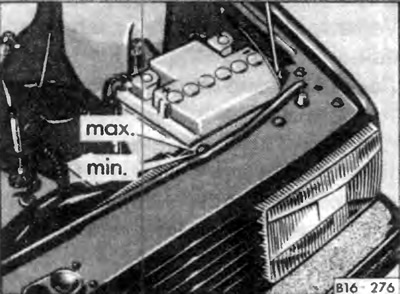
The battery is located under the front hood of the car.

Battery electrolyte level


Under normal operating conditions, Volkswagen batteries do not require maintenance. At high outside temperatures, it is recommended to regularly check the electrolyte level in the battery (the battery case is made of transparent material). In each section, the electrolyte level should be between the min and max marks.

If the electrolyte level is below the minimum mark, contact your Volkswagen dealer to determine the possible cause.

Caution: When working with electrolyte, do not allow it to come into contact with skin, eyes, clothing or painted surfaces of the vehicle.

If electrolyte gets into your eyes or on your skin, rinse immediately with cold water for several minutes and consult a doctor.

Do not place batteries near open flames or any devices that can create sparks. Hydrogen gas produced by the battery may explode.


Working in winter conditions


During the winter months, the battery capacity decreases as a result of the drop in air temperature, since significantly more energy is needed to start the engine, as well as due to the more intensive operation of the headlights, blower fan, rear window defogger, etc. Avoid unnecessary consumption of electricity, especially when driving in urban conditions or short distances.


When preparing for winter driving conditions, contact your Volkswagen dealer to check the battery capacity. A properly charged battery will not only avoid various problems associated with starting the engine, but will also last much longer. If you are forced to leave your car outdoors for several weeks in extremely low temperatures, it is imperative to remove the battery and move it to a warm room to avoid damaging it.

To remove the battery, first disconnect both cables (see chapter "Charging the battery"), and then unscrew the battery hanger.

Caution: Keep the battery out of the reach of children.


Charging the battery


Warning: The battery contains sulfuric acid. Therefore, keep the battery out of the reach of children.

Charge the battery in well-ventilated areas, away from open flames, any devices or objects that can create sparks. Do not smoke. The hydrogen produced by the battery is explosive.

When working with electrolyte, avoid contact with eyes and skin.

If electrolyte gets into your eyes or on your skin, rinse immediately with cold water for several minutes and consult a doctor.

Never attempt to charge a frozen battery. Allow the battery to thaw first.

Rapid charging of a battery is very dangerous and requires that this type of work be performed by a qualified mechanic who has the necessary equipment.

  • If electrolyte is spilled during battery charging, it must be washed off with a solution of warm water and baking soda to neutralize the acid.
  • Never use the charger as an auxiliary device for starting the engine. This can cause serious damage to both the charger itself and sensitive electronic components such as glow plugs, relays, radios, etc.

Slow battery charging


Caution: Use caution and follow all operating instructions for your charger.


  • There is no need to remove the battery from the engine compartment of the car and disconnect the cables from it.
  • Make sure that the electrolyte level in each battery cell is between the "min" and "max" marks.
  • If the electrolyte level is below the "min" mark, have the battery checked by a Volkswagen dealer.

Connect the charger cables: "+" to and to
To reduce the risk of explosion, do not connect (do not disconnect) cables during charger operation.
  • Turn off the charger.
  • The battery charging current should not exceed 6 A.

Typically, the charging current should be no more than 10% of the battery's rated capacity. For example, for a 45 Ah battery, the charging current should be no more than 4.5 A. The rated capacity of your car's battery is marked on its body.
  • When charging is complete, turn off the charger and disconnect its cables.

To remove the battery from the vehicle:
  • Disconnect the negative ground cable.
  • Disconnect the positive cable.
  • Using a roller wrench, loosen the plastic retaining bolt.

To reinstall the battery in the vehicle:
  • Install the battery into the vehicle and tighten the retaining plate bolt.
  • Connect the positive cable.
  • Connect the negative ground cable.

Caution: Observe polarity strictly.


Cleaning terminals and connectors


Caution: Before working on the electrical system, disconnect the negative ground cable.

When working with a battery, avoid short-circuiting the terminals with a handy tool or other metal objects. In this case, the battery is subject to rapid heating, which can lead to its failure or explosion and injury.


The terminals and connectors should always be clean and lubricated with Vaseline or silicone spray. Make sure that the ground cable is securely connected to the body and that there are no signs of corrosion on the contact surface.

To avoid damaging the electrical system, do not run the engine with the battery disconnected.

Replacing the battery

The new battery must match the replacement battery in terms of its technical characteristics and dimensions. The technical characteristics and battery type are indicated on its casing. Make sure that the new battery is installed correctly and securely. See the chapter "Removing and reinstalling the battery" above.

Due to the existing problems with the disposal of old batteries, it is recommended that if you need to replace the battery, you contact a Volkswagen dealer. Batteries contain sulfuric acid and lead, so their disposal must be carried out in strict compliance with established environmental protection regulations.

This article is available at russian, bulgarian, belarusian, ukrainian, serbian, croatian, romanian, polish, slovak, hungarian
The text has been checked: Semenova Anna

Share information:

Previous articles
Caring for brake fluid in a car
V-profile belt
Maintenance of the cooling system
Power steering
Air Filter Maintenance
Caring for your air purifier
Next articles
Windshield Cleaning Solution Tank
Replacing windshield wiper blades
Tire (wheel) care
New Tires: Lifespan, Wear and Replacement
Technical characteristics of the tire
Tires used in winter


Similar articles from other manuals for VW cars:
Battery Care Rules Passat B5 (1996-2005)
Starting the engine from an auxiliary battery Polo 3 (1995-2003)
Checking the battery Touareg 1 (2002-2006)
Disconnecting and connecting the battery Tiguan 1 (2007-2015)
Battery — General Information Sharan 1 (1995-2000)
Care of varnish coating Transporter T4 (1990-2003)
Remote control battery health indicator Caddy 3 (2003-2010)
Link to this page in different formats


Visitor comments


No comments yet


How much will 46 + 37 =


Golf 5 
  • General information
  • User manual
  • Maintenance
  • Troubleshooting
  • Power unit
  • Engine repair
  • Cooling and ventilation system
  • Fuel system
  • Ignition system
  • Transmission
  • Clutch
  • Mechanical gearbox
  • Automatic gearbox
  • Chassis
  • Brake system
  • Car suspension
  • Steering
  • Body
  • Interior (internal elements)
  • Exterior (external elements)
  • Doors and covers
  • Electrical equipment
  • Power devices
  • Washers and wipers
  • Lighting and appliances
  • Electrical circuits
Golf 4 
  • General information
  • User manual
  • Weekly checks
  • Maintenance
  • Power unit
  • Petrol engines
  • Diesel engines
  • Cooling system
  • Fuel system (petrol)
  • Control system (petrol)
  • Fuel system (diesel)
  • Exhaust system
  • Transmission
  • Clutch
  • Car gearbox
  • Drive shafts
  • Chassis
  • Car suspension
  • Steering
  • Wheels and tires
  • Brake system
  • Body
  • Exterior (external elements)
  • Interior (internal elements)
  • Ventilation and heating
  • Car doors and sunroof
  • Washers and glass cleaners
  • Electrical equipment
  • Power devices
  • Lighting and appliances
  • Electrical circuits
Golf 3 
  • Petrol engine
  • Engine repair
  • Lubrication system
  • Cooling system
  • Ignition system
  • Diesel engine
  • Engine repair
  • Diesel injection system
  • Pre-glow system
  • Transmission
  • Clutch
  • Gearbox and drive shafts
  • Chassis
  • Steering
  • Wheels and suspension
  • Brake system
  • Electrical equipment
  • Lighting and appliances
  • Electrical circuits
Golf 2 
  • General information
  • Introduction to guide
  • User manual
  • Petrol engines 1.3 l
  • Engine repair
  • Lubrication system
  • Cooling system
  • Carburetors
  • Supply system
  • Ignition system
  • Petrol engines 1.6/1.8 l
  • Engine repair
  • Supply system
  • Ignition system
  • Diesel engines
  • Engine repair
  • Lubrication system
  • Cooling system
  • Power and exhaust system
  • Transmission
  • Clutch
  • 4-speed gearbox 084
  • 5-speed gearbox 085
  • 4-speed gearbox 020/4R
  • 5-speed gearbox 020/4T
  • Automatic gearbox
  • Drive shafts
  • Chassis
  • Steering
  • Car suspension
  • Brake system
  • Body
  • Body elements
  • Doors, locks and windows
  • Electrical equipment
  • Equipment and devices
  • Power devices
Golf 2 (petrol) 
  • General information
  • Characteristics
  • Car care
  • Maintenance
  • Power unit
  • Engine repair
  • Engine 1.05/1.30
  • Engine 1.60/1.80
  • Cooling and lubrication system
  • Power and exhaust system
  • Transmission
  • Clutch
  • Car gearbox
  • Drive shafts
  • Chassis
  • Brake system
  • Steering
  • Suspension
  • Body
  • Body and equipment
  • Electrical equipment
  • Lighting and appliances
  • Electrical circuits
Golf 1 (petrol) 
  • General information
  • Characteristics
  • User manual
  • Maintenance
  • Power unit
  • Engine adjustment
  • Engine 1.1/1.3
  • Engine 1.5/1.6/1.8
  • Engine electrical equipment
  • Cooling system
  • Fuel system
  • Transmission
  • Clutch and manual gearbox
  • Automatic gearbox
  • Chassis
  • Steering
  • Front suspension
  • Rear suspension
  • Brake system
  • Electrical equipment
  • Lighting and appliances
  • Electrical circuits
  • Body
  • Body and equipment
  • Optional equipment
Golf 1 (diesel) 
  • General information
  • Specifications
  • Maintenance
  • Power unit
  • Engine repair
  • Exhaust and turbocharger
  • Cooling system
  • Fuel system
  • Fuel injection system
  • Transmission
  • Clutch and drive shafts
  • Car gearbox
  • Chassis
  • Suspension and wheels
  • Steering
  • Brake system
  • Wheels and tires
  • Body
  • Heating and ventilation
  • Exterior (external elements)
  • Interior (internal elements)
  • Doors and windows
  • Electrical equipment
  • Equipment and devices
  • Lighting system
  • Power devices
  • Electrical circuits
VWmanual.ru © 2016-2026 | Mobile version | News and articles | Sitemap: EN BG BY UA RS HR RO PL SK HU | Write message | Site search
Passat B2 • Passat B3 • Passat B4 • Passat B5 • Passat B6 • Golf 1, diesel • Golf 1, petrol • Golf 2, petrol • Golf 2 • Golf 3 • Golf 4 • Golf 5 • Polo 3 • Polo 4 • Touareg 1 • Tiguan 1 • Sharan 1 • Transporter T3 • Transporter T4 • LT 28 • LT 2D • Beetle • Caddy 3 •
Our website uses cookies to ensure functionality and convenience.