



Do not reduce the coolant concentration in the summer with plain water. To ensure the protective properties of the antifreeze and the efficiency of the cooling system, the percentage of additives in the coolant should be at least 40% and no more than 60%.
To ensure year-round operation of the vehicle, the manufacturer additionally fills the cooling system with antifreeze, ensuring normal operation of the vehicle at an ambient temperature of 25-35°C. Use only the recommended type of antifreeze, which can be purchased from a Volkswagen dealer.
Other types of antifreeze significantly reduce the anti-corrosion properties of the coolant. And this in turn can cause it to leak, which will lead to serious engine damage.
Checking the coolant level
The expansion tank for the cooling system is located in the engine compartment next to the front plenum panel.
Caution: To avoid getting burned, never open the hood if you hear or see coolant evaporating or leaking from the engine compartment. Wait until the evaporating or leaking coolant has stopped before opening the hood.
It is very important to maintain the required level of coolant in the cooling system to ensure its normal operation. That is why it is necessary to regularly check the coolant level in the cooling system every time you refuel the car. To obtain objective and accurate data, the engine must be turned off during the coolant level check.
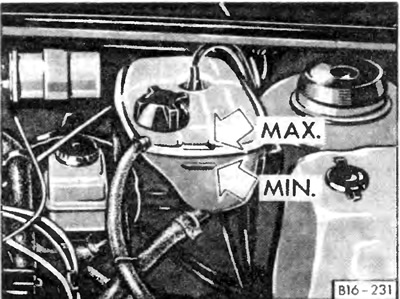
Since the expansion tank is made of transparent material, there is no need to remove the cap to check the coolant level.
The coolant level should be between the MIN and MAX marks when the engine is cold, and slightly above the MAX mark when the engine is warm. If the expansion tank on your vehicle is equipped with an electric coolant level control device, its connection to the top of the tank is clearly visible in the figure.
If the coolant level is too low, the warning light flashes until the normal level is restored.
Loss of coolant
Loss of coolant may indicate a leak in the cooling system. In this case, you should immediately contact your Volkswagen dealer for a thorough inspection. Simply topping up the cooling system is not enough.
In a sealed system, loss of coolant can only occur when the boiling point of the coolant rises as a result of overheating.
The coolant is susceptible to overheating if:
- The air flow towards the radiator is blocked by leaves, dust, insects accumulated on it, or by a headlight additionally installed in front of the decorative radiator grille.
- The boiling point of the coolant is lowered as a result of using a water/coolant mixture of the wrong concentration, see previous page.
- The radiator fan is not working or
- The vehicle is driven downhill for a long period of time in low gear at very high engine speed and at very high outside temperatures.
The original text is available on the website (VWmanual.ru)
If the cause of overheating cannot be determined and corrected, contact your Volkswagen dealer immediately to avoid serious engine damage.
Topping up the cooling system
Caution: To avoid getting burned by hot coolant, do the following:
- Turn off the engine and allow it to cool. The cooling system is under pressure.
- Cover the lid with a large, thick cloth to prevent coolant and steam from getting on your face and hands.
- Turn the lid slowly and very carefully counterclockwise while pressing it lightly.
If only water is added to the cooling system, it is necessary to restore the required ratio of water and antifreeze as quickly as possible.
If a significant amount of coolant is lost, only water and antifreeze should be added to the cooling system once the engine has cooled.
Do not fill the cooling system above the MAX mark.
Excess coolant will escape through the relief valve in the cap when the engine warms up.
Replace the lid and screw it tightly.
Warning: Antifreeze is poisonous. Always store it in a special container out of reach of children.
The coolant drained from the cooling system is generally not suitable for reuse, so dispose of it in accordance with environmental protection regulations.
Radiator fan
The electric radiator fan is controlled by thermal sensors depending on the temperature of the engine compartment and the temperature of the coolant.
Caution: Never touch the radiator fan as it operates depending on engine temperature and may turn on unexpectedly even when the ignition is off.
The radiator fan turns on automatically when the cooler reaches a certain temperature and will continue to rotate until the cooler temperature drops, i.e. for about 10 minutes.
Note: If the radiator fan does not turn on when the coolant reaches a very high temperature, check the fuse and replace it if necessary.
The rotation speed of the radiator fan is independent of the rotation speed of the engine, so the cooling effect cannot be improved by shifting the engine to a lower gear. If the engine runs smoothly and the speed of the vehicle moving downhill decreases slightly, there is no need to shift the engine to a lower gear.
Working in winter conditions
At the beginning of the winter season, check the concentration of antifreeze in the cooler. If it is necessary to add it, use only high-quality antifreeze without phosphoric acid salts (phosphate) containing ethylene glycol, which can be purchased from a Volkswagen dealer. The ratio between water and antifreeze depends on the expected air temperature.
Visitor comments