



Contents: Taper ↓ One-sided pull on the front axle ↓ Lateral pull during normal driving…↓ Lateral pull under heavy acceleration ↓
Taper
Conicity is caused by a slight offset of the tread and/or breaker relative to the geometric center of the tire by a few tenths of a millimeter. Conicity is not visually noticeable and is not measured in a car repair shop.
Due to the offset, the rigidity on the inner and outer shoulders of the tire is different, which leads to different forces. acting on the supporting surface of the wheel. Therefore, the breaker and the tread "rest" on the road surface with different forces (F1, F2). The result is a cone. The force caused by the cone (Fk) can, depending on the speed, become so great that it begins to pull the car to one side or the other.
If the force (Fk) on one wheel of the axle is, for example, 50 N, on the other wheel also 50 N, and these forces are also directed in the same direction, then they are summed up. By turning the tire on the disk, the lateral slip can be compensated, since the forces will then act in the opposite direction.
Since the direction in which the force caused by the conicity acts is not visible on the tire, it is possible to determine which tire caused the lateral pull only by test driving and deliberately rearranging the wheels and tires.
A tire consists of many elements and materials, which are partly vulcanized at the end of a labor-intensive manufacturing process. This results in various errors that can become noticeable at higher or lower lateral forces. These forces can also appear on new tires.
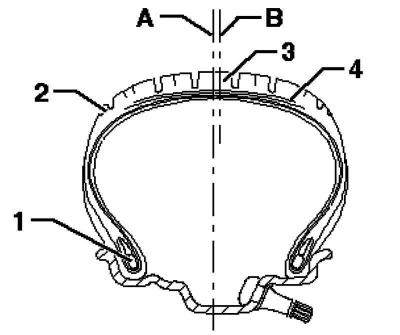
Fig. 4.18. Tire elements: 1 – side; 2 – shoulder; 3 – protector; 4 – metal cord breaker; a – geometric center of the tire; b – actual position of the breaker; it can be shifted inward or outward
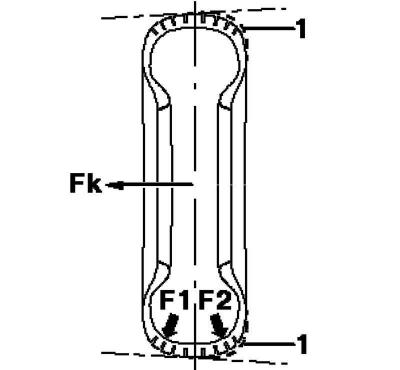
Fig. 4.19. Forces acting on the tire: 1 – breaker/tread offset; F1 – unequal forces acting on the supporting surface of the wheel; F2 – unequal forces acting on the supporting surface of the wheel; Fk – force generated by conicity
One-sided pull on the front axle
The causes of lateral pull may lie in the chassis. However, experience shows that in over 90% of complaints, lateral pull is caused by the tires.
Lateral pull during normal driving style
The car "pulls" to one side on a straight, level road, during smooth movement or moderate acceleration. At the same time, effort is felt on the steering wheel.
Lateral pull under heavy acceleration
Lateral slip under strong acceleration is partly built into the design of front-wheel drive vehicles. Different friction conditions of the left and right wheels, including uneven road surfaces (potholes), and therefore inconsistent traction, greatly affect driving performance. This problem is not covered by the warranty.
Visitor comments