



Contents: General information about rolling…↓ Tire noise ↓ Tread wear in the form of a sawtooth…↓ Non-directional tires ↓ Directional tread tires ↓ Wear spots due to driving with…↓ Reasons for a rough ride ↓
General information about rolling noise
Rolling noises perceived by the human ear are vibrations emanating from the sound source and reaching the ear through the air.
What is interesting here are the noises that arise due to certain features, as well as the effects of rolling tires (noise source).
The cause of noise depends largely on the combination of tires and road surface.
The surface structure and material of the road surface also have a strong influence on rolling noise. The noise level on a wet road, for example, is much higher than on a dry road.
The tread pattern profiling has a significant impact on noise levels. Tires with 90° transverse grooves are noisier than tires with diagonal grooves.
Small tread blocks are unstable. Because of their strong deformation, the air is shaken when the tires roll. Air vibrations are created, which lead to noise.
Wider tires are noisier. They need more grooves to drain water. When rolling, these grooves displace air, which also causes air vibrations.
Other effects that affect noise.
"Tire wobble" is the primary cause of rolling noise. It is caused by the excitation of air columns in the tread grooves.
"Air pulsation" is the compression and expansion of air when the contact area of the tire hits the road surface, which deforms the tread blocks.
Tire noise
Noise is mainly determined by the tires and road surface.
The road surface qualities that affect noise are unevenness (roughness), structure and material.
The parameters of the tire's impact are, among other things, the width of the tire and the wheel. A wider tire, due to the larger area of contact with the road surface, creates more noise, since a larger volume of air is squeezed out and a larger "mass" is excited into vibrations than with a smaller size.
Wider rims also increase the contact area of the tire. Thus, the effect on noise is the same as with a wide tire. In addition, wider rims have a negative effect on the damping properties of the tire.
Tire rolling noise is heard in cars with the engine mounted in the front, better in the rear seats, since aerodynamic noise and engine sound in this part of the cabin are less disturbing.
Tread wear in the form of a sawtooth track
Sawtooth tread wear is a step-by-step wear of individual tread blocks, which can lead to increased noise. Sawtooth wear occurs due to uneven deformation of the tread blocks on the contact surface of the tire with the road surface. This type of wear is more common on non-driving wheels than on driving wheels.
New tires are more prone to sawtooth tread wear because the tall tread blocks are more flexible. As the tread depth decreases, the stiffness of the tread blocks increases, reducing the tendency for this type of wear.
A – Tread blocks of a new tire; the tread blocks, when viewed in the direction of rolling arrow 1, are the same height at the front and rear.
B – Tread wear in the form of a sawtooth track; the tread blocks, when viewed in the direction of rolling arrow 1, are higher at the front than at the rear arrow 2.
C – The profile blocks, viewed in the direction of rolling arrow 1, have severe wear in the front part of the "tooth" arrow 3.
If the tread wear is very pronounced and forms a saw-tooth pattern, increased tire noise may become noticeable.
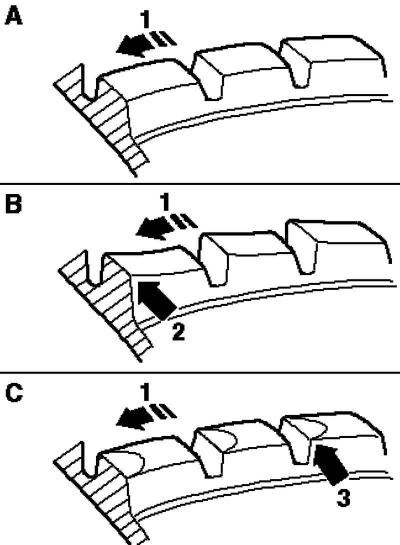
Fig. 4.11. Sawtooth wear pattern
Severe tread wear in the form of a sawtooth track occurs due to excessive toe-in, incorrect air pressure in tires with large tread blocks, tires mounted on non-drive axle wheels, and extreme cornering.
Non-directional tires
If you find saw-tooth tread wear, you should change the direction of the tire. If you find increased saw-tooth tread wear and increased noise, you should rotate the wheels crosswise. This will reduce wear.
On front-wheel drive vehicles, the effectiveness of this approach will be even more noticeable due to the greater wear of the tires on the front axle.
The rolling noise immediately after the wheel rotation will be slightly stronger, but after a run of 500–1000 km the normal noise level will be reached again.
Directional tread tires
If there is increased tread wear in the form of a sawtooth track on the rear axle tyres – especially with front-wheel drive – the rear wheels should be moved forward. If there is increased sawtooth wear on the outer edges on one axle, both tyres should be turned over on the rim. The left wheel should then be mounted on the right side and the right wheel on the left.
Wear spots due to driving with locked wheels
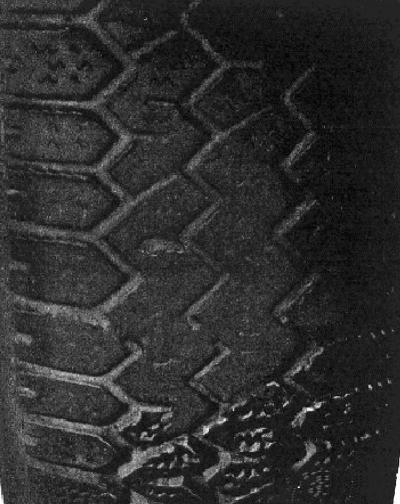
Fig. 4.12. Wear spots on the tread due to braking with locked wheels
This type of wear is a consequence of strong braking with locked wheels, during which the rubber of the tread wears off on the area of contact between the tire and the road surface (Fig. 4.12).
When tires slide on the road surface, frictional heat is generated, which reduces the abrasion resistance of the tread material.
Even the most wear-resistant rubber compounds of treads do not eliminate wear spots that can form under extreme braking.
And even brake systems equipped with ABS do not exclude short-term blocking and thus slight wear.
The extent of such wear depends significantly on the speed of movement, road surface and load on the wheel. The following examples are given for clarity.
When a car brakes with locked front wheels on a dry road surface until it comes to a complete stop, the wear of the rubber on a contact area equal to a postcard will be:
- from 57 km/h = 23.8 m braking distance up to 2.0 mm;
- from 75 km/h = 41.8 m braking distance up to 3.3 mm;
- from 92 km/h = 71.6 m braking distance up to 4.8 mm.
Tires with such damage are unsuitable for further use and must be replaced.
Reasons for a rough ride
The reasons for a rough ride are different. A rough ride may also appear due to tire wear. During operation, tires do not always wear evenly across the entire tread surface. Because of this, a slight imbalance appears, which interferes with the smooth rolling of a previously perfectly balanced wheel.
This imbalance is not yet felt on the steering wheel, but it does exist. It increases tire wear and thus reduces service life.
Note: To ensure optimum safety, optimum smooth running and even wear throughout the life of the tyre, it is recommended to balance the rims with tyres at least twice during the life of the tyres.
Visitor comments