



Tire air pressure
The weight of the vehicle flattens the tire on the area of its contact with the road. The rolling of the tire leads to forced deformation of the tread and the entire breaker. With insufficient pressure, the forced deformation increases, as a result of which the temperature and rolling resistance increase. These factors lead to increased wear and negatively affect traffic safety.
Too high air pressure in the tire leads to increased wear of the middle part of the tread and worsens comfort. It is recommended to always maintain the air pressure in the tires specified by the manufacturer.
Note: The graphs provided do not apply to the entire product range.
Note: These are required to show the wear of the tires on the front and rear axles, as well as the wear of the tires on front-wheel drive and all-wheel drive vehicles.
Note: Depending on operating conditions and chassis, achievable tire service lives may vary significantly from those listed below.
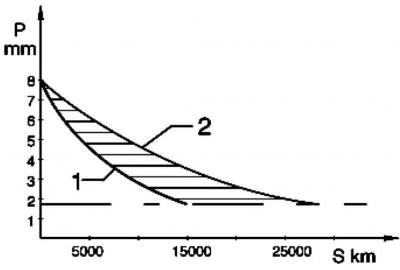
Fig. 4.3. Tire wear chart 1
Tread depth over service life for front-wheel drive vehicles with V-speed rating tyres.
- P - Tread pattern height.
- S - Mileage.
- 1 - Front axle.
- 2 - Rear axle.
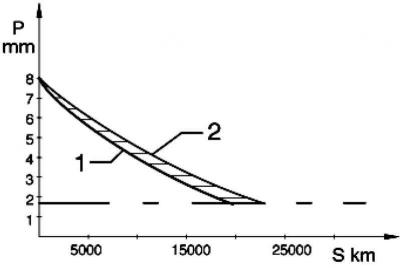
Fig. 4.4. Tire wear graph 2
Tread depth over the life of a 4WD vehicle fitted with V-speed rated tyres.
- P - Tread pattern height.
- S - Mileage.
- 1 - Front axle.
- 2 - Rear axle.
As can be seen from graphs 1 and 2, a tire with a full tread pattern wears out more during a given mileage than a significantly more worn tire. After the first 5,000 km, it is impossible to judge the overall service life of the tire, since the wear characteristic is nonlinear.
The original text can be found at (vwmanual.ru)
On front-wheel drive vehicles, the front wheels, in addition to the forces during turns and acceleration, are forced to withstand most of the lateral and braking forces. Due to such loads, the tires on the front wheels of front-wheel drive vehicles wear out noticeably faster than those on the rear wheels. Even wear of all tires is achieved by regularly rearranging the front and rear wheels.
Prescribed standard air pressure depending on the degree of loading with cold tires
| Air pressure (bar) | Air pressure (%) | Walkability (%) |
| 2,3 | 100 | 100 |
| 1,9 | 80 | 85 |
| 1,4 | 60 | 60 |
| 1,0 | 40 | 25 |
Visitor comments