
English Русский
Български
Беларускі
Український
Српски
Hrvatski
Română
Polski
Slovenský
Magyar
  |  Articles  |  Sitemap  |  Contacts  |    |
Car maintenance Ford Car maintenance Hyundai Car maintenance Chevrolet Car maintenance BMW Car maintenance Audi Car maintenance Opel Car maintenance AvtoVAZ
VWmanual.ru


Main   Passat   Golf   Polo   Touareg   Tiguan   Sharan   Transporter   Others  
Passat B2 (1981-1988) Passat B3 (1988-1993) Passat B4 (1988-1996) Passat B5 (1996-2005) Passat B6 (2005-2010)

Wheel balancing (VW Passat B6)

  • Main
  • Passat
  • Passat B6
  • Chassis
  • Wheels and tires
  • Wheel balancing
            0


Contents: Test drive before balancing ↓ Balancing on a stationary balancing…↓ Procedure for wheel/tire balancing ↓ Minimization ↓ Balancing test stand VAS 6230 ↓
Before you begin balancing, the following conditions must be met.

The air pressure in the tire must be normal.

The tread pattern must not have one-sided wear, and its depth must be at least 4 mm.

The tire should not have any damage, such as cuts, punctures, foreign objects, etc.

The wheel suspension, steering, steering rods, including shock absorbers, must be in perfect condition.

Test drive before balancing


If a car is brought to an authorized station with a complaint about "unsmooth running", then before balancing it is necessary to perform a test drive.

While driving, you should determine at what speed the imbalance appears.

(The original material is available on the portal: vwmanual)

Immediately after the test drive, raise the car on a lift.

Mark the installation location on each tire.

Remove and balance the wheels.

Balancing on a stationary balancing stand


Clamp the wheel on the balancing stand

Note: It is important to remember that when balancing wheels, as with any other repair, the most important rule is cleanliness. Only by monitoring cleanliness can you achieve a flawless result.


Note: Dirt and rust in the area of the wheel seat and center hole will distort the result.


Note: Before installing the wheel on the balancer, clean the mating surface, centering hole and disc.


Note: Place the wheel and tire on the balancing stand.
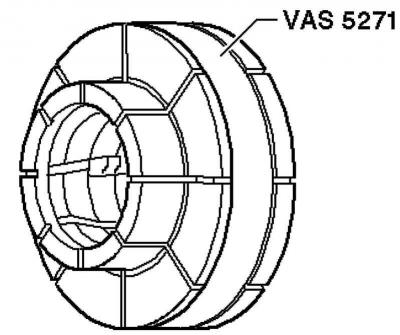


Fig. 4.13. Collet adapter

Fig. 4.13. Collet adapter


Note: To tighten the wheel, use, for example, the collet self-expanding adapter for wheel balancers VAS 5271 (fig. 4.13Note:).


When used, it guarantees 100% wheel centering and gentle disk clamping.

Conical centering adapters do not provide 100% wheel centering on the stand.

A 0.1 mm deviation from the center results in an imbalance of 10 grams on the wheel and tire.

Procedure for wheel/tire balancing


Spin the wheel and tire on the balancing stand.

Check the alignment of the marking strips on the sidewalls of the tire in the area of the bead flange.

Check the tread pattern while the wheel is rotating.

Note: In case of one-sided wear, wear spots due to braking with locked wheels or severe uneven wear, balancing will not achieve a smooth ride. In this case, the tire must be replaced.


Check the accuracy of rotation of the wheel with the tire. If the wheel with the tire rotates unevenly, although there is no flattening of the tire, the cause may be radial and lateral runout.

Check the wheel and tire for radial and lateral runout.

If the radial and lateral runout are within tolerance, balance the wheel and tire.


Note: Do not use more than 60 grams of weight per wheel.


Note: If more weights are needed, good balance can be achieved by minimizing them if necessary.


Minimization


The balancer display should show 0 grams.

As an alternative to minimization, you can use the VAS 6230 balancing stand.

Screw the wheel to the hub.

First tighten the lowest wheel bolt to approximately 30 Nm.

Then tighten the remaining bolts to 30 Nm in a crisscross pattern. This will center the wheel on the hub.

Lower the car onto its wheels.

Now tighten the wheel bolts in a crisscross pattern using a torque wrench to the specified torque.

After balancing the wheels, take a test drive.

If you still feel a beating during a test drive, it may be caused by a balancing error due to wheel centering.

Wheel and hub alignment errors can overlap in unfavorable cases. For this reason, runout is also possible. This can be eliminated using a final balancing stand

Balancing test stand VAS 6230
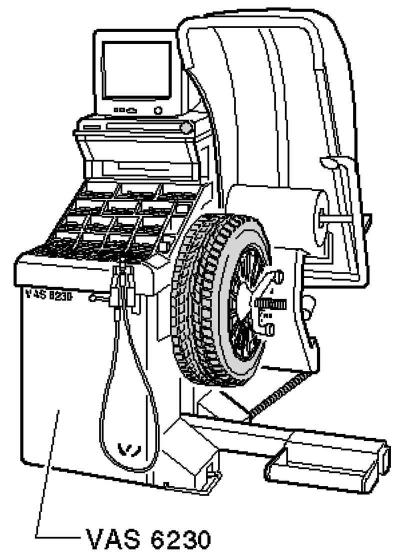


Fig. 4.14. Balancing stand

Fig. 4.14. Balancing stand


With the help of the balancing test stand VAS 6230, in addition to the well-known static balancing, additional functions can be performed (Fig. 4.14).

The peculiarity of this system is the checking of the radial force of the wheel with the tire during rotation.

During this test, a roller is applied to the wheel with a force of approximately 635 kg. This simulates the force acting on the bearing surface of the wheel from the road surface during movement.

Due to radial and lateral runout in the wheel and tire and different stiffnesses in the tire, the forces acting on the tire-road contact area vary.

The VAS 6230 system detects and stores the position of the maximum measured radial force in the tyre. This is used to measure the position of the smallest distance between the rim flange and the centre of the disc.

This article is available at russian, bulgarian, belarusian, ukrainian, serbian, croatian, romanian, polish, slovak, hungarian
The text has been checked: Orlov Dmitry

Share information:

Previous articles
Tire rolling noise
Diagonal uneven wear
One-sided tire wear
Measuring the tread depth
Evenly worn tires
Tire maintenance
Next articles
Radial and lateral runout of wheels and tires
Minimization of mounted wheels
Lateral vehicle pull
Eliminating lateral drift
Tire damage
Radial tire construction


Similar articles from other manuals for VW cars:
Wheel balancing Golf 5 (2003-2008)
Wheel balancing Polo 4 (2001-2009)
Wheel balancing Touareg 1 (2002-2006)
Removal and installation the compressor (all-wheel drive… Tiguan 1 (2007-2015)
Wheel Drive Shafts — Design Description Sharan 1 (1995-2000)
Brakes, tires, wheel rims Transporter T4 (1990-2003)
Wheel balancing Beetle (1960-1986)
Link to this page in different formats


Visitor comments


No comments yet


How much will 28 + 14 =


Passat B6 
  • General information
  • User manual
  • Maintenance
  • Petrol engine 1.6L
  • Engine repair
  • Cooling and lubrication system
  • Fuel injection system
  • Petrol engine 2.0L
  • Engine repair
  • Lubrication system
  • Cooling system
  • Fuel and exhaust systems
  • Diesel engine 2.0L
  • Engine repair
  • Cooling and lubrication system
  • Fuel and exhaust systems
  • Transmission
  • Clutch
  • Mechanical gearbox
  • Automatic gearbox
  • Drive shafts
  • Chassis
  • Wheels and tires
  • Car suspension
  • Steering
  • Brake system
  • Body
  • Exterior (external elements)
  • Electrical equipment
  • Power devices
  • Lighting and appliances
  • Electrical circuits
Passat B5 
  • General information
  • User manual
  • Weekly checks
  • Maintenance
  • Power unit
  • Engine repair
  • Cooling system
  • Fuel system (petrol)
  • Fuel system (diesel)
  • Engine management
  • Exhaust system
  • Transmission
  • Clutch
  • Car gearbox
  • Drive shafts
  • Chassis
  • Car suspension
  • Wheels and tires
  • Steering
  • Brake system
  • Body
  • Exterior (external elements)
  • Interior (internal elements)
  • Doors and covers
  • Ventilation and heating
  • Electrical equipment
  • Power devices
  • Lighting and appliances
  • Electrical circuits
Passat B4 
  • General information
  • User manual
  • Maintenance
  • Technical data
  • 8-valve engine
  • Engine repair
  • Cooling and lubrication system
  • Supply system
  • Ignition system
  • Fuel injection «Mono-Jetronic»
  • Control system «Mono-Motronic»
  • Control system «Digifant»
  • Control system «Simos»
  • 16-valve engine
  • Engine repair
  • Cooling and lubrication system
  • Fuel injection «K-Jetronic»
  • Control system «KE-Motronic»
  • Control system «Digifant»
  • Diesel engine
  • Engine repair
  • Cooling and lubrication system
  • Power and control system
  • Turbocharging system
  • Digital control system
  • Transmission
  • Clutch
  • Manual gearbox
  • Hydromechanical gearbox
  • Front wheel drive
  • Chassis
  • Car suspension
  • Steering
  • Brake system
  • Body
  • Body elements
  • Electrical equipment
  • Power devices
  • Lighting and appliances
  • Electrical circuits
Passat B3 
  • General information
  • User manual
  • Driving Tips
  • Maintenance instructions
  • Technical data
  • Power unit
  • Engine repair
  • Ignition system
  • Lubrication system
  • Cooling system
  • Supply system
  • Petrol injection system
  • Diesel engine
  • Exhaust system
  • Transmission
  • Clutch
  • Car gearbox
  • Chassis
  • Suspension
  • Steering
  • Brake system
  • Wheels and tires
  • Body
  • Exterior
  • Interior
  • Heating system
  • Electrical equipment
  • Power devices
  • Lighting system
  • Equipment and devices
  • Wiper system
  • Electrical circuits
Passat B2 
  • General information
  • Introduction to instructions
  • User manual
  • Power unit
  • Engines 4-cylinder FZ
  • Engines 4-cylinder
  • Engines 5-cylinder
  • Transmission
  • Clutch
  • Four-speed gearbox
  • Five-speed gearbox
  • Hydromechanical gearbox
  • Front wheel drive
  • Chassis
  • Front suspension
  • Rear suspension
  • Steering
  • Brake system
  • Body
  • Body elements
  • Electrical equipment
  • Equipment and devices
  • Electrical circuits
VWmanual.ru © 2016-2026 | Mobile version | News and articles | Sitemap: EN BG BY UA RS HR RO PL SK HU | Write message | Site search
Passat B2 • Passat B3 • Passat B4 • Passat B5 • Passat B6 • Golf 1, diesel • Golf 1, petrol • Golf 2, petrol • Golf 2 • Golf 3 • Golf 4 • Golf 5 • Polo 3 • Polo 4 • Touareg 1 • Tiguan 1 • Sharan 1 • Transporter T3 • Transporter T4 • LT 28 • LT 2D • Beetle • Caddy 3 •
Our website uses cookies to ensure functionality and convenience.