



Contents: Replacing brake pads ↓ Removal and installation the brake…↓ Disassembly and assembly of the…↓ Removal and installation the brake…↓
Replacing brake pads
Brake pads should only be replaced in pairs on both wheels at the same time using pads of the specified brand.
Raise the rear of the vehicle, place it on stands and remove the wheels. Perform the following operations on both sides of the vehicle. Set the parking brake lever to its lowest position. Disconnect the parking brake cable from the holder on the rear suspension arm. Loosen the two caliper mounting bolts and remove the caliper (Fig. 7-16). Remove the brake pads. Clean the pad pockets in the caliper and move the piston as far inside the cylinder as possible, removing some of the brake fluid from the brake fluid reservoir if necessary. Check the condition of the brake disc and brake dust cap.
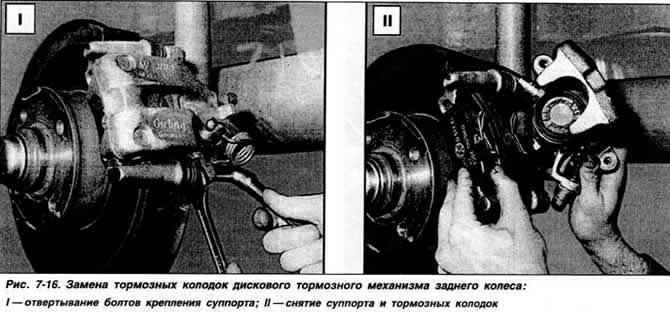
Install new brake pads. Tighten new caliper mounting bolts to 2.5 kgf·m. Connect the parking brake cable and adjust its tension as shown below. Install the rear wheels and lower the vehicle. Press the brake pedal several times to set the piston to the operating position. Check and, if necessary, restore the fluid level in the reservoir.
Removal and installation the brake mechanism
Raise the rear of the vehicle, place it on stands and remove the wheels. Use a syringe to remove fluid from the brake master cylinder reservoir. Disconnect the brake hose from the caliper and plug its hole. Disconnect the parking brake cable. Unscrew the two bolts securing the shoe guide to the wheel hub. Remove the shoe guide assembly with the caliper and brake pads. Wash the parts with alcohol, dry them and check their condition. Reinstall the shoe guide assembly with the caliper and pads. Tighten the shoe guide mounting bolts and tighten them to a torque of 6.5 kgf·m. Connect the brake hose.
Fill the brake fluid into the brake master cylinder reservoir. Install the wheels and lower the vehicle. Bleed the brake hydraulic system as described below.
Disassembly and assembly of the brake mechanism
Remove the brake mechanism as described above. Clamp the brake mechanism in a vice with soft pads. Remove the piston dust cap. Remove the piston from the cylinder by unscrewing it. Use a screwdriver to remove the sealing ring from the cylinder.
Wash the parts thoroughly with denatured alcohol. Check the condition of the parts carefully.
If scratches or signs of wear are found on the surface of the piston or cylinder, replace the caliper as a whole.
Assemble the brake mechanism, replacing all sealing parts and lubricating the parts with brake fluid. Install the brake mechanism as described above. Bleed air from the brake hydraulic drive. as described below.
Removal and installation the brake disc
Replace brake discs in pairs only.
Raise the rear of the vehicle, place it on stands and remove the wheels. Disconnect the parking brake cable from the holder on the rear suspension arm. Loosen the two bolts securing the shoe guide to the wheel hub and remove the brake mechanism without disconnecting the brake hose. Remove the brake shoes. Hang the brake mechanism with a hook, being careful not to damage the brake hose.
Mark the position of the brake disc relative to the wheel hub. Remove the hub cap. Remove the cotter pin and the toothed lock of the hub nut. Unscrew the hub nut and remove the washer. Remove the inner ring of the hub bearing. Remove the brake disc, which is made integral with the hub.
The brake disc is installed in the reverse order of removal, taking into account the following:
- before installing the brake disc, apply universal grease to the hub;
- replace the hub nut cotter pin with a new one and adjust the clearance in the hub bearings as specified in the section "Rear suspension";
- press the brake pedal several times to set the brake piston to the working position.
Visitor comments