
English Русский
Български
Беларускі
Український
Српски
Hrvatski
Română
Polski
Slovenský
Magyar
  |  Articles  |  Sitemap  |  Contacts  |    |
Car maintenance Ford Car maintenance Hyundai Car maintenance Chevrolet Car maintenance BMW Car maintenance Audi Car maintenance Opel Car maintenance AvtoVAZ
VWmanual.ru


Main   Passat   Golf   Polo   Touareg   Tiguan   Sharan   Transporter   Others  
Passat B2 (1981-1988) Passat B3 (1988-1993) Passat B4 (1988-1996) Passat B5 (1996-2005) Passat B6 (2005-2010)

Elimination of vibrations of the steering wheel / front of the car (VW Passat B3)

  • Main
  • Passat
  • Passat B3
  • Chassis
  • Steering
  • Elimination of vibrations of the steering wheel / front of the car
            0


Contents: Examination ↓ Checking the radial and lateral…↓ Elimination of radial runout ↓ Checking the radial and lateral…↓ Mounting wheels on a car ↓ Subsequent balancing or…↓
Vibration of the steering wheel at a certain speed usually indicates an imbalance of the wheels.

Examination


Check the tire pressure and adjust if necessary.

Perform a test drive. Determine as accurately as possible the limits of the malfunction: speed range, road conditions, driving on turns and in a straight line.

Raise the car, see section "Lifting a car".

Check the centering of the middle part of the rim. The wheel hub should protrude above the console of the disc wheel or at least end with it. Otherwise, replace the rim.

Check the wheel suspensions. To do this, check the rubber-metal bearings, joints, shock absorbers and rims for perfect condition.

Remove the wheels and clean them. Also remove any stones from the tread.

Check the tires for wear spots. These are areas with a slight tread depth that can occur as a result of the wheel locking up when braking.

Check the tread depth of individual tires and compare them with each other. If the tires are abnormally worn at the front and/or rear, it is necessary to determine the parameters of the vehicle's chassis at the front and rear and adjust them if necessary. In this case, the wheel alignment must be adjusted to the upper tolerance limit.

Please note: To determine the chassis parameters, appropriate measuring equipment is required, which is usually only available in a specialized workshop.


Perform a test drive and check if there are any other faults.

Checking the radial and lateral runout of wheels


With the vehicle raised, place the linear movement dial indicator first on the tread track and then on the sidewall of the tire. Turn the wheel slowly by hand and read the indicator scale. Mark the maximum radial runout on the tire with chalk. Prescribed wheel runout values: maximum radial runout is 0.8 mm; maximum lateral runout is 1.2 mm.

If these values are not maintained, balance the wheels on a stationary balancing machine. In this case, the wheels, as on a car, must be centered in the middle part. Conical clamping devices that center the wheel relative to the central hole are not allowed. The permissible residual imbalance in both balancing planes is 5 grams.

Elimination of radial runout


Release the air from the tire and press the tire bead against the base of the rim.

Rotate the tire on the rim by 120°.

Inflate the tire and check the radial runout again.

If the measured value exceeds the specified value, rotate the tyre on the rim another 120° and check the radial runout.

If the prescribed maximum value is observed, perform wheel balancing.

Checking the radial and lateral runout of the rim


Center the rim without the tire in the middle part on the balancing machine or install it on the wheel hub. Perform measurements with a linear displacement indicator.
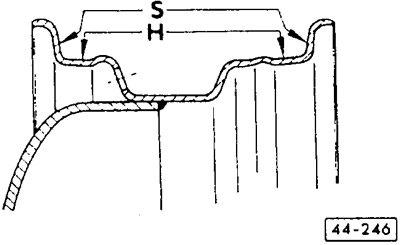
Center the rim without the tire in the middle part on the balancing machine or install it on the…


Check the radial runout in the "H" locations and the lateral runout in the "S" locations. In this case, local deviations in the dial indicator readings caused by elevations or depressions in the rim material are not taken into account.


Prescribed rim runout values: radial runout of a steel rim is 0.6 mm (for a light alloy rim - 0.5 mm), maximum lateral runout of a steel rim is 0.8 mm (for a light alloy rim - 0.5 mm).

The original material is available on the portal: www.VWManual.ru

If the measured runout values exceed the specified values, replace the rim.

Mounting wheels on a car


With the vehicle raised, position the wheels so that the maximum radial runout is at the top. In this position, tighten the wheel bolts crosswise with a torque wrench to 110 Nm.

Note: If the difference in wear between individual tires is insignificant, install the wheels with the smallest radial runout and minimum imbalance on the front axle.


Perform a test drive. If vibrations still occur at the front of the vehicle or at the steering wheel, this may be due to residual imbalance, which can be corrected by subsequent balancing on the vehicle.

Subsequent balancing or equilibration of wheels on a car


When balancing the drive wheels, it is necessary to rotate both tires of one axle.

The wheels must be driven by the car engine so that the wheels rotate synchronously. In cars with all-wheel drive, both axles must be lifted. Wheel balancing on the axles must be performed alternately.

Take a test drive.

If the faults still occur, the radial or lateral runout of one or more wheels is too large. This cannot be measured with workshop tools. In this case, the only option is to replace the front and/or rear tires. In this case, the tires must be replaced in pairs, i.e. for the entire axle at the same time.

This article is available at russian, bulgarian, belarusian, ukrainian, serbian, croatian, romanian, polish, slovak, hungarian
The text has been checked: Medvedeva Elena

Share information:

Previous articles
Bleeding the steering gear
Checking the tightness of the steering drive
Power steering vane pump
Checking the steering wheel free play
Removal and installation the tie rod end
Removal and installation the steering wheel
Next articles
Steering maintenance
Definition of chassis parameters


Similar articles from other manuals for VW cars:
Front wheel brake calipers Golf 2 (1984-1993, petrol)
Steering wheel height adjustment Polo 3 (1995-2003)
Controls on the multifunction steering wheel Touareg 1 (2002-2006)
Repair of shock absorber of adaptive chassis control system DCC… Tiguan 1 (2007-2015)
Adjusting the front wheel alignment angles Sharan 1 (1995-2000)
Eliminate vibration of the steering wheel and the front of the… Transporter T4 (1990-2003)
Steering Angles and Front Wheel Alignment — explanation of terms LT 28 (1975-1991)
Link to this page in different formats


Visitor comments


No comments yet


How much will 12 + 11 =


Passat B6 
  • General information
  • User manual
  • Maintenance
  • Petrol engine 1.6L
  • Engine repair
  • Cooling and lubrication system
  • Fuel injection system
  • Petrol engine 2.0L
  • Engine repair
  • Lubrication system
  • Cooling system
  • Fuel and exhaust systems
  • Diesel engine 2.0L
  • Engine repair
  • Cooling and lubrication system
  • Fuel and exhaust systems
  • Transmission
  • Clutch
  • Mechanical gearbox
  • Automatic gearbox
  • Drive shafts
  • Chassis
  • Wheels and tires
  • Car suspension
  • Steering
  • Brake system
  • Body
  • Exterior (external elements)
  • Electrical equipment
  • Power devices
  • Lighting and appliances
  • Electrical circuits
Passat B5 
  • General information
  • User manual
  • Weekly checks
  • Maintenance
  • Power unit
  • Engine repair
  • Cooling system
  • Fuel system (petrol)
  • Fuel system (diesel)
  • Engine management
  • Exhaust system
  • Transmission
  • Clutch
  • Car gearbox
  • Drive shafts
  • Chassis
  • Car suspension
  • Wheels and tires
  • Steering
  • Brake system
  • Body
  • Exterior (external elements)
  • Interior (internal elements)
  • Doors and covers
  • Ventilation and heating
  • Electrical equipment
  • Power devices
  • Lighting and appliances
  • Electrical circuits
Passat B4 
  • General information
  • User manual
  • Maintenance
  • Technical data
  • 8-valve engine
  • Engine repair
  • Cooling and lubrication system
  • Supply system
  • Ignition system
  • Fuel injection «Mono-Jetronic»
  • Control system «Mono-Motronic»
  • Control system «Digifant»
  • Control system «Simos»
  • 16-valve engine
  • Engine repair
  • Cooling and lubrication system
  • Fuel injection «K-Jetronic»
  • Control system «KE-Motronic»
  • Control system «Digifant»
  • Diesel engine
  • Engine repair
  • Cooling and lubrication system
  • Power and control system
  • Turbocharging system
  • Digital control system
  • Transmission
  • Clutch
  • Manual gearbox
  • Hydromechanical gearbox
  • Front wheel drive
  • Chassis
  • Car suspension
  • Steering
  • Brake system
  • Body
  • Body elements
  • Electrical equipment
  • Power devices
  • Lighting and appliances
  • Electrical circuits
Passat B3 
  • General information
  • User manual
  • Driving Tips
  • Maintenance instructions
  • Technical data
  • Power unit
  • Engine repair
  • Ignition system
  • Lubrication system
  • Cooling system
  • Supply system
  • Petrol injection system
  • Diesel engine
  • Exhaust system
  • Transmission
  • Clutch
  • Car gearbox
  • Chassis
  • Suspension
  • Steering
  • Brake system
  • Wheels and tires
  • Body
  • Exterior
  • Interior
  • Heating system
  • Electrical equipment
  • Power devices
  • Lighting system
  • Equipment and devices
  • Wiper system
  • Electrical circuits
Passat B2 
  • General information
  • Introduction to instructions
  • User manual
  • Power unit
  • Engines 4-cylinder FZ
  • Engines 4-cylinder
  • Engines 5-cylinder
  • Transmission
  • Clutch
  • Four-speed gearbox
  • Five-speed gearbox
  • Hydromechanical gearbox
  • Front wheel drive
  • Chassis
  • Front suspension
  • Rear suspension
  • Steering
  • Brake system
  • Body
  • Body elements
  • Electrical equipment
  • Equipment and devices
  • Electrical circuits
VWmanual.ru © 2016-2026 | Mobile version | News and articles | Sitemap: EN BG BY UA RS HR RO PL SK HU | Write message | Site search
Passat B2 • Passat B3 • Passat B4 • Passat B5 • Passat B6 • Golf 1, diesel • Golf 1, petrol • Golf 2, petrol • Golf 2 • Golf 3 • Golf 4 • Golf 5 • Polo 3 • Polo 4 • Touareg 1 • Tiguan 1 • Sharan 1 • Transporter T3 • Transporter T4 • LT 28 • LT 2D • Beetle • Caddy 3 •
Our website uses cookies to ensure functionality and convenience.