



Contents: Examination ↓ Checking the height and lateral play…↓ Elimination of height runout…↓ Checking the rim runout and lateral…↓ Installing wheels on a car ↓ Wheel balancing on a car ↓
Vibration of the steering wheel at certain speeds usually occurs in the case of wheel imbalance.
Examination
1. Check the tire pressure.
2. Make a test drive. Determine the malfunction as accurately as possible: speed, road surface condition, turns and exits from them onto straights.
3. Place the machine on stands.
4. Check the rim alignment. The wheel hubs or brake drums should protrude beyond the flange of the disc wheels or at least be flush with them. Otherwise, replace the rims.
5. Check the wheel suspension, checking the impeccable condition of the rubber-metal supports, hinges, shock absorbers and rims.
6. Remove and clean the wheels, removing any stones from the tread.
7. Check the wheels for brake bald spots, which are visible through a thin layer of residual tread that forms when braking fully with the wheels locked.
8. Check the tread depth on the tires and compare them with each other. If the tires are not worn out at the front or rear, the wheel alignment must be adjusted. In this case, the wheel alignment must be adjusted to the upper limit of the tolerance.
Attention! To measure the chassis, you need a corresponding measuring system, which, as a rule, is only available at service stations.
9. Make a test drive and check again for faults.
Checking the height and lateral play of the wheels
1. Place the machine on trestles. Place a suitable clock micrometer on the tread, then on the sidewall of the tire. Rotate the wheel slowly by hand, measure the maximum values of runout in height and lateral runout, mark these places with chalk.
2. Required values: maximum height difference – 0.8 mm; maximum lateral runout – 1.2 mm.
3. If these values are not maintained, balance the wheels on a stationary balancing machine. The wheels must be centered in the same way as on the machine. Conical tightening devices that center the wheel in the centering hole are not allowed. The permissible residual imbalance in both balancing planes is 5 grams.
Elimination of height runout (alignment)
1. Release air from the tire and press it onto the rim.
The information is posted on this website www.vwmanual.ru
2. Rotate the tire on the rim by 120°.
3. Inflate the tire and check the height runout again.
4. If the maximum value is exceeded, rotate the tyre on the rim another 120° and measure the height runout.
5. If the maximum value is maintained, balance the wheel.
Checking the rim runout and lateral runout
1. Mount, centering the wheel rim without the tire on a balancing machine or machine. Install a clock micrometer.
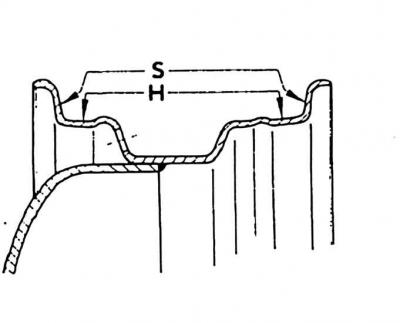
2. Check the height runout (H) and lateral runout (S) on the specified sheets, ignoring any unevenness in the rim material or the valve recess, which may interfere with accurate measurement.
Required values: steel rim: H = 0.6 mm; S = 0.5 mm.
3. If the dimensions are exceeded, replace the rim.
Installing wheels on a car
1. With the machine mounted on trestles, set the wheels so that the maximum runout height is at the top. Tighten the wheel screws in this position crosswise with a torque wrench to 160 Nm.
Caution! If the difference in wear of individual tires is small, install the wheels with the smallest height runout and the smallest imbalance weight on the front axle.
2. Make a test drive. If the front end is again found to be beating or the steering wheel is vibrating, then they are a consequence of residual imbalance, which is eliminated on the car by additional balancing.
Wheel balancing on a car
1. When balancing the drive wheels, be sure to install both wheels of one axle on rollers.
2. The wheels must be driven by the engine so that the wheels rotate synchronously. All-wheel drive vehicles must be raised on both axles. Balance the axles sequentially.
3. Make a test run.
4. If the faults are not corrected, then the radial and lateral movements of one or more wheels are too great. They cannot be measured by means of a service station. In this case, the only option is to replace the front or rear wheels. In this case, tires should be replaced only in pairs.
Visitor comments