



Front wheel alignment angles
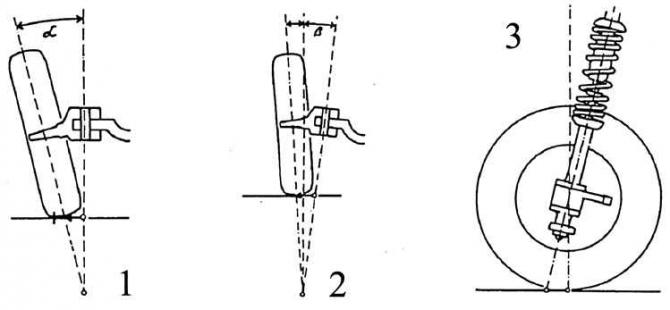
1. Collapse; 2. Transverse inclination of the kingpin; 3. Longitudinal tilt of the kingpin back
Toe-in is the lateral distance between the wheels. Toe-in means that the wheels are closer together at the midpoint height in the front than in the rear. Negative toe-in means that the front wheels are slightly further apart at the front than in the rear. The VW T4 has positive toe-in.
Camber and kingpin inclination reduce the transmission of shocks from uneven road surfaces to the steering and provide the least possible friction when cornering.
Camber is the angle a, the angle of deviation of the plane of the wheel from the vertical. Thus, the front wheels are at an angle. With positive camber, for example, at the point of contact of the wheels with the supporting surface they are closer to each other than at the top. VW T4 has positive camber.
The toe-in and camber of the VW T4 change depending on the load.
The transverse inclination of the kingpin is the angle b between the pivot axis of the steering knuckle and the vertical at the point of contact of the wheel with the supporting surface, relative to the longitudinal axis of the car.
Due to the camber angle and the kingpin angle, the points of contact of the wheels with the road surface are close to the axis of the steering knuckle. This achieves a small, so-called, rolling shoulder. The smaller the rolling shoulder, the easier the steering movement. Even impacts from the road surface act on the steering lever system significantly less.
The longitudinal inclination of the kingpin is the angle between the pivot axis of the steering knuckle and the vertical at the point of inclination of the wheel with the supporting surface, relative to the transverse axis of the car.
The longitudinal inclination of the kingpin significantly affects the straight-line performance of the front wheels. Too small an inclination of the kingpin ensures insufficient return of the steering wheel to the middle position after cornering or contributes to its deviation from the straight-line direction on flat roads.
Verification conditions:
- prescribed tire pressure;
- flat, horizontal surface when measuring;
- the car is empty: not loaded, with a spare wheel, a car jack and a full tank;
- the car is thoroughly sprung;
- steering adjusted;
- absence of unacceptable gaps in the steering lever system;
- absence of unacceptable gaps in the wheel suspension.
Visitor comments