
English Русский
Български
Беларускі
Український
Српски
Hrvatski
Română
Polski
Slovenský
Magyar
  |  Articles  |  Sitemap  |  Contacts  |    |
Car maintenance Ford Car maintenance Hyundai Car maintenance Chevrolet Car maintenance BMW Car maintenance Audi Car maintenance Opel Car maintenance AvtoVAZ
VWmanual.ru


Main   Passat   Golf   Polo   Touareg   Tiguan   Sharan   Transporter   Others  
Passat B2 (1981-1988) Passat B3 (1988-1993) Passat B4 (1988-1996) Passat B5 (1996-2005) Passat B6 (2005-2010)

Definition of chassis parameters (VW Passat B3)

  • Main
  • Passat
  • Passat B3
  • Chassis
  • Steering
  • Definition of chassis parameters
            0


Contents: Wheel alignment / kingpin camber and…↓ Adjustment ↓
Optimum driving dynamics and minimal wear can only be achieved with perfect wheel alignment. In the event of abnormal tyre wear, as well as unsatisfactory driving stability – poor stabilisation when driving straight ahead and poor steering qualities when turning – it is necessary to contact a workshop for an optical determination of the chassis parameters. The chassis can only be measured using a suitable measuring device. Therefore, we will limit ourselves here to a description of the main parameters determined during measurement.

Wheel alignment / kingpin camber and caster


The toe-in is the difference in distances measured in front and behind the steering wheels at the height of their axis of rotation from the road. As a rule, the front wheels should have a positive toe-in, since they - due to camber and rolling resistance - roll slightly outward when moving in a straight line, since there are minor gaps in the wheel hub bearings, suspensions and tie rod joints. Positive toe-in limits the tendency of the wheels to roll outward. With positive toe-in, the distance between the wheels in front is less than the distance in the back. With negative toe-in, on the contrary, the distance between the wheels will be less in the back.

In VW PASSAT cars, zero wheel alignment (0°) is installed. It is necessary to keep in mind that in cars with power steering, the alignment can only be adjusted on the right transverse steering rod.


Wheel camber and kingpin inclination reduce the transmission of shock loads from the road to the steering and maintain a minimum friction moment between the wheels and the road when turning.

Camber is the tilt of the front wheel plane relative to the vertical plane (the figure shows a positive camber with the wheel plane tilted at an angle of a). VW PASSAT cars have a negative camber angle. The prescribed camber angle is -1°20'±20'; with a 150 hp engine and a VR6 engine: -1°10±20': for vehicles designed for off-road driving: -1°±20'. The camber angle adjustment can only be made at the junction of the wheel hub bearing housing and the shock absorber strut,
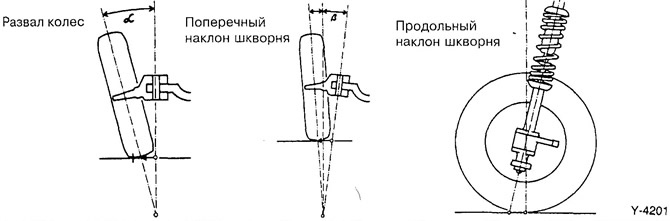
Camber is the tilt of the front wheel plane relative to the vertical plane (the figure shows a…


The transverse inclination of the kingpin is characterized by the angle p between the kingpin axis and the vertical passing through the point of contact of the tire with the road, when looking in the direction of vehicle travel.

The camber angle and the kingpin angle have a combined effect on the so-called rolling shoulder - the distance between the center of the supporting surface of the tire of the steered wheel and the point of intersection of the kingpin axis with the road. The smaller the rolling shoulder, the easier the car is to control.


The jolts transmitted from the road to the steering also become significantly weaker.

The longitudinal inclination of the kingpin is characterized by the angle between the kingpin axis and the vertical line passing through the point of contact of the tire with the road, when viewed in a direction perpendicular to the direction of travel of the vehicle.

The longitudinal inclination of the kingpin has a proportional effect on the straightness of the front wheels. A slight longitudinal inclination of the kingpin causes a deviation from straight-line movement on a bad road or in a crosswind and also forces you not to completely return the steering to the neutral position after a turn.

Adjustment


To determine the chassis parameters, an inspection pit or lifting platform is required. The following prerequisites must be met for each parameter determination:
  • The tire pressure is within the prescribed value,
  • A perfectly flat horizontal surface for taking measurements.
  • The car is unloaded.
  • The car is pre-deformed strongly elastically.
  • The steering is adjusted correctly.
  • No unacceptable gaps in the steering gear.
  • No unacceptable gaps in the wheel suspensions.

This article is available at russian, bulgarian, belarusian, ukrainian, serbian, croatian, romanian, polish, slovak, hungarian
The text has been checked: Medvedeva Elena

Share information:

Previous articles
Steering maintenance
Elimination of vibrations of the steering wheel / front of the car
Bleeding the steering gear
Checking the tightness of the steering drive
Power steering vane pump
Checking the steering wheel free play
Next articles


Similar articles from other manuals for VW cars:
Technical data: steering, suspension, brakes, body/chassis Golf 2 (1984-1993, petrol)
Components and assemblies of the shock absorber strut of the… Tiguan 1 (2007-2015)
Basic parameters for adjusting the chassis Transporter T4 (1990-2003)
Switching in the control system to check the injection system… Caddy 3 (2003-2010)
Link to this page in different formats


Visitor comments


No comments yet


How much will 46 + 30 =


Passat B6 
  • General information
  • User manual
  • Maintenance
  • Petrol engine 1.6L
  • Engine repair
  • Cooling and lubrication system
  • Fuel injection system
  • Petrol engine 2.0L
  • Engine repair
  • Lubrication system
  • Cooling system
  • Fuel and exhaust systems
  • Diesel engine 2.0L
  • Engine repair
  • Cooling and lubrication system
  • Fuel and exhaust systems
  • Transmission
  • Clutch
  • Mechanical gearbox
  • Automatic gearbox
  • Drive shafts
  • Chassis
  • Wheels and tires
  • Car suspension
  • Steering
  • Brake system
  • Body
  • Exterior (external elements)
  • Electrical equipment
  • Power devices
  • Lighting and appliances
  • Electrical circuits
Passat B5 
  • General information
  • User manual
  • Weekly checks
  • Maintenance
  • Power unit
  • Engine repair
  • Cooling system
  • Fuel system (petrol)
  • Fuel system (diesel)
  • Engine management
  • Exhaust system
  • Transmission
  • Clutch
  • Car gearbox
  • Drive shafts
  • Chassis
  • Car suspension
  • Wheels and tires
  • Steering
  • Brake system
  • Body
  • Exterior (external elements)
  • Interior (internal elements)
  • Doors and covers
  • Ventilation and heating
  • Electrical equipment
  • Power devices
  • Lighting and appliances
  • Electrical circuits
Passat B4 
  • General information
  • User manual
  • Maintenance
  • Technical data
  • 8-valve engine
  • Engine repair
  • Cooling and lubrication system
  • Supply system
  • Ignition system
  • Fuel injection «Mono-Jetronic»
  • Control system «Mono-Motronic»
  • Control system «Digifant»
  • Control system «Simos»
  • 16-valve engine
  • Engine repair
  • Cooling and lubrication system
  • Fuel injection «K-Jetronic»
  • Control system «KE-Motronic»
  • Control system «Digifant»
  • Diesel engine
  • Engine repair
  • Cooling and lubrication system
  • Power and control system
  • Turbocharging system
  • Digital control system
  • Transmission
  • Clutch
  • Manual gearbox
  • Hydromechanical gearbox
  • Front wheel drive
  • Chassis
  • Car suspension
  • Steering
  • Brake system
  • Body
  • Body elements
  • Electrical equipment
  • Power devices
  • Lighting and appliances
  • Electrical circuits
Passat B3 
  • General information
  • User manual
  • Driving Tips
  • Maintenance instructions
  • Technical data
  • Power unit
  • Engine repair
  • Ignition system
  • Lubrication system
  • Cooling system
  • Supply system
  • Petrol injection system
  • Diesel engine
  • Exhaust system
  • Transmission
  • Clutch
  • Car gearbox
  • Chassis
  • Suspension
  • Steering
  • Brake system
  • Wheels and tires
  • Body
  • Exterior
  • Interior
  • Heating system
  • Electrical equipment
  • Power devices
  • Lighting system
  • Equipment and devices
  • Wiper system
  • Electrical circuits
Passat B2 
  • General information
  • Introduction to instructions
  • User manual
  • Power unit
  • Engines 4-cylinder FZ
  • Engines 4-cylinder
  • Engines 5-cylinder
  • Transmission
  • Clutch
  • Four-speed gearbox
  • Five-speed gearbox
  • Hydromechanical gearbox
  • Front wheel drive
  • Chassis
  • Front suspension
  • Rear suspension
  • Steering
  • Brake system
  • Body
  • Body elements
  • Electrical equipment
  • Equipment and devices
  • Electrical circuits
VWmanual.ru © 2016-2026 | Mobile version | News and articles | Sitemap: EN BG BY UA RS HR RO PL SK HU | Write message | Site search
Passat B2 • Passat B3 • Passat B4 • Passat B5 • Passat B6 • Golf 1, diesel • Golf 1, petrol • Golf 2, petrol • Golf 2 • Golf 3 • Golf 4 • Golf 5 • Polo 3 • Polo 4 • Touareg 1 • Tiguan 1 • Sharan 1 • Transporter T3 • Transporter T4 • LT 28/35 • Beetle • Caddy 3 •
Our website uses cookies to ensure functionality and convenience.