English Русский
Български
Беларускі
Український
Српски
Hrvatski
Română
Polski
Slovenský
Magyar
  |  Articles  |  Sitemap  |  Contacts  |    |
Car maintenance Ford Car maintenance Hyundai Car maintenance Chevrolet Car maintenance BMW Car maintenance Audi Car maintenance Opel Car maintenance AvtoVAZ
VWmanual.ru


Main   Passat   Golf   Polo   Touareg   Tiguan   Sharan   Transporter   Others  
Passat B2 (1981-1988) Passat B3 (1988-1993) Passat B4 (1988-1996) Passat B5 (1996-2005) Passat B6 (2005-2010)

Checking and adjusting the Pierburg 1B3 carburetor (VW Passat B2)

  • Main
  • Passat
  • Passat B2
  • Power unit
  • Engines 4-cylinder
  • Checking and adjusting the Pierburg 1B3 carburetor
            0


Contents: Checking the fuel level in the float…↓ Adjusting the idle speed of a cold…↓ Adjusting the starting clearances of…↓ Adjusting the throttle opening ↓ Adjusting the accelerator pump ↓ Adjusting the idle speed of a warm…↓

Checking the fuel level in the float chamber


The position of the float in the float chamber is not adjustable. If a malfunction is detected, check the tightness of the float and the technical condition of the needle valve, replace the faulty parts.

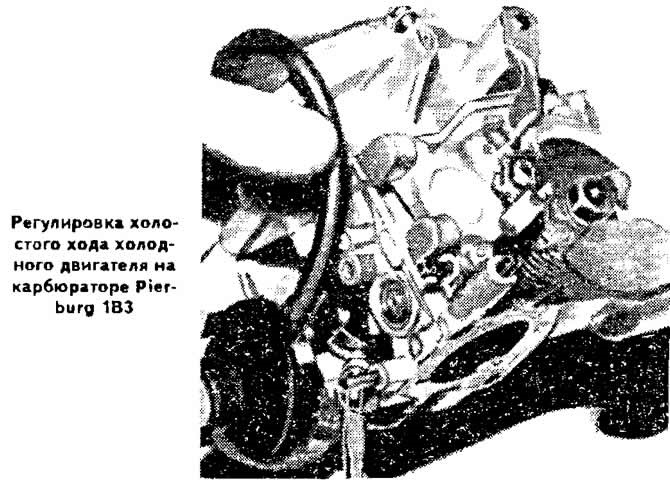
Adjusting the idle speed of a cold engine


Warm up the engine.

Connect the tachometer.

Stop the engine.

Open the throttle valve fully, placing the profiled throttle opening cam in the appropriate position.

Start the engine without pressing the accelerator pedal.

Check the engine crankshaft speed, which should be within 3500-3900 rpm.

If necessary, adjust the crankshaft speed using the throttle stop screw, which rests on the profiled throttle opening cam.

If necessary, adjust the crankshaft speed using the throttle stop screw, which rests on the…


If necessary, adjust the crankshaft speed using the throttle stop screw, which rests on the…


Adjusting the starting clearances of the air damper


Remove the starter cover.

Open the throttle valve fully, placing the throttle valve opening cam on the appropriate profile.

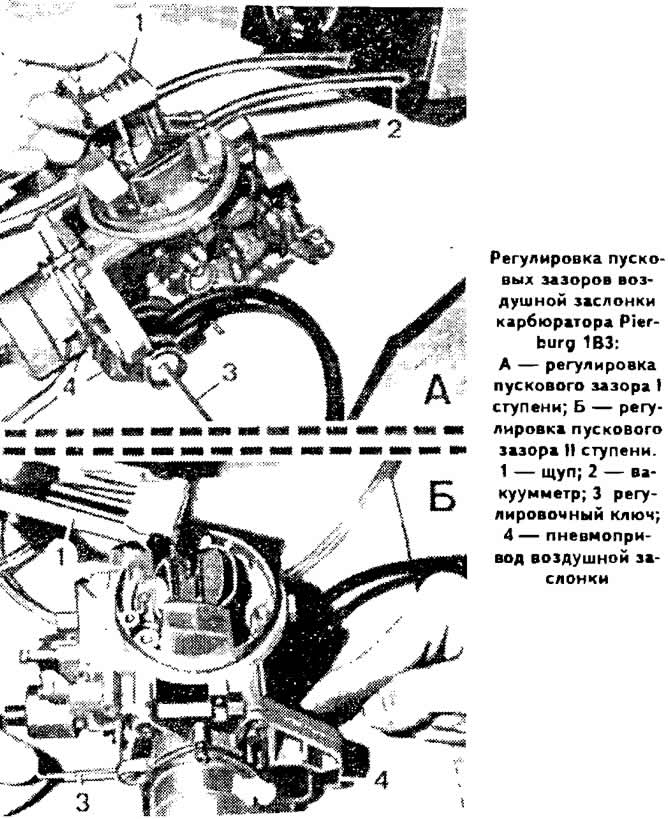
Connect a vacuum gauge and a vacuum pump to the air damper pneumatic drive and create a vacuum of 100 mbar in the pneumatic drive.

If the air damper pneumatic drive is hermetically sealed, the vacuum should not decrease by more than 5 mbar per minute and should not decrease to less than 40 mbar.

Bring the vacuum in the air damper pneumatic drive to 200-300 mbar.

Measure the starting gap of the first stage of the air damper using a set of feeler gauges, which for cars with a manual transmission should be 2.0±0.15 mm, for cars with an automatic transmission - 2.4±0.15 mm.

If necessary, set the required gap using the pneumatic drive diaphragm stroke adjustment screw located on its cover (see photo).

Close the atmospheric hole of the air damper pneumatic drive with a plug, create a vacuum of 200 mbar in the pneumatic drive, which, if the pneumatic drive is sealed, should remain unchanged for at least 1 min.

Measure the starting gap of the second stage of the air damper using a set of feeler gauges, which on vehicles with a YN engine should be within 4.3±0.15 mm, on vehicles with a WV engine with a manual transmission - 3.5±0.15 mm, with an automatic transmission - 3.3+0.15 mm.

If necessary, set the proper clearance using the adjusting screw on the end of the air damper pneumatic actuator rod.

If necessary, set the proper clearance using the adjusting screw on the end of the air damper…


Adjusting the throttle opening


The throttle position is adjusted at the factory, but if the adjustment is out of adjustment, it can be restored as follows:
  • remove the throttle limit screw plug;
  • connect the vacuum gauge in parallel to the vacuum regulator of the ignition timing sensor-distributor;
  • start and warm up the engine;
  • move the throttle control sector away from the idle stop;
  • turn the throttle valve limit screw so that the vacuum begins to increase;
  • turn the throttle valve limit screw until a minimum vacuum is obtained, then turn it back another half turn;
  • adjust the idle speed of a warm engine as indicated below;
  • install a new plug on the throttle valve limit screw.

Adjusting the accelerator pump


Remove the carburetor.

Fill the carburetor float chamber with fuel and place a measuring cup with a funnel under the carburetor.

Move the throttle control sector away from the idle stop.

Slowly move the throttle valve ten times from stop to stop, spending approximately 3 seconds each time, thereby activating the accelerator pump.

Measure the amount of fuel in the measuring cup: in one cycle the accelerator pump should supply 0.9+0.15 cm³ of fuel.

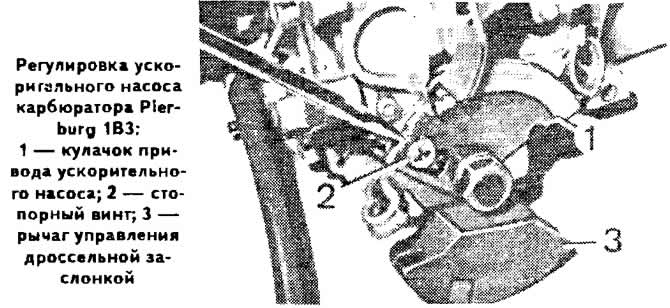
If necessary, adjust the performance of the accelerator pump by moving the cam of the accelerator pump drive lever on the bracket, after first loosening the lock screw.

If necessary, adjust the performance of the accelerator pump by moving the cam of the accelerator…


Adjusting the idle speed of a warm engine


Adjustment of the engine idle speed must be performed on a warmed-up engine with adjusted clearances in the valve drive mechanism, with the ignition timing set correctly.

Connect the tachometer and gas analyzer in accordance with the operating instructions.

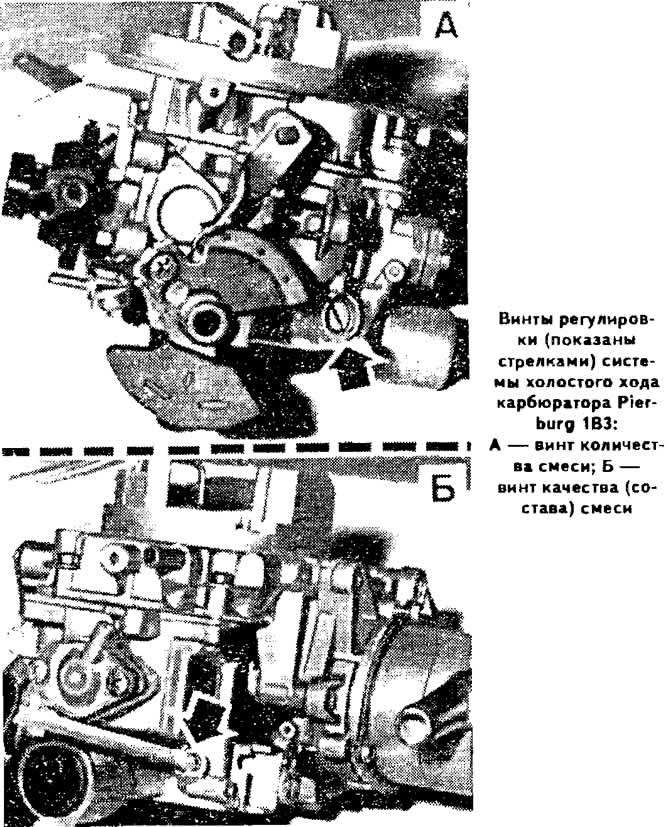
Use the mixture quantity adjusting screw to set the crankshaft speed within 900-1000 rpm.

Using the mixture quality (composition) adjustment screw, achieve a carbon monoxide (CO) content in the exhaust gases of no more than 0.5-1.5%. Restore the crankshaft speed to 900-1000 rpm. If necessary, restore the specified CO content.

This article is available at russian, bulgarian, belarusian, ukrainian, serbian, croatian, romanian, polish, slovak, hungarian
The text has been checked: Kolesnikov Artem

Share information:

Previous articles
Operating principle of the Pierburg 1B3 carburetor
Adjusting the Keihin 26-30 DC carburetor
Operating principle of the Keihin 26-30 DC carburetor
Fuel pump of the power supply system
Checking and adjusting clearances in the valve drive mechanism
Tightening torques of main threaded connections, kgf.m
Next articles
Operating principle of the Pierburg 2B5 carburetor
Checking and adjusting the Pierburg 2B5 carburetor
Operating principle of the Pierburg 2E2 carburetor
Checking and adjusting the Pierburg 2E2 carburetor
The structure and principle of operation of the electronic ignition system
Checking and adjusting the ignition system


Similar articles from other manuals for VW cars:
Adjusting the Pierburg 2E3 carburetor Golf 2 (1984-1993)
Checking the self-adjusting tension roller Polo 3 (1995-2003)
Checking and adjusting the position of the pump-injector pistons… Touareg 1 (2002-2006)
Checking the operation of the intake manifold flap Tiguan 1 (2007-2015)
Checking the engine oil level and replacing it Sharan 1 (1995-2000)
Adjusting the carburetor cable 34 PICT Transporter T3 (1979-1992)
Checking and adjusting idle speed Beetle (1960-1986)
Link to this page in different formats


Visitor comments


No comments yet


How much will 49 + 37 =


Passat B6 
  • General information
  • User manual
  • Maintenance
  • Petrol engine 1.6L
  • Engine repair
  • Cooling and lubrication system
  • Fuel injection system
  • Petrol engine 2.0L
  • Engine repair
  • Lubrication system
  • Cooling system
  • Fuel and exhaust systems
  • Diesel engine 2.0L
  • Engine repair
  • Cooling and lubrication system
  • Fuel and exhaust systems
  • Transmission
  • Clutch
  • Mechanical gearbox
  • Automatic gearbox
  • Drive shafts
  • Chassis
  • Wheels and tires
  • Car suspension
  • Steering
  • Brake system
  • Body
  • Exterior (external elements)
  • Electrical equipment
  • Power devices
  • Lighting and appliances
  • Electrical circuits
Passat B5 
  • General information
  • User manual
  • Weekly checks
  • Maintenance
  • Power unit
  • Engine repair
  • Cooling system
  • Fuel system (petrol)
  • Fuel system (diesel)
  • Engine management
  • Exhaust system
  • Transmission
  • Clutch
  • Car gearbox
  • Drive shafts
  • Chassis
  • Car suspension
  • Wheels and tires
  • Steering
  • Brake system
  • Body
  • Exterior (external elements)
  • Interior (internal elements)
  • Doors and covers
  • Ventilation and heating
  • Electrical equipment
  • Power devices
  • Lighting and appliances
  • Electrical circuits
Passat B4 
  • General information
  • User manual
  • Maintenance
  • Technical data
  • 8-valve engine
  • Engine repair
  • Cooling and lubrication system
  • Supply system
  • Ignition system
  • Fuel injection «Mono-Jetronic»
  • Control system «Mono-Motronic»
  • Control system «Digifant»
  • Control system «Simos»
  • 16-valve engine
  • Engine repair
  • Cooling and lubrication system
  • Fuel injection «K-Jetronic»
  • Control system «KE-Motronic»
  • Control system «Digifant»
  • Diesel engine
  • Engine repair
  • Cooling and lubrication system
  • Power and control system
  • Turbocharging system
  • Digital control system
  • Transmission
  • Clutch
  • Manual gearbox
  • Hydromechanical gearbox
  • Front wheel drive
  • Chassis
  • Car suspension
  • Steering
  • Brake system
  • Body
  • Body elements
  • Electrical equipment
  • Power devices
  • Lighting and appliances
  • Electrical circuits
Passat B3 
  • General information
  • User manual
  • Driving Tips
  • Maintenance instructions
  • Technical data
  • Power unit
  • Engine repair
  • Ignition system
  • Lubrication system
  • Cooling system
  • Supply system
  • Petrol injection system
  • Diesel engine
  • Exhaust system
  • Transmission
  • Clutch
  • Car gearbox
  • Chassis
  • Suspension
  • Steering
  • Brake system
  • Wheels and tires
  • Body
  • Exterior
  • Interior
  • Heating system
  • Electrical equipment
  • Power devices
  • Lighting system
  • Equipment and devices
  • Wiper system
  • Electrical circuits
Passat B2 
  • General information
  • Introduction to instructions
  • User manual
  • Power unit
  • Engines 4-cylinder FZ
  • Engines 4-cylinder
  • Engines 5-cylinder
  • Transmission
  • Clutch
  • Four-speed gearbox
  • Five-speed gearbox
  • Hydromechanical gearbox
  • Front wheel drive
  • Chassis
  • Front suspension
  • Rear suspension
  • Steering
  • Brake system
  • Body
  • Body elements
  • Electrical equipment
  • Equipment and devices
  • Electrical circuits
VWmanual.ru © 2016-2026 | Mobile version | News and articles | Sitemap: EN BG BY UA RS HR RO PL SK HU | Write message | Site search
Passat B2 • Passat B3 • Passat B4 • Passat B5 • Passat B6 • Golf 1, diesel • Golf 1, petrol • Golf 2, petrol • Golf 2 • Golf 3 • Golf 4 • Golf 5 • Polo 3 • Polo 4 • Touareg 1 • Tiguan 1 • Sharan 1 • Transporter T3 • Transporter T4 • LT 28 • LT 2D • Beetle • Caddy 3 •
Our website uses cookies to ensure functionality and convenience.