
English Русский
Български
Беларускі
Український
Српски
Hrvatski
Română
Polski
Slovenský
Magyar
  |  Articles  |  Sitemap  |  Contacts  |    |
Car maintenance Ford Car maintenance Hyundai Car maintenance Chevrolet Car maintenance BMW Car maintenance Audi Car maintenance Opel Car maintenance AvtoVAZ
VWmanual.ru


Main   Passat   Golf   Polo   Touareg   Tiguan   Sharan   Transporter   Others  
Golf 1 (1974-1984, diesel) Golf 1 (1974-1984, petrol) Golf 2 (1984-1993, petrol) Golf 2 (1984-1993) Golf 3 (1991-1997) Golf 4 (1997-2004) Golf 5 (2003-2008)

Adjusting the Pierburg 2E3 carburetor (VW Golf 2)

  • Main
  • Golf
  • Golf 2
  • Petrol engines 1.3 l
  • Carburetors
  • Adjusting the Pierburg 2E3 carburetor
            0


Contents: Accelerator pump performance ↓ Installing the 2nd chamber damper ↓ Setting the idle speed to "fast" ↓ Idle speed adjustment ↓ Adjusting the accelerator thrust ↓

Accelerator pump performance


In order to check the performance of the accelerator pump without removing the carburetor, a vacuum pump is required. If such a pump is not available, the carburetor must be removed. Measure the performance of the pump using the method described below. Prepare a funnel and a measuring container.

Start the engine to fill the float chamber with gasoline. Remove the air filter and carburetor. Remove the carburetor carefully so as not to spill gasoline from it.

Rotate disc 1 (figure 145) so that it does not touch the fast idle speed adjustment bolt 2. Leave the disc in this position.

Rotate disc 1 (figure 145) so that it does not touch the fast idle speed adjustment bolt 2. Leave…


Place the carburetor over a funnel inserted into a measuring cup.

Turn the throttle lever several times until fuel appears from the sprayer. Make 5 full slow openings of the throttle. Each movement should last at least 1 second with 3-second breaks. Divide the amount of gasoline collected in the measuring cup by 5, the result is the pump capacity per one stroke of the membrane (diaphragm). It should be (1.0±0.15) cm.


If necessary, adjust the pump output. Loosen the lock screw 1 (figure 146) and turn cam 2. When turning in the direction of arrow "A", the pump performance increases, and in the direction of arrow "8", it decreases.
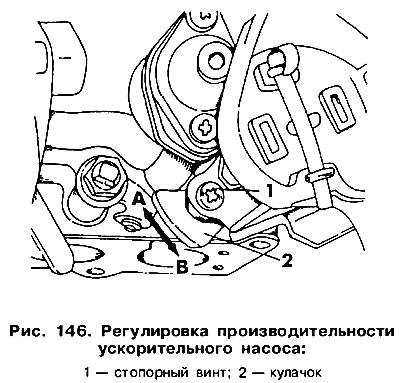
If necessary, adjust the pump output. Loosen the lock screw 1 (figure 146) and turn cam 2. When…


After finishing the adjustment, tighten screw 1 and fill the head with paint. The fuel jet from the nozzle of the accelerator pump sprayer should exactly fall into the corresponding cutout (arrow in figure 147). If this is not observed, the spray tube should be carefully bent with pliers. The adjustment is important and should be made according to the drawing.
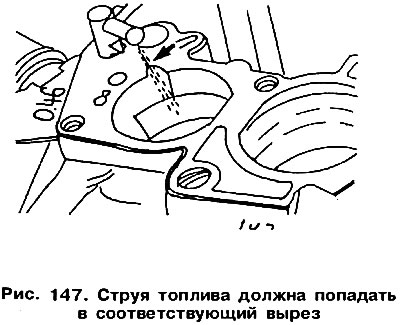
After finishing the adjustment, tighten screw 1 and fill the head with paint. The fuel jet from the…


Installing the 2nd chamber damper


Screw 2 (figure 148), used to adjust the installation of the 2nd chamber, is set at the factory. Its position cannot be changed. If necessary, adjust the position of the screw as follows:
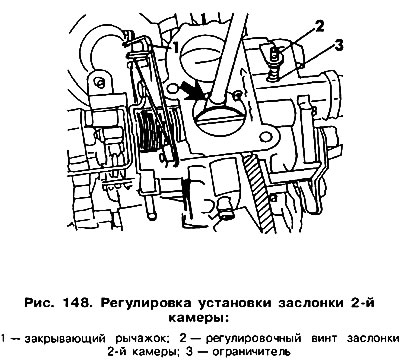

Screw 2 (figure 148), used to adjust the installation of the 2nd chamber, is set at the factory.…


Open the 1st chamber flap and lock it by inserting a round rod (arrow in figure 148).

Use a rubber band to pull back lever 1, which serves to close the shutter of the 2nd chamber.

Unscrew screw 2 so that there is a small gap between its end and limiter 3 (the thickness of thin paper).

Screw screw 2 back in until it touches the stopper, from this position, tighten it another 1/4 turn. In the s-th position, lock the screw with paint.

Remove the rubber band, take out the rod and check that both flaps are closed.

Check the clearances of the closing lever.

Gap "A" (figure 149) should be equal to 0.25-0.55 mm, and "B" - 0.85-1.15 mm.
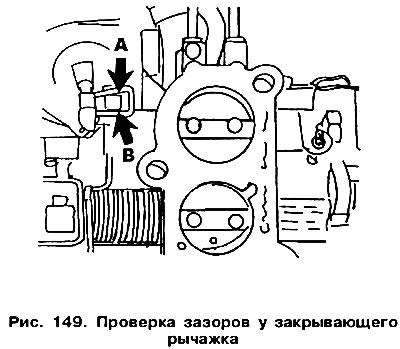
Gap «A» (figure 149) should be equal to 0.25-0.55 mm, and «B» - 0.85-1.15 mm.


If necessary, adjust the gaps by bending the lever frame.

After installing the carburetor, check the idle speed adjustment by measuring the CO content.

To check the air damper clearance, remove the starter cover.

Open the throttle valve and turn the step dial 1 (figure 150) so that the adjusting screw 2 rests on its highest step.
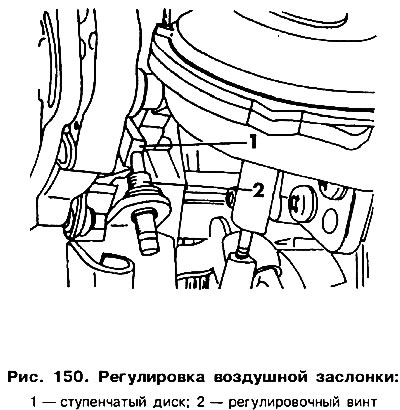
Open the throttle valve and turn the step dial 1 (figure 150) so that the adjusting screw 2 rests…


Insert the air damper control rod into the vacuum limiting device until it stops.

Insert drill bit 2 between the air damper and the housing (figure 151) diameter 2.7 mm. If the drill does not fit (taking into account the permissible deviation of ±0.10 mm), it is necessary to make adjustments using a screwdriver by turning screw 1.
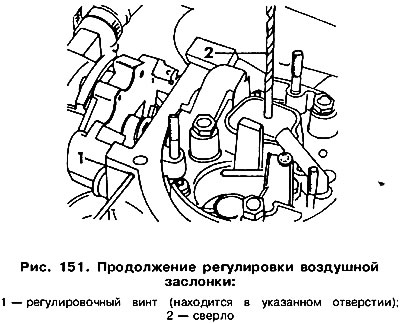
Insert drill bit 2 between the air damper and the housing (figure 151) diameter 2.7 mm. If the…


Setting the idle speed to "fast"


If a cold engine stalls, then you should adjust the so-called "fast" idle speed without removing the carburetor. The engine should be warmed up, and the ignition and idle speed should be adjusted correctly, then do the following:
  • Connect the tachometer.
  • Remove the air filter and close the temperature controller connection.
  • Start the engine.
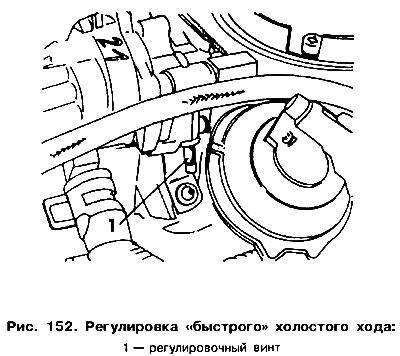
  • Check the engine speed and if it is not in the range of 1990-2100 rpm, it must be set with the adjusting screw (figure 152). Then seal the screw with paint to prevent it from unscrewing.
  • Check the idle speed setting and adjust if necessary.

(The article is posted on the portal: VWmanual.ru)
Check the idle speed setting and adjust if necessary.


Idle speed adjustment


The idle speed and the CO content in the exhaust gases are interdependent values. Therefore, it is necessary to first set the idle speed, and then you can start checking the composition of the exhaust gases. The engine must be warmed up, and the "fast" idle adjusting screw must not touch the stepped disk.

All electrical consumers must be switched off, this also applies to the electric fan.

Disconnect the crankcase ventilation hose from the air filter and plug its end.

The ignition must be adjusted correctly.

If a catalytic converter is installed, insert the gas analyzer probe into the pipe used to measure CO content.

The connection must be hermetically sealed, otherwise erroneous results will be obtained. If there is an additional built-in microcatalyst, the gas analyzer probe is inserted into the exhaust pipe.

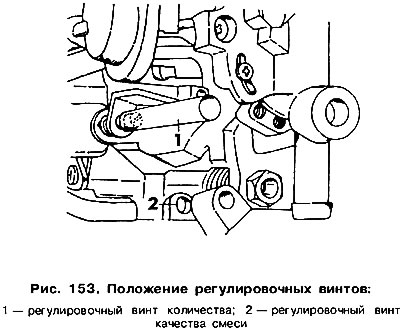
Measure the idle speed with a tachometer. It should be (800±50) rpm. If necessary, adjust it using the adjusting screw 1 (figure 153).
Measure the idle speed with a tachometer. It should be (800±50) rpm. If necessary, adjust it using…


Check the CO content in the exhaust gases. It should be within (3.0±0.5)%. Otherwise, it should be adjusted using the adjusting screw 2. To do this, remove the screw plug (blue color) and after the adjustment is completed, install it in place.

Turn off the gas analyzer. If the catalytic converter is installed, plug the pipe for measuring the CO content.

Install the crankcase ventilation hose.

The calibration data for the carburetors are given in table 6.

Adjusting the accelerator thrust


To adjust the working length of the rod, press the accelerator pedal and check the gap between the pedal and the floor with the throttle fully open. This gap should be at least 5 mm. Otherwise, release the rod mount and move the rod to another groove. Check the gap between the pedal and the floor again.

Possible malfunctions of the fuel system of carburetor engines are listed below.

The prerequisites for troubleshooting using the data in the table are the perfect adjustment and operation of the engine, ignition system and all auxiliary units, as well as a working thermostat in the air filter. The exhaust system and air intake must be tight. In addition, it is necessary to check whether the fuel supply pressure to the carburetor corresponds to the recommended one.

This article is available at russian, bulgarian, belarusian, ukrainian, serbian, croatian, romanian, polish, slovak, hungarian
The text has been checked: Kolesnikov Artem

Share information:

Previous articles
Carburetor Pierburg 2E3 — design description
Weber TLA Carburetor Adjustment
Disassembling the Weber TLA carburetor
Adjusting the Solex 1B3 carburetor
Disassembling the Solex 1B3 carburetor
Replacing the Solex 1B3 carburetor
Next articles
Carburetor calibration data
Possible malfunctions of the fuel system of carburetor engines


Similar articles from other manuals for VW cars:
Checking and adjusting the Pierburg 2E2 carburetor Passat B2 (1981-1988)
Removal and adjusting headrests Polo 3 (1995-2003)
Adjusting headrests Touareg 1 (2002-2006)
Adjusting the hood Tiguan 1 (2007-2015)
Adjusting the tension of the drive belt of engine units Sharan 1 (1995-2000)
Adjusting the carburetor cable 34 PICT Transporter T3 (1979-1992)
Adjusting the windshield washer jets Caddy 3 (2003-2010)
Link to this page in different formats


Visitor comments


No comments yet


How much will 25 + 30 =


Golf 5 
  • General information
  • User manual
  • Maintenance
  • Troubleshooting
  • Power unit
  • Engine repair
  • Cooling and ventilation system
  • Fuel system
  • Ignition system
  • Transmission
  • Clutch
  • Mechanical gearbox
  • Automatic gearbox
  • Chassis
  • Brake system
  • Car suspension
  • Steering
  • Body
  • Interior (internal elements)
  • Exterior (external elements)
  • Doors and covers
  • Electrical equipment
  • Power devices
  • Washers and wipers
  • Lighting and appliances
  • Electrical circuits
Golf 4 
  • General information
  • User manual
  • Weekly checks
  • Maintenance
  • Power unit
  • Petrol engines
  • Diesel engines
  • Cooling system
  • Fuel system (petrol)
  • Control system (petrol)
  • Fuel system (diesel)
  • Exhaust system
  • Transmission
  • Clutch
  • Car gearbox
  • Drive shafts
  • Chassis
  • Car suspension
  • Steering
  • Wheels and tires
  • Brake system
  • Body
  • Exterior (external elements)
  • Interior (internal elements)
  • Ventilation and heating
  • Car doors and sunroof
  • Washers and glass cleaners
  • Electrical equipment
  • Power devices
  • Lighting and appliances
  • Electrical circuits
Golf 3 
  • Petrol engine
  • Engine repair
  • Lubrication system
  • Cooling system
  • Ignition system
  • Diesel engine
  • Engine repair
  • Diesel injection system
  • Pre-glow system
  • Transmission
  • Clutch
  • Gearbox and drive shafts
  • Chassis
  • Steering
  • Wheels and suspension
  • Brake system
  • Electrical equipment
  • Lighting and appliances
  • Electrical circuits
Golf 2 
  • General information
  • Introduction to guide
  • User manual
  • Petrol engines 1.3 l
  • Engine repair
  • Lubrication system
  • Cooling system
  • Carburetors
  • Supply system
  • Ignition system
  • Petrol engines 1.6/1.8 l
  • Engine repair
  • Supply system
  • Ignition system
  • Diesel engines
  • Engine repair
  • Lubrication system
  • Cooling system
  • Power and exhaust system
  • Transmission
  • Clutch
  • 4-speed gearbox 084
  • 5-speed gearbox 085
  • 4-speed gearbox 020/4R
  • 5-speed gearbox 020/4T
  • Automatic gearbox
  • Drive shafts
  • Chassis
  • Steering
  • Car suspension
  • Brake system
  • Body
  • Body elements
  • Doors, locks and windows
  • Electrical equipment
  • Equipment and devices
  • Power devices
Golf 2 (petrol) 
  • General information
  • Characteristics
  • Car care
  • Maintenance
  • Power unit
  • Engine repair
  • Engine 1.05/1.30
  • Engine 1.60/1.80
  • Cooling and lubrication system
  • Power and exhaust system
  • Transmission
  • Clutch
  • Car gearbox
  • Drive shafts
  • Chassis
  • Brake system
  • Steering
  • Suspension
  • Body
  • Body and equipment
  • Electrical equipment
  • Lighting and appliances
  • Electrical circuits
Golf 1 (petrol) 
  • General information
  • Characteristics
  • User manual
  • Maintenance
  • Power unit
  • Engine adjustment
  • Engine 1.1/1.3
  • Engine 1.5/1.6/1.8
  • Engine electrical equipment
  • Cooling system
  • Fuel system
  • Transmission
  • Clutch and manual gearbox
  • Automatic gearbox
  • Chassis
  • Steering
  • Front suspension
  • Rear suspension
  • Brake system
  • Electrical equipment
  • Lighting and appliances
  • Electrical circuits
  • Body
  • Body and equipment
  • Optional equipment
Golf 1 (diesel) 
  • General information
  • Specifications
  • Maintenance
  • Power unit
  • Engine repair
  • Exhaust and turbocharger
  • Cooling system
  • Fuel system
  • Fuel injection system
  • Transmission
  • Clutch and drive shafts
  • Car gearbox
  • Chassis
  • Suspension and wheels
  • Steering
  • Brake system
  • Wheels and tires
  • Body
  • Heating and ventilation
  • Exterior (external elements)
  • Interior (internal elements)
  • Doors and windows
  • Electrical equipment
  • Equipment and devices
  • Lighting system
  • Power devices
  • Electrical circuits
VWmanual.ru © 2016-2026 | Mobile version | News and articles | Sitemap: EN BG BY UA RS HR RO PL SK HU | Write message | Site search
Passat B2 • Passat B3 • Passat B4 • Passat B5 • Passat B6 • Golf 1, diesel • Golf 1, petrol • Golf 2, petrol • Golf 2 • Golf 3 • Golf 4 • Golf 5 • Polo 3 • Polo 4 • Touareg 1 • Tiguan 1 • Sharan 1 • Transporter T3 • Transporter T4 • LT 28 • LT 2D • Beetle • Caddy 3 •
Our website uses cookies to ensure functionality and convenience.