
English Русский
Български
Беларускі
Український
Српски
Hrvatski
Română
Polski
Slovenský
Magyar
  |  Articles  |  Sitemap  |  Contacts  |    |
Car maintenance Ford Car maintenance Hyundai Car maintenance Chevrolet Car maintenance BMW Car maintenance Audi Car maintenance Opel Car maintenance AvtoVAZ
VWmanual.ru


Main   Passat   Golf   Polo   Touareg   Tiguan   Sharan   Transporter   Others  
Passat B2 (1981-1988) Passat B3 (1988-1993) Passat B4 (1988-1996) Passat B5 (1996-2005) Passat B6 (2005-2010)

Operating principle of the Pierburg 1B3 carburetor (VW Passat B2)

  • Main
  • Passat
  • Passat B2
  • Power unit
  • Engines 4-cylinder
  • Operating principle of the Pierburg 1B3 carburetor
            0


Contents: Starting device ↓ Idle and transition system ↓ Main dosing system ↓ Accelerator pump ↓
The design features and calibration data of the carburetor are given in the subsection "Design and technical characteristics".

Starting device


When starting a cold engine, under the influence of the thermostatic bimetallic spring of the automatic starting device, the air damper blocks the air flow through the carburetor duct, the throttle valve 3 (see diagram) under the influence of the system of rods and cams 2 of the drive opens slightly, ensuring an increase in the rotation speed of the cold engine at idle.

Under the action of the vacuum in the diaphragm cavity of the starting device, an increased amount of fuel passes through the main fuel jet, which ensures the starting of a cold engine.

After starting the engine, the vacuum that occurs in the intake manifold of the running engine activates the pneumatic actuator 4, which opens the air damper. After warming up with the transition to the load mode, the air damper opens through a system of rods and levers, driven by the throttle valve, which causes depletion of the combustible mixture and ensures uninterrupted operation of the engine.

Idle and transition system


Fuel taken from the float chamber enters the emulsion tube well through the main fuel jet 5 (see diagram) and is fed to the idle fuel jet 6. At the outlet of jet 6, the fuel is mixed with air entering through the idle air jet. The emulsion is fed to the outlet opening 7 of the idle system under the throttle valve through the opening regulated by the needle screw 8 of the mixture quality (composition), and through the opening closed when the ignition is turned off by the electromagnetic shut-off valve 9.


When the throttle valve 3 is smoothly opened, the combustible mixture enters the vertical channel of the transition system 10, which leads to a gradual increase in the rotation frequency of the engine crankshaft.
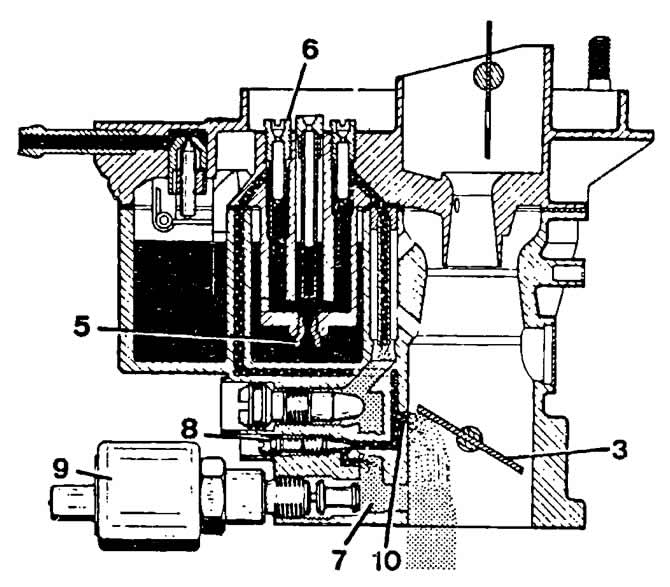
Diagram of the idle system and transition system of the Pierburg 1B3 carburetor:
3 - throttle valve;
5 - main fuel jet;
6 - idle fuel jet;
7 — spray hole of the idle system;
8 — mixture quality (composition) adjustment screw;
9 - electromagnetic shut-off valve;
10 — gaps of the transition system.


Main dosing system


Fuel is supplied to the float chamber through a needle valve. The float, hinged on the axis, regulates the opening of the needle valve hole to maintain a constant fuel level in the float chamber. There is a damping device between the needle valve and the float tongue.

From the float chamber, the fuel enters the emulsion tube through the main fuel jet 5 (see diagram), where it mixes with air passing through jet 11. Then the fuel-air mixture fills the mixing chamber formed by the small and large diffusers 12.

The carburetor has an economizer, which additionally enriches the fuel-air mixture at full engine load at speeds close to maximum. From the float chamber, the fuel passes through the channel and through the jet 13 enters the fuel tube, in the upper part of which it mixes with air entering through the air jet 14. The resulting emulsion passes through the check valve 15 and is ejected through the injection tube 16 into the mixing chamber, additionally enriching the combustible mixture, ensuring engine operation at increased speeds.
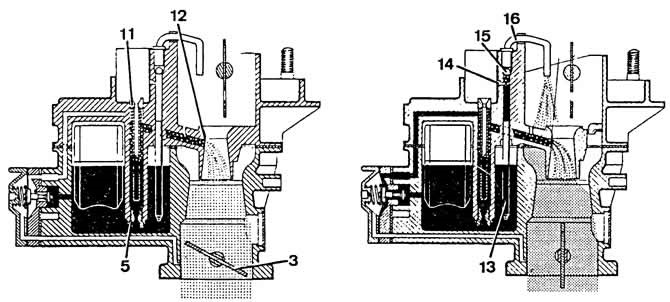

Diagram of the main metering system and economizer of the Pierburg 1B3 carburetor:
3 - throttle valve;
5 - main fuel jet;
11 - main air jet;
12 - sprayer;
13 — fuel jet economizer;
14 — economizer air jet;
15 - check valve;
16 - injection tube


Accelerator pump


Under the action of lever 17, the throttle valve opens, spring 18 turns cam 19, which acts on lever 20 of the accelerator pump drive. The lever presses piston 21, which pumps fuel coming from the float chamber through check ball valve 22 to sprayer 23.

The cam drive spring 18 dampens the force of the abrupt opening of the throttle valve, which increases the duration of fuel injection. The position of the cam drive spring on the throttle valve axis is adjustable. In the piston well there is a sealing cuff 24 and a return spring 25. The damper spring 26, located in the cavity of the piston itself, serves to regulate the movement of the piston depending on the amount of fuel passing through the atomizer.
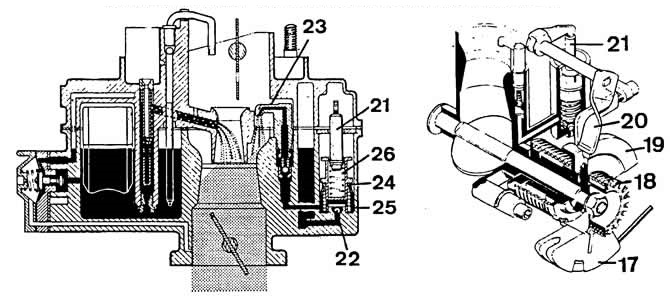
Accelerator pump diagram of the Pierburg 1B3 carburetor:
17 — throttle control lever;
18 — accelerator pump cam drive spring;
19 — accelerator pump cam;
20 — accelerator pump drive lever;
21 — accelerator pump piston rod;
22 - check ball valve;
23 - accelerator pump nozzle;
24 - sealing cuff;
25 — return spring;
26 — damper spring of the accelerator pump piston.
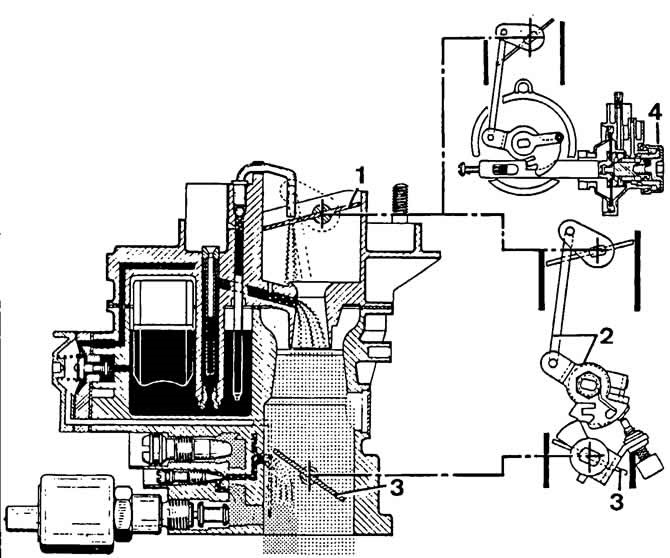

The Pierburg 1B3 carburetor operation diagram when starting a cold engine:
1 - air damper;
2 - system of rods and cams for opening the throttle valve;
3 - throttle valve;
4 — pneumatic drive of the air damper.
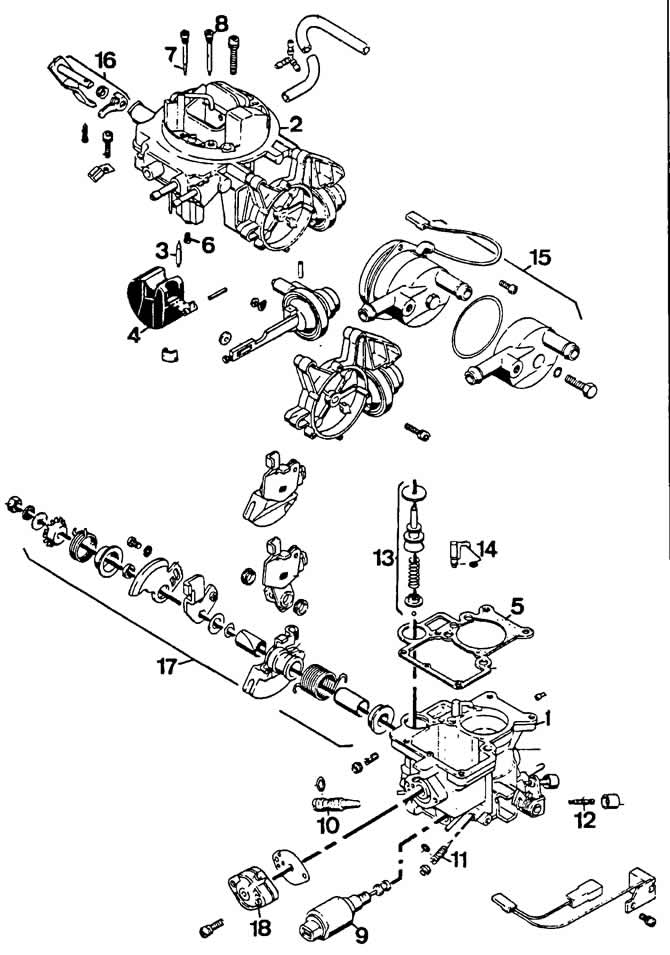

Main parts of the Pierburg 1B3 carburetor:
1 - carburetor body;
2 - carburetor cover;
3 - needle valve;
4 - float;
5 - float chamber gasket;
6 - main fuel jet;
7 — idle fuel jet;
8 — fuel jet of economizer;
9 - electromagnetic shut-off valve;
10 — idle mixture quantity adjusting screw;
11 — adjusting screw for idle mixture quality (composition);
12 — throttle valve limit screw;
13 - accelerator pump;
14 - accelerator pump sprayer;
15 - Automatic starting device;
16 — accelerator pump drive lever;
17 — Throttle control levers and sectors;
18 — power mode economizer.

This article is available at russian, bulgarian, belarusian, ukrainian, serbian, croatian, romanian, polish, slovak, hungarian
The text has been checked: Kolesnikov Artem

Share information:

Previous articles
Adjusting the Keihin 26-30 DC carburetor
Operating principle of the Keihin 26-30 DC carburetor
Fuel pump of the power supply system
Checking and adjusting clearances in the valve drive mechanism
Tightening torques of main threaded connections, kgf.m
Technical characteristics of the ignition system
Next articles
Checking and adjusting the Pierburg 1B3 carburetor
Operating principle of the Pierburg 2B5 carburetor
Checking and adjusting the Pierburg 2B5 carburetor
Operating principle of the Pierburg 2E2 carburetor
Checking and adjusting the Pierburg 2E2 carburetor
The structure and principle of operation of the electronic ignition system


Similar articles from other manuals for VW cars:
Carburetor Pierburg 2E2 Golf 1 (1974-1984, petrol)
Checking the engine operating modes Polo 3 (1995-2003)
Operating principle of the ECM under various conditions Sharan 1 (1995-2000)
Operating principle of a gas turbine supercharger Transporter T3 (1979-1992)
Carburetor — design description Beetle (1960-1986)
Link to this page in different formats


Visitor comments


No comments yet


How much will 42 + 36 =


Passat B6 
  • General information
  • User manual
  • Maintenance
  • Petrol engine 1.6L
  • Engine repair
  • Cooling and lubrication system
  • Fuel injection system
  • Petrol engine 2.0L
  • Engine repair
  • Lubrication system
  • Cooling system
  • Fuel and exhaust systems
  • Diesel engine 2.0L
  • Engine repair
  • Cooling and lubrication system
  • Fuel and exhaust systems
  • Transmission
  • Clutch
  • Mechanical gearbox
  • Automatic gearbox
  • Drive shafts
  • Chassis
  • Wheels and tires
  • Car suspension
  • Steering
  • Brake system
  • Body
  • Exterior (external elements)
  • Electrical equipment
  • Power devices
  • Lighting and appliances
  • Electrical circuits
Passat B5 
  • General information
  • User manual
  • Weekly checks
  • Maintenance
  • Power unit
  • Engine repair
  • Cooling system
  • Fuel system (petrol)
  • Fuel system (diesel)
  • Engine management
  • Exhaust system
  • Transmission
  • Clutch
  • Car gearbox
  • Drive shafts
  • Chassis
  • Car suspension
  • Wheels and tires
  • Steering
  • Brake system
  • Body
  • Exterior (external elements)
  • Interior (internal elements)
  • Doors and covers
  • Ventilation and heating
  • Electrical equipment
  • Power devices
  • Lighting and appliances
  • Electrical circuits
Passat B4 
  • General information
  • User manual
  • Maintenance
  • Technical data
  • 8-valve engine
  • Engine repair
  • Cooling and lubrication system
  • Supply system
  • Ignition system
  • Fuel injection «Mono-Jetronic»
  • Control system «Mono-Motronic»
  • Control system «Digifant»
  • Control system «Simos»
  • 16-valve engine
  • Engine repair
  • Cooling and lubrication system
  • Fuel injection «K-Jetronic»
  • Control system «KE-Motronic»
  • Control system «Digifant»
  • Diesel engine
  • Engine repair
  • Cooling and lubrication system
  • Power and control system
  • Turbocharging system
  • Digital control system
  • Transmission
  • Clutch
  • Manual gearbox
  • Hydromechanical gearbox
  • Front wheel drive
  • Chassis
  • Car suspension
  • Steering
  • Brake system
  • Body
  • Body elements
  • Electrical equipment
  • Power devices
  • Lighting and appliances
  • Electrical circuits
Passat B3 
  • General information
  • User manual
  • Driving Tips
  • Maintenance instructions
  • Technical data
  • Power unit
  • Engine repair
  • Ignition system
  • Lubrication system
  • Cooling system
  • Supply system
  • Petrol injection system
  • Diesel engine
  • Exhaust system
  • Transmission
  • Clutch
  • Car gearbox
  • Chassis
  • Suspension
  • Steering
  • Brake system
  • Wheels and tires
  • Body
  • Exterior
  • Interior
  • Heating system
  • Electrical equipment
  • Power devices
  • Lighting system
  • Equipment and devices
  • Wiper system
  • Electrical circuits
Passat B2 
  • General information
  • Introduction to instructions
  • User manual
  • Power unit
  • Engines 4-cylinder FZ
  • Engines 4-cylinder
  • Engines 5-cylinder
  • Transmission
  • Clutch
  • Four-speed gearbox
  • Five-speed gearbox
  • Hydromechanical gearbox
  • Front wheel drive
  • Chassis
  • Front suspension
  • Rear suspension
  • Steering
  • Brake system
  • Body
  • Body elements
  • Electrical equipment
  • Equipment and devices
  • Electrical circuits
VWmanual.ru © 2016-2026 | Mobile version | News and articles | Sitemap: EN BG BY UA RS HR RO PL SK HU | Write message | Site search
Passat B2 • Passat B3 • Passat B4 • Passat B5 • Passat B6 • Golf 1, diesel • Golf 1, petrol • Golf 2, petrol • Golf 2 • Golf 3 • Golf 4 • Golf 5 • Polo 3 • Polo 4 • Touareg 1 • Tiguan 1 • Sharan 1 • Transporter T3 • Transporter T4 • LT 28 • LT 2D • Beetle • Caddy 3 •
Our website uses cookies to ensure functionality and convenience.