
English Русский
Български
Беларускі
Український
Српски
Hrvatski
Română
Polski
Slovenský
Magyar
  |  Articles  |  Sitemap  |  Contacts  |    |
Car maintenance Ford Car maintenance Hyundai Car maintenance Chevrolet Car maintenance BMW Car maintenance Audi Car maintenance Opel Car maintenance AvtoVAZ
VWmanual.ru


Main   Passat   Golf   Polo   Touareg   Tiguan   Sharan   Transporter   Others  
Golf 1 (1974-1984, diesel) Golf 1 (1974-1984, petrol) Golf 2 (1984-1993, petrol) Golf 2 (1984-1993) Golf 3 (1991-1997) Golf 4 (1997-2004) Golf 5 (2003-2008)

Restoration of rubber cuffs (VW Golf 3)

  • Main
  • Golf
  • Golf 3
  • Transmission
  • Gearbox and drive shafts
  • Restoration of rubber cuffs
            0


Contents: Checking the outer constant velocity…↓ Checking the inner constant velocity…↓
If it can be found that the rubber seal is scratched, this means in most cases that dirt has entered the corresponding constant velocity joint. This means that either it must be replaced with a new corresponding joint, or it must be disassembled in order to thoroughly clean the inside of the ball and the ball race. In every suitable case, it should also be checked whether the wear has already exceeded the permissible limits, in which case it is best to install a new joint.

Under certain conditions, however, it is possible to disassemble the constant velocity joint in accordance with the instructions given and reassemble it.

Checking the outer constant velocity joint


If the car has been driven for a long time, the constant velocity joint has undergone a certain amount of wear. Excessive clearances in the joints manifest themselves as a noisy beat when the accelerator pedal is released, they become noticeable if the engine is "pushed". If this can be determined after a long period of service of the car, the constant velocity joint can be replaced with a new one without delay.

To disassemble a constant velocity joint, you need a vice to clamp the shaft.

The installation position of the inner sleeve relative to the ball bearing separator and housing should be marked in an appropriate manner.
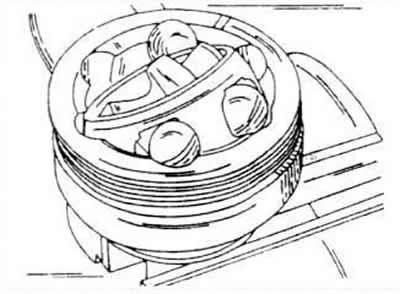
The installation position of the inner sleeve relative to the ball bearing separator and housing…


The shaft is clamped in a vice and the sleeve with the ball bearing separator is folded back. The balls are removed one by one. The balls of this joint belong to a certain group of tolerances and cannot be replaced.


The ball bearing separator is turned until the rectangular holes shown by the arrow are aligned with the edges of the housing. Now the separator is removed together with the bushing.

The sleeve is turned until the segment can be moved into the rectangular opening of the bearing separator and the sleeve can be removed.
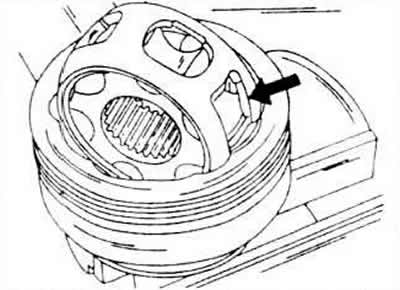
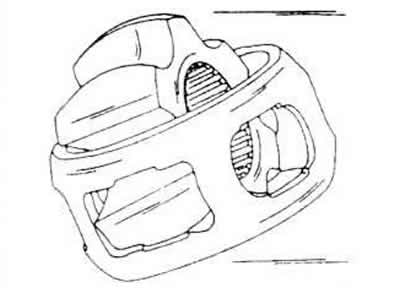
The sleeve is turned until the segment can be moved into the rectangular opening of the bearing…


The sleeve is turned until the segment can be moved into the rectangular opening of the bearing…


All removed parts are checked, and the jamming of the balls is also monitored.

Smooth spots are not an indication that the CV joint needs to be replaced with a new one, as they are simply ball races.

When assembling a constant velocity joint, proceed as follows.

Apply approximately 55 g of type G.6.3 grease to the constant velocity joint.

Insert the separator together with the bushing into the housing.


Insert the balls of the opposite sides, but make sure that they return to their original position in the separator and housing.

Insert a new retaining ring into the constant velocity joint.

Apply approximately 55 g of type G.6.3 grease to the inside of the constant velocity joint.

Place a rubber cuff on the constant velocity joint and secure it with a clamp. To secure it in this way, you should again use special pliers.

Make sure the clamp is properly installed at the other end and carefully insert a screwdriver between the collar and the shaft. This will release any trapped air. Tighten the small clamp securely.

Checking the inner constant velocity joint
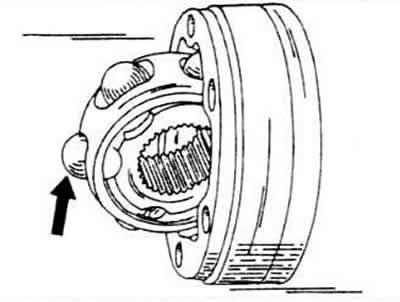


Checking the inner constant velocity joint


After the constant velocity joint is removed, the bearing separator and outer ring are aligned and the separator is removed in the direction shown by the arrow. It is necessary to take into account that the bushing, outer ring and six balls are matched with each other and can only be replaced with new ones as a complete set.

The assembly of the constant velocity joint is carried out in the following sequence.
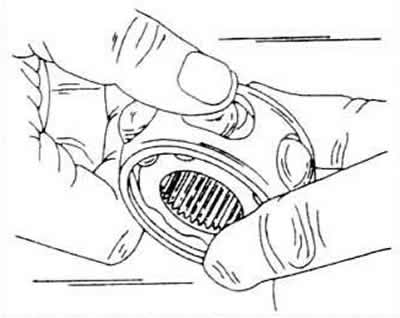
The assembly of the constant velocity joint is carried out in the following sequence.


The ball bushing is inserted into both grooves of the bearing separator, and then the balls are pressed in. To do this, hold the part and press the balls inward along the circumference.
The ball bushing is inserted into both grooves of the bearing separator, and then the balls are…


The bearing sleeve is inserted into the outer ring in the following manner:

The inclined part on the inside of the bushing should be directed towards the contact connection on the drive shaft and towards the large diameter of the outer ring.

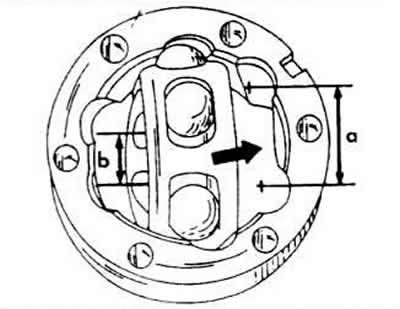
The sleeve together with the separator and bearings is inserted perpendicularly into the outer ring as shown in the figure.

Note that in each case the wide ball groove (a) and the narrow ball groove (d) in the sleeve are together on the same side when the sleeve is tilted into the outer ring.

The constant velocity joint is pressed onto the shaft, with the shaft supported from below.

A new spring retaining ring is inserted into the groove. If required, it is pressed in well using pliers with a water pump.

The constant velocity joint is reinstalled.

This article is available at russian, bulgarian, belarusian, ukrainian, serbian, croatian, romanian, polish, slovak, hungarian
The text has been checked: Medvedeva Elena

Share information:

Previous articles
Dismantling and installation of the shock absorber
Repair of the drive shaft
Dismantling and installation of the drive shaft
Front drive shafts
Checking the oil and working fluid levels in the automatic transmission and final drive
Removal an automatic transmission
Next articles


Similar articles from other manuals for VW cars:
Replacing the rubber band of the windshield wiper blade Passat B3 (1988-1993)
Checking the rubber bands of the windshield wipers/adjusting the… Polo 4 (2001-2009)
Replacing the rubber-metal support of the gearbox bracket Touareg 1 (2002-2006)
Replacing the rubber band of the wiper blade and the wiper blade… Sharan 1 (1995-2000)
Replacing rubber wiper blades Transporter T4 (1990-2003)
Replacing the front rubber-metal support Beetle (1960-1986)
Link to this page in different formats


Visitor comments


No comments yet


How much will 24 + 35 =


Golf 5 
  • General information
  • User manual
  • Maintenance
  • Troubleshooting
  • Power unit
  • Engine repair
  • Cooling and ventilation system
  • Fuel system
  • Ignition system
  • Transmission
  • Clutch
  • Mechanical gearbox
  • Automatic gearbox
  • Chassis
  • Brake system
  • Car suspension
  • Steering
  • Body
  • Interior (internal elements)
  • Exterior (external elements)
  • Doors and covers
  • Electrical equipment
  • Power devices
  • Washers and wipers
  • Lighting and appliances
  • Electrical circuits
Golf 4 
  • General information
  • User manual
  • Weekly checks
  • Maintenance
  • Power unit
  • Petrol engines
  • Diesel engines
  • Cooling system
  • Fuel system (petrol)
  • Control system (petrol)
  • Fuel system (diesel)
  • Exhaust system
  • Transmission
  • Clutch
  • Car gearbox
  • Drive shafts
  • Chassis
  • Car suspension
  • Steering
  • Wheels and tires
  • Brake system
  • Body
  • Exterior (external elements)
  • Interior (internal elements)
  • Ventilation and heating
  • Car doors and sunroof
  • Washers and glass cleaners
  • Electrical equipment
  • Power devices
  • Lighting and appliances
  • Electrical circuits
Golf 3 
  • Petrol engine
  • Engine repair
  • Lubrication system
  • Cooling system
  • Ignition system
  • Diesel engine
  • Engine repair
  • Diesel injection system
  • Pre-glow system
  • Transmission
  • Clutch
  • Gearbox and drive shafts
  • Chassis
  • Steering
  • Wheels and suspension
  • Brake system
  • Electrical equipment
  • Lighting and appliances
  • Electrical circuits
Golf 2 
  • General information
  • Introduction to guide
  • User manual
  • Petrol engines 1.3 l
  • Engine repair
  • Lubrication system
  • Cooling system
  • Carburetors
  • Supply system
  • Ignition system
  • Petrol engines 1.6/1.8 l
  • Engine repair
  • Supply system
  • Ignition system
  • Diesel engines
  • Engine repair
  • Lubrication system
  • Cooling system
  • Power and exhaust system
  • Transmission
  • Clutch
  • 4-speed gearbox 084
  • 5-speed gearbox 085
  • 4-speed gearbox 020/4R
  • 5-speed gearbox 020/4T
  • Automatic gearbox
  • Drive shafts
  • Chassis
  • Steering
  • Car suspension
  • Brake system
  • Body
  • Body elements
  • Doors, locks and windows
  • Electrical equipment
  • Equipment and devices
  • Power devices
Golf 2 (petrol) 
  • General information
  • Characteristics
  • Car care
  • Maintenance
  • Power unit
  • Engine repair
  • Engine 1.05/1.30
  • Engine 1.60/1.80
  • Cooling and lubrication system
  • Power and exhaust system
  • Transmission
  • Clutch
  • Car gearbox
  • Drive shafts
  • Chassis
  • Brake system
  • Steering
  • Suspension
  • Body
  • Body and equipment
  • Electrical equipment
  • Lighting and appliances
  • Electrical circuits
Golf 1 (petrol) 
  • General information
  • Characteristics
  • User manual
  • Maintenance
  • Power unit
  • Engine adjustment
  • Engine 1.1/1.3
  • Engine 1.5/1.6/1.8
  • Engine electrical equipment
  • Cooling system
  • Fuel system
  • Transmission
  • Clutch and manual gearbox
  • Automatic gearbox
  • Chassis
  • Steering
  • Front suspension
  • Rear suspension
  • Brake system
  • Electrical equipment
  • Lighting and appliances
  • Electrical circuits
  • Body
  • Body and equipment
  • Optional equipment
Golf 1 (diesel) 
  • General information
  • Specifications
  • Maintenance
  • Power unit
  • Engine repair
  • Exhaust and turbocharger
  • Cooling system
  • Fuel system
  • Fuel injection system
  • Transmission
  • Clutch and drive shafts
  • Car gearbox
  • Chassis
  • Suspension and wheels
  • Steering
  • Brake system
  • Wheels and tires
  • Body
  • Heating and ventilation
  • Exterior (external elements)
  • Interior (internal elements)
  • Doors and windows
  • Electrical equipment
  • Equipment and devices
  • Lighting system
  • Power devices
  • Electrical circuits
VWmanual.ru © 2016-2026 | Mobile version | News and articles | Sitemap: EN BG BY UA RS HR RO PL SK HU | Write message | Site search
Passat B2 • Passat B3 • Passat B4 • Passat B5 • Passat B6 • Golf 1, diesel • Golf 1, petrol • Golf 2, petrol • Golf 2 • Golf 3 • Golf 4 • Golf 5 • Polo 3 • Polo 4 • Touareg 1 • Tiguan 1 • Sharan 1 • Transporter T3 • Transporter T4 • LT 28 • LT 2D • Beetle • Caddy 3 •
Our website uses cookies to ensure functionality and convenience.