



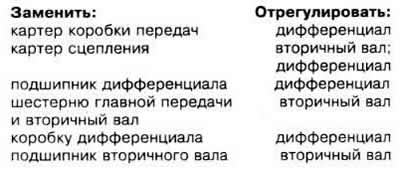
Before any of the adjustments mentioned are carried out, we must once again draw attention to the fact that special tools are required. Never attempt to carry out adjustments without special tools. The operations described below must be carried out only with special tools.
Secondary shaft adjustment
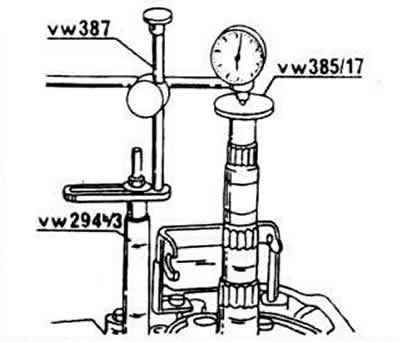
Adjusting the secondary shaft involves determining the thickness of the adjusting shim located under the outer race of the shaft's front bearing. This is the smaller of the two tapered roller bearings.
Place a 0.65mm thick compensation washer into the bearing shield and press in the outer race of the smaller bearing.
Insert the input shaft and tighten the bearing cover screws to 40 Nm.
Mount the tools and set the dial indicator to "O" by pre-tensioning it by 1 mm.
Move the shaft up and down and look at the dial indicator; it can be, for example, equal to 0.3 mm. During the measurement itself, the primary shaft must not be turned.
The bearing preload according to the instructions will be achieved by adding 0.2 mm to the dial indicator reading. An example of such a measurement is as follows:
The thickness of the inserted compensation washer is 0.65 mm
+ measured value - 0.30 mm
+ preload value - 0.20 mm
Compensating washer thickness: 1.15 mm
Once the measurement is complete, remove the secondary shaft again and take the outer bearing ring out of the gearbox housing. Insert a compensation washer of a thickness equal to the obtained value. Press in the bearing ring. Mount the secondary shaft and bearing cap. Compensation washers of different thicknesses are available (total of 16 sizes from 0.65 to 1.40 mm with a step of 0.05 mm).
Differential adjustment
Press the outer race of the differential bearing towards the flat bevel gear, placing a 1 mm adjusting washer under the race. For subsequent adjustments, we will designate this washer as S2. Now we will talk about how to find the thickness of the S1 washer, located on the other side.
Install the outer race of the differential bearing into the gearbox housing on the side of the flat bevel gear where the compensation washer is missing. Insert the differential case into the bearing housing.
Fit the gearbox housing with a new seal and tighten the five screws to a torque of 20 Nm.
Install the dial indicator together with the holder. Place the VW 385/17 measuring disc on the upper end of the primary flange shaft.
Set the dial indicator to "0" by pre-tensioning it by 1 mm.
Move the differential up and down and look at the dial indicator; it should be, for example, equal to 0.9 mm. Do not turn the differential during the measurement itself.
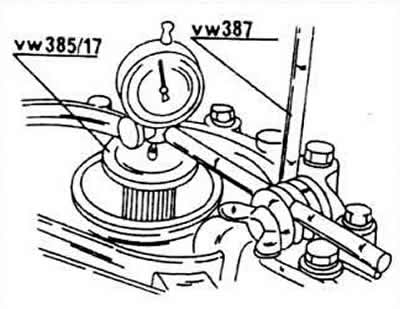
To obtain the bearing preload according to the instructions, you need to add 0.4 mm to the dial indicator reading. An example of measurement looks like this:
The reading obtained is 0.90 mm + preload is 0.40 mm
Thickness of washer S1 - 1.30 mm
Remove the gearbox housing again and knock out the bearing ring. Insert the necessary compensation washers and hammer the bearing ring back in. Always insert the thickest washer first (if possible, a 1mm thick washer). Washers of various thicknesses are available (only six sizes), therefore, any combination of washers can be created.
According to the instructions, now you need to measure the torque of the differential. To do this, attach a torque wrench to the shaft and turn the shaft. For new bearings, the wrench reading should be 50-150 Ncm; for used bearings, at least 30 Ncm.
Visitor comments