



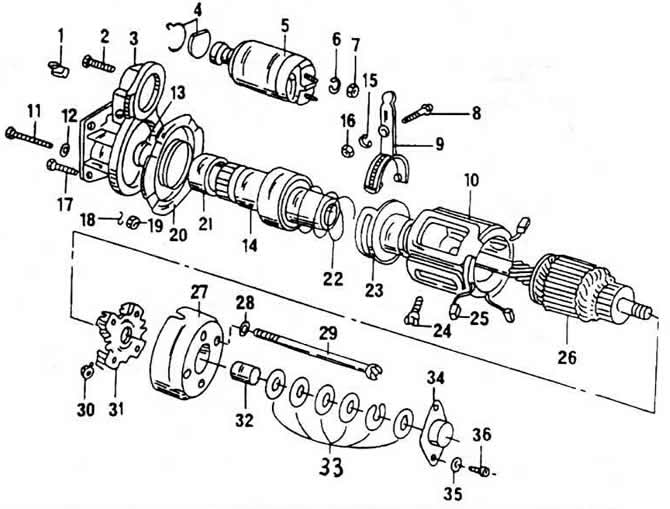
1 - starter bushing
2 - screw for starter
3 - drive bearing shield
4 - small parts
5 - switch with solenoid drive
6 - spring washer
7 - nut, 8 Nm
8 - screw
9 - single track lever
10-pole coils
11 - screw, M10
12 - lining washer
13 - thrust ring
14 - starter drive
15 - spring washer
16 - nut, M6
From the front of the solenoid operated switch, remove the screws and disengage the single track lever to remove the switch.
From the back of the starter, unscrew and remove the cap.
Remove the manifold bearing cover screws.
Press out the locking clip located at the end of the armature shaft (screwdriver), remove the small parts and remove the cover from the starter. If necessary, press out with a screwdriver. Save the washers.
Remove both carbon brushes from their mounting devices and remove the brush crossbars.
Pull down the starter housing together with the pole coils.
Remove the bearing bolt and take out the lever.
Remove the seal from the bearing shield, paying attention to the location of the seal.
The pole coil brushes are soldered to the coil windings and can only be replaced together with the entire coil. In the event of this operation, the following work must be performed.
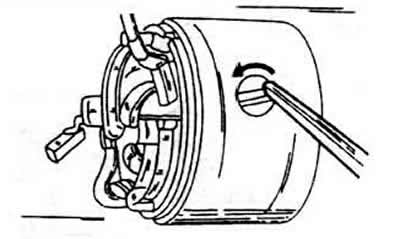
Remove the four pole piece screws by using a brass drift to pry them loose.
Remove the pole piece and remove the pole coils together with the brushes from the pole pieces.
The original text is available on the website (VWmanual)
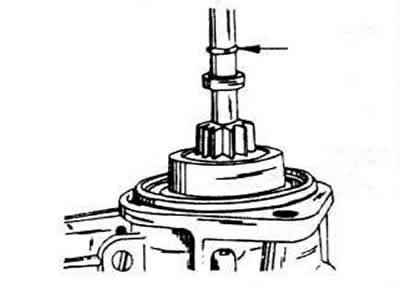
Using a piece of pipe of the appropriate diameter, tap down on the thrust ring to release the snap ring (arrow).
Pull the snap ring out of the groove in the armature shaft.
Remove burrs from the end of the armature shaft.
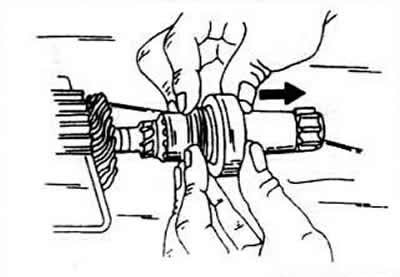
Clamp the anchor in a vice and remove the drive gear downwards from the anchor shaft.
Clean and check all parts (except for pole coils in case they are used again). Check for burnt windings in the anchor, how smooth the surface of the commutator is. Using very fine sandpaper, you can sand the commutator, but if the commutator is quite worn, you should turn it on a lathe, and the diameter of the commutator should not be below a certain minimum value. A Volkswagen car repair shop can provide this necessary diameter.
The starter gear must not be disassembled; if damaged, it must be replaced.
The starter assembly is carried out in the reverse order of disassembly. It should also be taken into account that the minimum length of carbon brushes is 13 mm. In case of replacing brushes, crush the old brush with pliers and clean the end of the brush sheet (multi-wire flexible wire). Insert the lint into the new brush and fan it out on the other side.
Use pliers to press the die to the bottom side and solder on the other side.
When working with the starter, you need to pay special attention to the following.
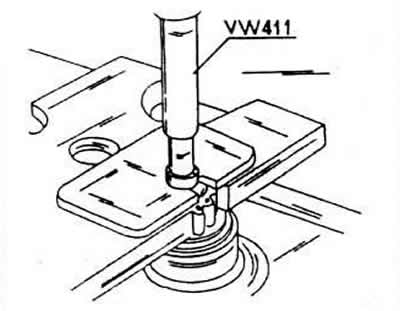
Slide the starter gear onto the shaft. Put on the thrust ring and secure it with a new retaining ring mounted on the shaft. Place the thrust ring on a support suitable for the pressing operation and press the retaining ring into the thrust ring, applying pressing force to the anchor shaft.
If you need to replace the bushing in the manifold bearing shield (it can be easily pressed out), the new bushing should be pressed in after preheating the bearing cap in hot oil for 5 minutes.
When positioning a switch with a solenoid actuator, ensure that the plunger makes perfect contact with the single-track lever.
Lubricate the connections of the starter housing with the drive bearing shield with sealing compound "D3".
The axial clearance of the anchor should be 0.1-63 mm. It can be adjusted by changing the thickness of the compensation washer located between the end of the bushing in the collector bearing cover and the C-shaped lock washer. To check, assemble the starter, check the axial clearance and adjust it if necessary.
Visitor comments