



Work programs
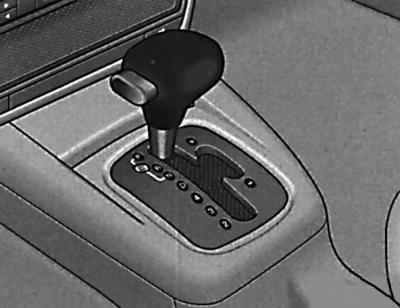
The automatic transmission control system provides for various transmission operation programs. Depending on the driver's actions or the vehicle's driving conditions, either an economical program, i.e. one aimed at saving fuel, or an active program, which can be very conditionally called "sporty", is selected.
The selection of the gearbox operating program is carried out automatically depending on the nature of the driver's work with the accelerator pedal.
In slow or normal accelerator pedal operation, earlier engagement of higher gears and later shifting to lower gears results in fuel economy.
The so-called "sport" program of the gearbox operation is selected when the accelerator pedal is controlled quite sharply. In this case, the accelerator pedal should not be pressed so vigorously, so as not to unnecessarily exceed the pressure threshold on the accelerator pedal, beyond which the forced anticipatory engagement of a lower gear, provided for in the gearbox control system, occurs. When selecting the "sport" mode, the engine power reserves are fully utilized due to a slight delay in switching to a higher gear.
Depending on the driving resistance, for example when towing a trailer or driving uphill, a program is automatically selected to provide increased traction on the drive wheels by shifting down and thus avoiding constant gear shifting.
Sequential shift mode
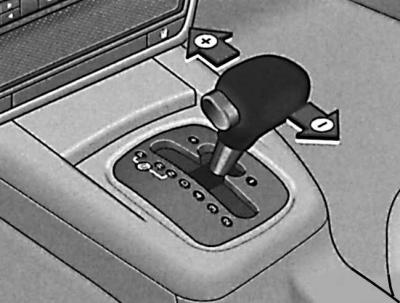
The presence of a sequential gear shift mode (tiptronic system) allows the driver to manually shift gears.
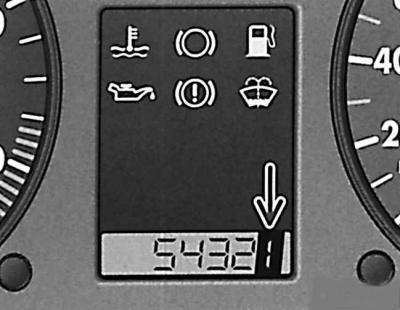
To switch to the manual shift program, move the selector from position "D" to the right. The transition can be made both when the car is stationary and when moving. When shifting gears, numbers appear on the display "5, 4, 3, 2, 1". The gear currently engaged is shown.
A slight push of the selector forward (+) engages the gears up in sequence, and a slight push backward (-) engages the gears down in sequence.
When accelerating the car, the 2nd, 3rd and 4th gears are automatically engaged shortly before the engine reaches the maximum permissible rotation speed.
If the driver shifts from a gear to a lower gear, the transmission control unit will only engage this lower gear when there is no danger of the engine over-revving.
Selector lock
The selector is locked in the "P" and "N" positions when the ignition is on. To move the selector out of these positions, you need to press the brake pedal and press the button in the selector handle. Thanks to this, there is no situation where one of the gears can be inadvertently engaged and the car will move off completely uncontrollably.
The design of the automatic transmission includes a delay device so that when changing from one position to another via the "N" position (for example, from "R" to "D"), the selector is not blocked. Thanks to this, it is possible to "rock" a stuck car. Only when the selector is in the "N" position for more than one second without pressing the brake pedal, the selector is blocked.
At speeds above 5 km/h, the selector lock in position "N" is automatically disengaged.
Visitor comments