



Warning: Remove the key from the ignition only after the vehicle has come to a complete stop! Otherwise, the steering lock may engage while driving.
Warning: To prevent the vehicle from rolling away uncontrollably, you must always apply the parking brake securely after the vehicle has come to a complete stop.
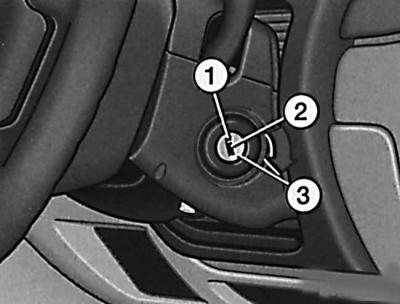
Petrol engines
1 – Ignition off/engine off.
2 – Ignition is on.
3 – Starting the engine.
Diesel engines
1 – Fuel supply is cut off/engine is off.
2 – Switching on the pre-heating and position when the vehicle is moving.
During operation of the pre-heater, no other electrical appliances - large consumers of current should be switched on. Otherwise, there will be too much load on the battery.
3 – Starting the engine.
For all vehicles:
Position 1
To lock the steering wheel, turn the steering wheel with the ignition key removed until you hear the steering lock pin click into place.
If the lights or turn signal are not switched off after the ignition key is removed, a buzzer-type sound signal will sound as soon as the driver's door is opened.
Position 2
If it is difficult or impossible to turn the ignition key to this position, you should slightly rock the steering wheel left and right - then the steering lock will be released!
Position 3
In this position, the headlights switch to parking lights and other large consumers of electrical current are turned off.
The original article is available on the website: www.VWmanual.ru
Before each new attempt to start the engine, it is necessary to return the ignition key to position 1. The starter re-engagement interlock device, located in the ignition switch, prevents the starter from engaging when the engine crankshaft is rotating, thereby protecting the starter from damage.
Key removal lock from ignition switch
On vehicles with an automatic transmission, the key can only be removed after the ignition is turned off when the selector is in the "P" position.
When the ignition key is removed, the selector is locked in this position.
Visitor comments