



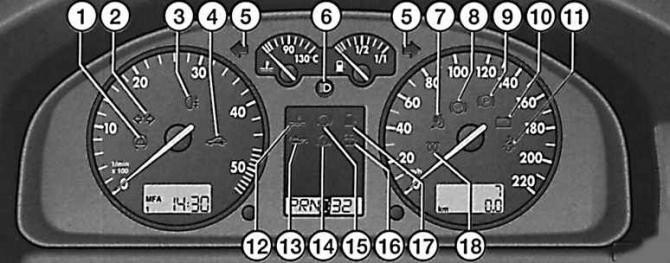
- 1 - traction control system with engine torque reduction or electronic stabilization system,
- 2 - direction indicator when driving with a trailer,
- 3 - rear fog lights,
- 4 - electronic anti-theft system,
- 5 - direction indicator,
- 6 - high beam,
- 7-inflatable airbag system,
- 8 - anti-lock braking system,
- 9 - parking brake,
- 10 - battery discharge,
- 11 - seat belts,
- 12 - coolant temperature/coolant level,
- 13 - engine oil pressure,
- 14 - brake system,
- 15 - wear of brake pad linings,
- 16 - windshield washer fluid,
- 17fuel reserve,
- 18 - pre-heater
The arrangement of the indicator lamps on the instrument cluster depends on the vehicle model and engine version. The pictograms shown in this description are located on the corresponding indicator lamps.
1 – Traction control system with engine torque reduction (ASR)

The indicator lamp comes on when the ignition is switched on and should go out after approximately 2 seconds. The lamp flashes when driving while the traction control system is in operation. When the traction control system is switched off or if there is a malfunction in it, the indicator lamp lights continuously. Since this traction control system works together with the anti-lock brake system and the traction control system with braking of the slipping wheel, if there is a malfunction in the anti-lock brake system, the ASR traction control indicator lamp also comes on.
1 – Electronic stabilization system (ESP)

The indicator lamp comes on when the ignition is switched on and should go out after approximately 2 seconds. The electronic stability control system supplements the traction control system with engine torque reduction. The lamp flashes when driving during the operation of the electronic stability control system or the traction control system with engine torque reduction. When the system is switched off or if there is a malfunction, the indicator lamp lights up continuously.
Since the electronic stabilization system works together with the anti-lock braking system and also with the traction control system with braking of the slipping wheel, if the anti-lock braking system fails, the electronic stabilization system control lamp also lights up.
2 – Direction indicator when driving with a trailer

The indicator lamp flashes together with the direction indicators on the vehicle and trailer. If one of the direction indicator lamps on the vehicle or trailer fails, the indicator lamp does not flash.
3 – Rear fog lights

After the rear fog lights are switched on, the indicator lamp comes on.
4 – Electronic anti-theft system

When the ignition is switched on, the ignition key code is automatically requested. The data comparison is confirmed by the control lamp briefly lighting up. If an unauthorized key is used, the control lamp switches to flashing with short breaks. The car cannot be used.
5 – Direction indicator

Depending on which side of the vehicle the turn signals are flashing, the left or right indicator lamp flashes simultaneously. If one of the turn signal lamps fails, the indicator lamp flashes twice as fast as usual. This does not happen when towing a trailer.
6 – High beam

The indicator lamp lights up when the high beam is on and when the headlight signal is on.
7-Inflatable airbag system

The indicator lamp lights up for approximately 3 seconds after the ignition is switched on. On vehicles with the front passenger airbag deactivated, the indicator lamp flashes for approximately 12 seconds.
If the lamp does not go out or lights up while driving, the airbag system is faulty. Such a system should be checked immediately by a Volkswagen service center.
8 – Anti-lock braking system (ABS)

The control lamp warns of a malfunction in the anti-lock braking system and in the traction control system with braking of the slipping wheel.
Anti-lock braking system (ABS)
The indicator lamp lights up after the ignition is turned on or during engine start-up for a few seconds. It goes out after the automatic system operability check is completed.
If the indicator lamp does not light up after a few seconds after the ignition is turned on, does not go out, or lights up while driving, then the anti-lock braking system is not in order.
If there is a fault in the ABS, the following may occur:
- if only one anti-lock braking system indicator lamp lights up while driving, the vehicle may still be braked by one normally functioning service brake system without the anti-lock braking system. You should contact a Volkswagen service center as soon as possible.
- if the ABS warning light comes on together with the brake warning light, this means that not only is there a fault with the ABS, but changes in the normal operation of the brake system should also be expected.
Warning: When both warning lights come on, the rear wheels may lock prematurely when braking. Contact a Volkswagen service centre immediately.
Traction control system with brake intervention of the slipping wheel (EDS)
Traction control system with braking of the slipping wheel (electronically controlled differential lock system) works together with ABS. A malfunction in the anti-skid system with braking of the slipping wheel is indicated by the ABS indicator lamp lighting up. It is necessary to contact a Volkswagen service center as soon as possible.
9 – Parking brake

When the parking brake is applied and the ignition is on, the indicator lamp lights up. It should go out when the parking brake is released.
10 – Battery discharge

The control lamp lights up when the ignition is turned on. It should go out after the engine starts. The generator is driven by a durable V-belt with ribs.
If the indicator light comes on while driving, you must stop, turn off the engine and check the condition of the V-belt with ribs.
If the belt tension is loose or broken, the vehicle cannot be driven any further – the engine cooling system pump is no longer activated. The belt condition must be checked and the belt replaced if necessary.
If the indicator lamp lights up and the engine coolant pump drive belt is not loose or broken, you can continue driving to the nearest Volkswagen service center.
Since the battery is continuously discharging, all electrical consumers that are not required to be turned on should be switched off.
11 – Seat belts

Control lamp (only on vehicles for export to certain countries) lights up after the ignition is turned on for approximately 6 seconds as a reminder to wear seat belts.
If the seat belts are not put on after the ignition is turned on, a beep sounds. It stops after the seat belts are put on or after approximately 6 seconds.
12 – Coolant temperature/coolant level

The control lamp lights up for several seconds when the ignition is turned on – checking the functionality.
[The information is presented on the website: VWmanual.ru]
If the control lamp does not go out further or lights up or starts flashing while driving, this indicates either too high a coolant temperature or too low a coolant level in the cooling system. As an additional warning, a sound signal sounds 3 times, at which point you should stop the car, turn off the engine and check the coolant level. If necessary, top up the coolant.
Warning: Never open the engine hood if you see steam or coolant leaking from the engine compartment – risk of getting burned!
Warning: Make sure that your hands are not in the fan rotation area! The fan may suddenly start rotating – even when the ignition is off!
Warning: To avoid being burned by high coolant temperatures, you should consider the following:
- be careful when opening the expansion tank cap of the cooling system! When the engine is hot, the cooling system has increased pressure. Therefore, before unscrewing the expansion tank cap, let the engine cool down;
- to protect your face and hands from steam and hot coolant, cover the radiator cap with a large enough piece of thick cloth.
Warning: Do not allow coolant to come into contact with hot exhaust system components or other hot components. The low temperature additive in the coolant may ignite.
If the coolant level is normal, the cooling system malfunction may be caused by a faulty fan. Check the fan fuse and replace it if necessary.
If the indicator lamp does not go out, although the coolant level is normal and the fan fuse is in good condition, do not continue driving - qualified assistance is required.
If the cause is a faulty fan and the coolant level is normal and the warning light is out, you can continue driving to the nearest Volkswagen service center. In order to use the oncoming air flow to cool the liquid, you should avoid idling the engine and driving at very low speeds.
13 – Engine oil pressure

The indicator lamp lights up for a few seconds when the ignition is turned on to check the functionality.
If the indicator lamp does not go out, an additional warning signal sounds 3 times. The engine must not be started! The engine oil level should be checked and oil added if necessary.
If the control lamp lights up or flashes while driving, and the engine speed exceeds 1500 rpm, an additional warning is given by the buzzer 3 times. Stop and switch off the engine! Check the oil level and top up if necessary.
If the warning light is flashing despite the engine oil level being normal, you should not continue driving. The engine should also not idle.
The oil pressure warning light is not a means of monitoring the engine oil level! Therefore, the oil level should be checked regularly, preferably at each refueling.
14 – Brake system

The indicator lamp lights up when the brake fluid level is too low.
The ignition must be on.
On vehicles with an anti-lock braking system (ABS), the indicator lamp lights up for a few seconds after the ignition is turned on or the engine is started. If the ABS fails, the brake system indicator lamp lights up together with the ABS indicator lamp.
Warning: If the warning lamp does not go out after starting the engine or lights up while driving, this indicates that the brake fluid level in the reservoir is too low. You should immediately find the nearest Volkswagen service center and check the service brake system.
On the way there, you need to be prepared to press the brake pedal harder when braking, to increase the braking distance and to have increased free play of the brake pedal.
If the brake system indicator light comes on together with the anti-lock brake system indicator light, the rear wheels may lock prematurely when braking.
15 – Brake pad wear indicator

You should contact a Volkswagen service center to check the condition of the brake pads.
Since the brake pad wear indicator only indicates significant wear on the front brake pads, we recommend that you check the condition of the rear brake pads at the same time as replacing the front brake pads.
16 – Windscreen washer fluid level

The indicator lamp comes on when the windshield washer fluid level in the reservoir is too low.
17 – Fuel reserve

The indicator lamp comes on when the fuel level drops to approximately 8 liters.
18 – Pre-heater (for diesel vehicles only)

When the engine is cold, the indicator lamp comes on when the drive position is engaged ("Ignition on").
If the control lamp does not light up, then there is a malfunction in the pre-heater.
After the indicator light goes out, you should start the engine immediately.
When the engine is warmed up to operating temperature, the control lamp does not light up – you can start the engine immediately.
Warning: If, while driving a vehicle equipped with a diesel engine, there are any irregularities in the engine operation, indicated by a flashing control lamp, the engine must be checked immediately by a Volkswagen service centre.
Visitor comments