



Warning: When checking the injection start pressure, take measures to protect your hands from the high-pressure fuel jet, which may cause serious injury.
Attach the injector to a device with a pressure gauge for checking the injection pressure. Using the device pump handle, create fuel pressure and check the injection start value. If the test result does not fit within the required limits, achieve the required value by selecting the thickness of the adjusting washers. With an increase in the thickness of the washers, the injection start pressure increases, and vice versa.
Note: A change in the thickness of the washers by 0.5 mm corresponds to a change in pressure of 5 kgf/cm².
Checking the fuel spray cone of the injectors
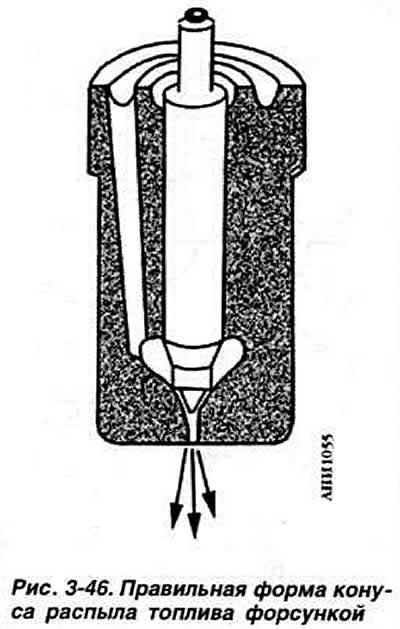
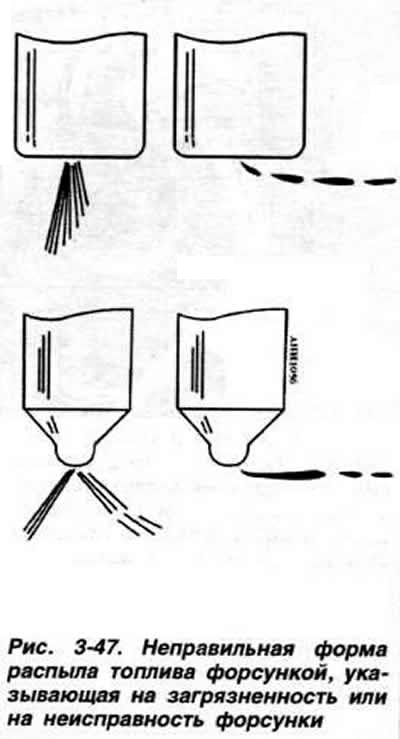
Attach the injector to a device with a pressure gauge to check the injection pressure. Position the injector over a container of suitable size and, using the pump handle of the device, create fuel injection pressure. Check the fuel spray cone of the injector, which should correspond to the shape shown in Fig. 3-46. If the fuel spray occurs at an angle, with breaks or a forked cone (Fig. 3-47), this indicates that the injector is dirty or faulty. Clean the injector or replace it.
Checking the tightness of the injectors
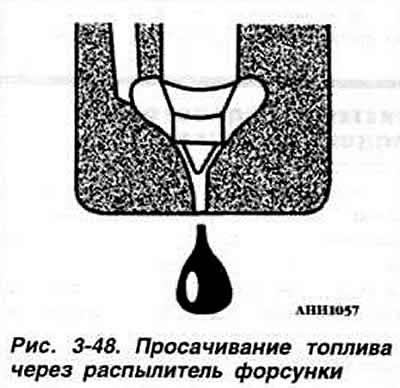
Attach the injector to a device with a pressure gauge to check the injection pressure. Slowly move the handle of the pump device downwards to create a pressure of about 110 kgf/cm² on the pressure gauge and, holding the handle in the lower position for 10 s, make sure that there is no fuel leakage through the injector atomizer. Fuel leakage through the injector atomizer (Fig. 3-48) can be easily detected by placing a sheet of blotting paper under the atomizer. If fuel leakage occurs on a cleaned and washed in kerosene atomizer and injector needle valve, replace the injector.
The information is posted on this website (VWManual.ru)
Visitor comments