



The engine has a second oil pressure switch connected to the warning signal. If the oil pressure drops below 0.3 bar, the 0.3 bar oil pressure switch closes and the low oil pressure warning lamp in the engine lubrication system lights up. If the oil pressure drops below 0.2 bar and the engine speed remains at 2000 min⁻¹ for more than a second, the 0.9 bar oil pressure switch is triggered. The low oil pressure warning lamp in the engine lubrication system lights up and an audible signal sounds. The 0.3 bar oil pressure switch is located in the cylinder block and has brown insulation; the 0.9 bar oil pressure switch is located at the top of the filter base.
When checking, both switches should be checked, but it is only possible to determine whether these switches work at all or not. Checking the operation of both oil pressure switches is carried out at the service station.
- check and adjust the oil level if necessary;
- turn on the ignition. The oil pressure warning light should flash,
- start the engine, the oil pressure warning light should go out;
- disconnect the cable from the 0.3 bar [30 kPa] oil pressure switch (oil pressure switch with brown insulation) and attach the end of the cable to the "ground". The oil pressure indicator light should light up;
- install the plug connector;
- disconnect the plug connector from the 0.9 bar [90 kPa] oil pressure switch (oil pressure switch with white insulation).
- run the engine for more than 1 second at a speed greater than 2000 min⁻¹. The oil pressure warning light should come on and the buzzer should sound.
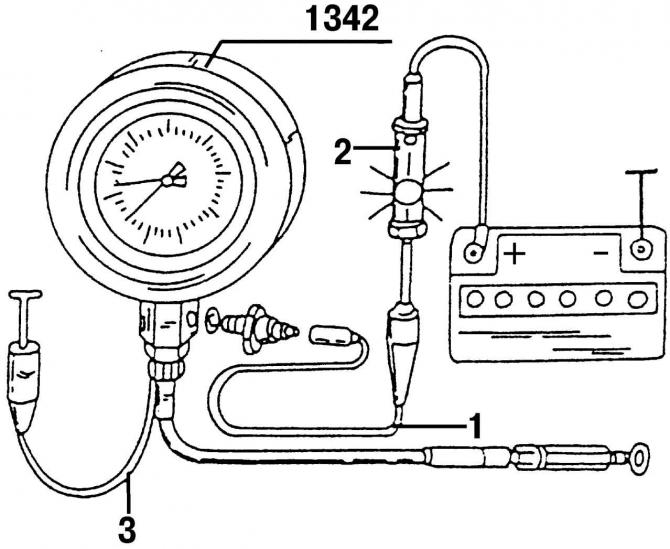
Fig. 458. Checking the oil pressure with a pressure gauge: 1 - blue wire; 2 - control lamp; 3 - brown wire
The described operations for checking the oil pressure switches allow you to establish that the oil pressure switches are in good condition and working well. To check the oil pressure, use the recommended Volkswagen pressure gauge 1342. The procedure for using this or a similar device is shown in Fig. 458:
- disconnect the oil pressure switch at 0.9 bar [90 kPa] (with white insulation) and install a pressure gauge;
- attach a pressure gauge instead of the oil pressure switch to the base of the filter;
- disconnect the brown wire from the 0.9 bar [90 kPa] oil pressure switch and connect the blue wire 1;
- connect test lamp 2 to cable 1 and to the "+" terminal of the battery;
- connect brown cable 3 of the pressure gauge to ground;
- turn on the ignition;
- start the engine. As soon as the pressure gauge shows a pressure of 0.15-0.45 bar [15-45 kPa], the control lamp should go out. Otherwise, replace the oil pressure switch with a new one.
Procedure for checking the oil pressure switch at 0.9 bar [90 kPa]:
- disconnect wire 1 (Fig. 458) from the 0.3 bar [30 kPa] oil pressure switch and connect it to the 0.9 bar [90 kPa] oil pressure switch (oil pressure switch with white insulation).
- start the engine and gradually increase the engine speed. If the indicator lamp does not light at a pressure of at least 0.75-1.05 bar [75-105 kPa], replace the oil pressure switch;
- increase engine speed to 2000 min⁻¹ — the pressure should be at least 2.0 bar [200 kPa]. Replace or repair the oil pump if the oil pressure is less than or falls below 0.2 bar [20 kPa].
Engine oil change
Oil change is carried out in the same way as oil change in gasoline engines.
Visitor comments