
English Русский
Български
Беларускі
Український
Српски
Hrvatski
Română
Polski
Slovenský
Magyar
  |  Articles  |  Sitemap  |  Contacts  |    |
Car maintenance Ford Car maintenance Hyundai Car maintenance Chevrolet Car maintenance BMW Car maintenance Audi Car maintenance Opel Car maintenance AvtoVAZ
VWmanual.ru


Main   Passat   Golf   Polo   Touareg   Tiguan   Sharan   Transporter   Others  
Passat B2 (1981-1988) Passat B3 (1988-1993) Passat B4 (1988-1996) Passat B5 (1996-2005) Passat B6 (2005-2010)

Self-diagnosis system (VW Passat B4)

  • Main
  • Passat
  • Passat B4
  • 16-valve engine
  • Control system «KE-Motronic»
  • Self-diagnosis system
            0


Contents: Injection system fault memory…↓ Clearing information in the fault…↓ Checking electrical circuits ↓ Timing advance control subsystem ↓
The operating principle of the self-diagnostic system and the method of coding faults are the same as in the diagnostic system used for the fuel injection system "Mono-Jetronic". Only the operations of interrogating the diagnostic system memory device are described below

Injection system fault memory interrogation


This operation can be performed using an LED tester.

In this case, the following order of operations must be strictly observed:
  • interrogate storage device;
  • eliminate the detected malfunction:
  • erase the information in the storage device, since the next survey can only be done after first eliminating the detected malfunction and erasing its code in the storage device;
  • make the following poll of the storage device;
  • if the fault is not detected, take the vehicle for a test drive for at least 10 minutes and interrogate the memory device again.

The injection system fault memory is interrogated as follows.

Slide the gearshift boot up to access the diagnostic connector terminals. Connect the LED tester wires to the black and blue terminal wires located at the top of the connector. Connect the two test wires to the black and brown (or white) terminals located at the bottom of the diagnostic connector, without connecting these wires to each other. Turn on the ignition. Connect the free ends of the test wires for 4 s, then disconnect them. The LED of the tester should blink. Determine the fault code by the number of blinks of the control lamp (table 2-32).
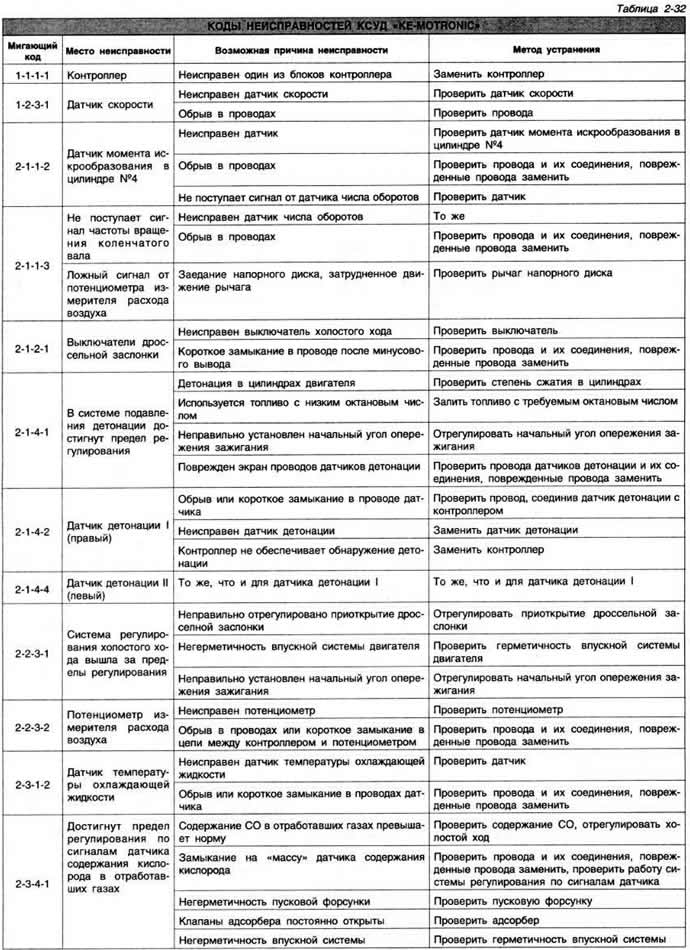
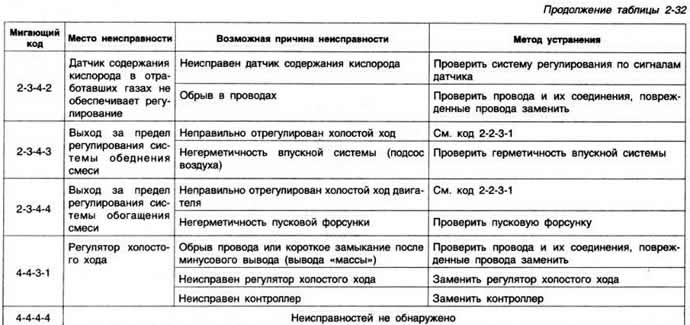

Slide the gearshift boot up to access the diagnostic connector terminals. Connect the LED tester…

Slide the gearshift boot up to access the diagnostic connector terminals. Connect the LED tester…

Clearing information in the fault memory


Connect the free ends of the test wires connected to the lower terminals of the diagnostic connector, then disconnect them. The control LED should light up.

Connect the test leads again for 4 seconds. The test lead LED should show the code "4-4-4-4". This indicates that the previous fault code has been cleared.

Checking electrical circuits


To check the electrical circuits of the KSUD, disconnect the controller connector and use a tester to measure the resistance and voltage values at the terminals of the controller socket. If these values deviate from the norm, first check the corresponding electrical circuit, and then the KSUD element.
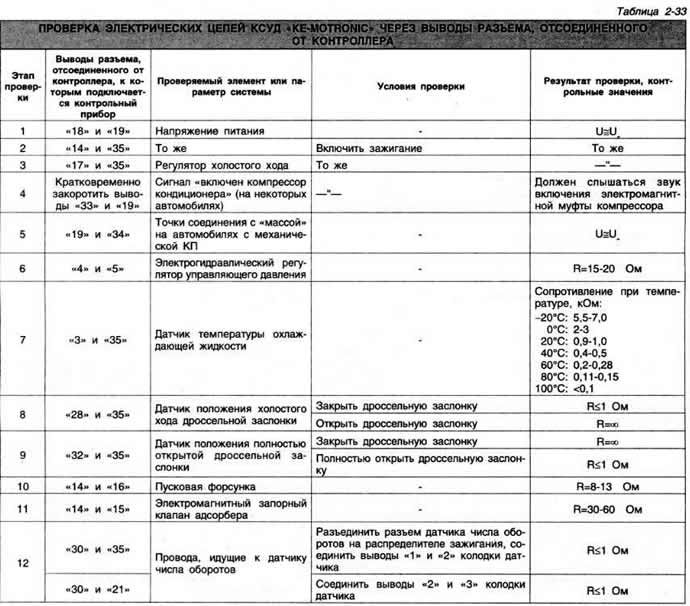
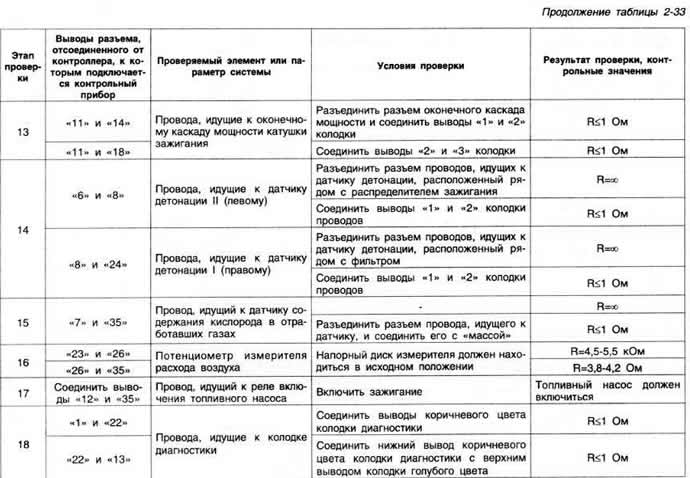
To check the electrical circuits of the KSUD, disconnect the controller connector and use a tester…

To check the electrical circuits of the KSUD, disconnect the controller connector and use a tester…


Timing advance control subsystem


The ignition timing control subsystem KSUD is a fully electronic ignition system. The controller calculates the optimal ignition timing angle depending on the engine operating conditions (speed, engine load and battery voltage). The ignition advance angle control subsystem generates the corresponding control pulses to interrupt and resume the flow of current in the primary winding of the ignition coil.

The high-voltage current induced in the secondary winding of the ignition coil during the break of the primary winding circuit is supplied through the distributor to the spark plugs. The distributor only performs the function of distributing the high-voltage current to the spark plugs; the Hall sensor built into it supplies the controller with information about the engine speed. The ignition timing control subsystem includes:
  • controller.
  • ignition distributor with built-in Hall sensor;
  • spark timing sensor in cylinder #4;
  • two knock sensors;
  • ignition unit;
  • spark plugs.

The ignition distributor with a built-in Hall sensor is driven by the intake camshaft. Brand and catalog number:
  • cars produced before March 1990: Bosch 051 905 205A;
  • cars produced since April 1990: Bosch 051 905 205B.

The original can be viewed on the portal: www.VWManual.ru

Setting ignition timing angle before TDC at idle: 5-7°,

Resistance of the primary winding of the ignition coil at 20UC 0.6-0.8 Ohm. Resistance of the secondary winding at 20°C 6.5-8.5 kOhm.

Brand and type of spark plugs: Bosch F6 DTC; Champion C6 BYC; Vegi 14F 6DTU. The gap between the electrodes is 0.7-0.9 mm.

This article is available at russian, bulgarian, belarusian, ukrainian, serbian, croatian, romanian, polish, slovak, hungarian
The text has been checked: Kolesnikov Artem

Share information:

Previous articles
Checking the fuel pressure in the system
Checking the electromagnetic shut-off valve of the adsorber
Checking for fuel cut-off at forced idle
Checking the mixture enrichment
Checking the supply voltage of the heating element of the oxygen sensor in the exhaust gases
Checking the idle speed control valve
Next articles
Checking and adjusting the subsystem
Fuel system of the engine «9A»
Wiring diagram of the KE-Motronic control system for the 9A engine
Adjustment of the fuel injection control subsystem KSUD «Motronic» of the engine «AAA»
Possible malfunctions of the fuel injection control subsystem KSUD «Motronic» of the engine «AAA»


Similar articles from other manuals for VW cars:
Cooling system data Golf 1 (1974-1984, petrol)
Self-diagnosis of the injection system Polo 3 (1995-2003)
Emergency alarm system Touareg 1 (2002-2006)
Removal and installation of lubrication system elements Tiguan 1 (2007-2015)
Checking the operation of the lighting system Sharan 1 (1995-2000)
Headlight Wash System Transporter T4 (1990-2003)
ESP stabilization system and ASR traction control system Caddy 3 (2003-2010)
Link to this page in different formats


Visitor comments


No comments yet


How much will 35 + 30 =


Passat B6 
  • General information
  • User manual
  • Maintenance
  • Petrol engine 1.6L
  • Engine repair
  • Cooling and lubrication system
  • Fuel injection system
  • Petrol engine 2.0L
  • Engine repair
  • Lubrication system
  • Cooling system
  • Fuel and exhaust systems
  • Diesel engine 2.0L
  • Engine repair
  • Cooling and lubrication system
  • Fuel and exhaust systems
  • Transmission
  • Clutch
  • Mechanical gearbox
  • Automatic gearbox
  • Drive shafts
  • Chassis
  • Wheels and tires
  • Car suspension
  • Steering
  • Brake system
  • Body
  • Exterior (external elements)
  • Electrical equipment
  • Power devices
  • Lighting and appliances
  • Electrical circuits
Passat B5 
  • General information
  • User manual
  • Weekly checks
  • Maintenance
  • Power unit
  • Engine repair
  • Cooling system
  • Fuel system (petrol)
  • Fuel system (diesel)
  • Engine management
  • Exhaust system
  • Transmission
  • Clutch
  • Car gearbox
  • Drive shafts
  • Chassis
  • Car suspension
  • Wheels and tires
  • Steering
  • Brake system
  • Body
  • Exterior (external elements)
  • Interior (internal elements)
  • Doors and covers
  • Ventilation and heating
  • Electrical equipment
  • Power devices
  • Lighting and appliances
  • Electrical circuits
Passat B4 
  • General information
  • User manual
  • Maintenance
  • Technical data
  • 8-valve engine
  • Engine repair
  • Cooling and lubrication system
  • Supply system
  • Ignition system
  • Fuel injection «Mono-Jetronic»
  • Control system «Mono-Motronic»
  • Control system «Digifant»
  • Control system «Simos»
  • 16-valve engine
  • Engine repair
  • Cooling and lubrication system
  • Fuel injection «K-Jetronic»
  • Control system «KE-Motronic»
  • Control system «Digifant»
  • Diesel engine
  • Engine repair
  • Cooling and lubrication system
  • Power and control system
  • Turbocharging system
  • Digital control system
  • Transmission
  • Clutch
  • Manual gearbox
  • Hydromechanical gearbox
  • Front wheel drive
  • Chassis
  • Car suspension
  • Steering
  • Brake system
  • Body
  • Body elements
  • Electrical equipment
  • Power devices
  • Lighting and appliances
  • Electrical circuits
Passat B3 
  • General information
  • User manual
  • Driving Tips
  • Maintenance instructions
  • Technical data
  • Power unit
  • Engine repair
  • Ignition system
  • Lubrication system
  • Cooling system
  • Supply system
  • Petrol injection system
  • Diesel engine
  • Exhaust system
  • Transmission
  • Clutch
  • Car gearbox
  • Chassis
  • Suspension
  • Steering
  • Brake system
  • Wheels and tires
  • Body
  • Exterior
  • Interior
  • Heating system
  • Electrical equipment
  • Power devices
  • Lighting system
  • Equipment and devices
  • Wiper system
  • Electrical circuits
Passat B2 
  • General information
  • Introduction to instructions
  • User manual
  • Power unit
  • Engines 4-cylinder FZ
  • Engines 4-cylinder
  • Engines 5-cylinder
  • Transmission
  • Clutch
  • Four-speed gearbox
  • Five-speed gearbox
  • Hydromechanical gearbox
  • Front wheel drive
  • Chassis
  • Front suspension
  • Rear suspension
  • Steering
  • Brake system
  • Body
  • Body elements
  • Electrical equipment
  • Equipment and devices
  • Electrical circuits
VWmanual.ru © 2016-2026 | Mobile version | News and articles | Sitemap: EN BG BY UA RS HR RO PL SK HU | Write message | Site search
Passat B2 • Passat B3 • Passat B4 • Passat B5 • Passat B6 • Golf 1, diesel • Golf 1, petrol • Golf 2, petrol • Golf 2 • Golf 3 • Golf 4 • Golf 5 • Polo 3 • Polo 4 • Touareg 1 • Tiguan 1 • Sharan 1 • Transporter T3 • Transporter T4 • LT 28 • LT 2D • Beetle • Caddy 3 •
Our website uses cookies to ensure functionality and convenience.