
English Русский
Български
Беларускі
Український
Српски
Hrvatski
Română
Polski
Slovenský
Magyar
  |  Articles  |  Sitemap  |  Contacts  |    |
Car maintenance Ford Car maintenance Hyundai Car maintenance Chevrolet Car maintenance BMW Car maintenance Audi Car maintenance Opel Car maintenance AvtoVAZ
VWmanual.ru


Main   Passat   Golf   Polo   Touareg   Tiguan   Sharan   Transporter   Others  
Passat B2 (1981-1988) Passat B3 (1988-1993) Passat B4 (1988-1996) Passat B5 (1996-2005) Passat B6 (2005-2010)

Adjustment of the fuel injection control subsystem KSUD «Motronic» of the engine «AAA» (VW Passat B4)

  • Main
  • Passat
  • Passat B4
  • 16-valve engine
  • Control system «KE-Motronic»
  • Adjustment of the fuel injection control subsystem KSUD «Motronic» of the engine «AAA»
            0


Contents: Checking the fuel pressure in the…↓ Checking the throttle position sensor ↓ Checking the coolant temperature…↓ Checking the intake air temperature…↓ Checking the resistance of the…↓ Checking the idle speed control valve ↓ Checking and adjusting the throttle…↓ Self-diagnosis ↓
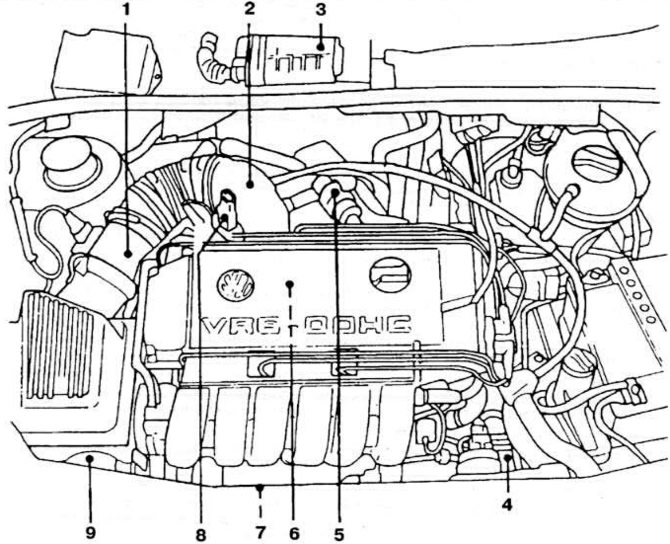
Fig. 15. Placement of elements of the fuel injection control subsystem KSUD «Motronic» on the…

Fig. 15. Placement of elements of the fuel injection control subsystem KSUD "Motronic" on the vehicle "Passat 2,8 VR6": 1 - mass air flow meter; 2 — throttle body; 3 — controller; 4 — intake air temperature sensor; 5 - idle speed controller; 6 — nozzle; 7 - exhaust gas oxygen sensor; 8 — throttle position sensor; 9 — electromagnetic valve of the adsorber.


Before checking the engine idle speed, perform the following operations:
  • warm up the engine to an oil temperature of at least 80°C;
  • check the correct adjustment of the gap between the spark plug electrodes and the ignition timing;
  • make sure the air filter element is in good condition;
  • turn off all auxiliary electrical equipment and air conditioning;
  • make sure the exhaust system is tight.

Connect the control tachometer according to the operating instructions, start the engine and check the crankshaft speed at idle, which should be within 650-750 rpm.


The crankshaft speed at idle is automatically regulated by the idle speed regulator based on signals from the controller and cannot be adjusted manually.

Connect the gas analyzer according to the operating instructions and check the CO content in the exhaust gases, which should be within 0.3-1.2%.

The CO content in the exhaust gases is regulated automatically by the controller based on signals from the oxygen content sensor in the exhaust gases and is not subject to manual adjustment.

NOTE: The throttle opening is set at the factory and cannot be adjusted during operation.


Checking the fuel pressure in the system


Self-diagnosis code: 2-4-1-3.

Turn off the ignition.

Connect the pressure gauge to the system's measuring pipe (Fig. 12).
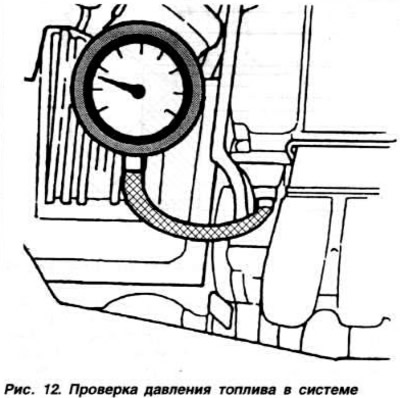
Connect the pressure gauge to the system's measuring pipe (Fig. 12).


Start the engine at idle speed and check the regulated fuel pressure, which should be about 3.5 kgf/cm². Disconnect the vacuum hose from the fuel pressure regulator and check the fuel pressure in the system using a pressure gauge, which should be about 4.0 kgf/cm².

Connect a vacuum hose to the fuel pressure regulator. Turn off the ignition and after 10 minutes check the residual fuel pressure, which should be at least 2.5 kgf/cm².


Checking the throttle position sensor


Self-diagnosis code: 2-2-1-2.

Turn off the ignition.

Disconnect the throttle position sensor connector, connect an ohmmeter to terminals "1" and "2" of the sensor block (Fig. 13) and check the ohmmeter readings, which should be within 1.13-1.15 kOhm.
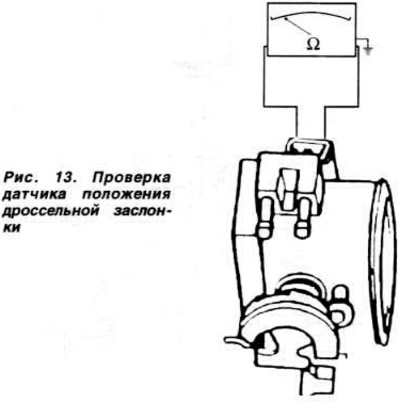
Disconnect the throttle position sensor connector, connect an ohmmeter to terminals «1» and «2» of…


Slowly open the throttle valve. The resistance on the ohmmeter should increase smoothly.

Connect an ohmmeter to terminals "2" and "3" of the sensor block and check its readings, which should be within 2.68-2.72 kOhm.

Slowly open the throttle valve. The resistance on the ohmmeter should decrease smoothly.

Connect an ohmmeter to terminals "1" and "3" of the sensor block and check its readings, which should be within 1.98-2.02 kOhm.

Checking the coolant temperature sensor


Self-diagnosis code: 2-3-1-2.

Turn off the ignition.

Disconnect the blue connector from the coolant temperature sensor.

Remove the sensor from the engine and immerse it in a container with coolant.

Connect an ohmmeter to the sensor terminals (Fig. 14) and check the sensor resistance, which at a coolant temperature of 20°C should be 2.5 kOhm; at 40°C - 1.25; at 60°C - 0.6 and at 80°C - 0.325 kOhm.
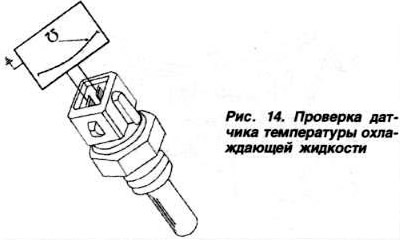
Connect an ohmmeter to the sensor terminals (Fig. 14) and check the sensor resistance, which at a…


The coolant temperature sensor can be checked without removing it from the engine.

Checking the intake air temperature sensor


Turn off the ignition.

Disconnect the intake air temperature sensor connector and connect an ohmmeter to the sensor terminals (Fig. 16). Measure the sensor resistance, which at an ambient air temperature of 10°C should be 3.5 kOhm; at 20°C - 2.5; at 40°C - 1.25; at 60°C - 0.6 and at 80°C - 0.325 kOhm.
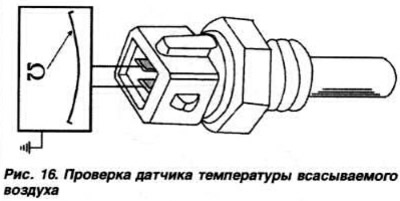
Disconnect the intake air temperature sensor connector and connect an ohmmeter to the sensor…


Checking the resistance of the injector windings


Turn off the ignition.

Disconnect the injector connector, connect an ohmmeter to its terminals (Fig. 17) and check its readings, which should be within 15.0-21.4 Ohms.
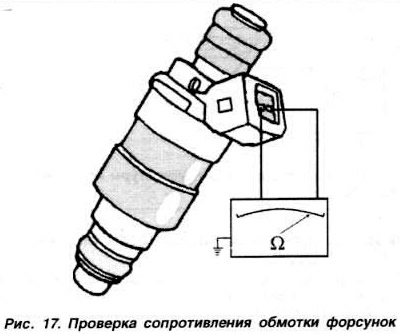
Disconnect the injector connector, connect an ohmmeter to its terminals (Fig. 17) and check its…


Checking the idle speed control valve


Turn off the ignition.

Disconnect the idle speed control connector, connect an ohmmeter to its terminals (Fig. 18) and check its readings, which should be within 10-20 Ohms.
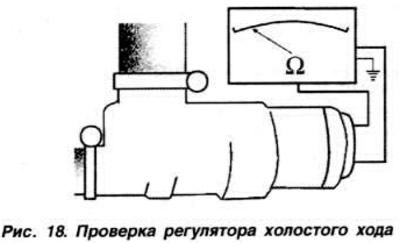
Disconnect the idle speed control connector, connect an ohmmeter to its terminals (Fig. 18) and…


Checking and adjusting the throttle damper


Open the throttle valve, then close it until pusher 2 (Fig. 19) touches roller 3.
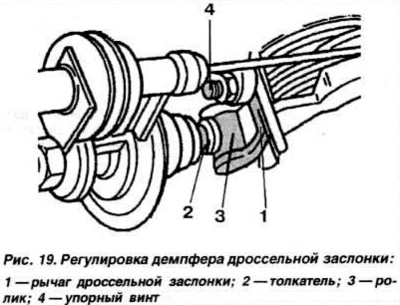
Open the throttle valve, then close it until pusher 2 (Fig. 19) touches roller 3.


In this position, using a 3 mm diameter drill, check the gap between stop screw 4 and lever 1.

If it is necessary to adjust the clearance, clamp the drill between the screw and the roller, loosen the lock nut of the stop screw and adjust the position of the damper so that the pusher 2 only slightly touches the roller 3.

Tighten the stop screw lock nut.

Self-diagnosis


Self-diagnosis of the system is performed as specified in the subsection "Self-diagnosis" for KSUD "KE-Motronic", described in the section "16-valve engines", using a controller, in the memory device of which fault codes are written. read using the appropriate equipment Before proceeding with the ROM interrogation. make sure that fuses No.18 and No.21 are intact.

This article is available at russian, bulgarian, belarusian, ukrainian, serbian, croatian, romanian, polish, slovak, hungarian
The text has been checked: Kolesnikov Artem

Share information:

Previous articles
Wiring diagram of the KE-Motronic control system for the 9A engine
Fuel system of the engine «9A»
Checking and adjusting the subsystem
Self-diagnosis system
Checking the fuel pressure in the system
Checking the electromagnetic shut-off valve of the adsorber
Next articles
Possible malfunctions of the fuel injection control subsystem KSUD «Motronic» of the engine «AAA»


Similar articles from other manuals for VW cars:
Starter, alternator, battery, ignition system and system that… Golf 2 (1984-1993, petrol)
Mono-Motronic fuel injection and ignition control system Polo 3 (1995-2003)
Removal and installation of the engine control unit (petrol… Touareg 1 (2002-2006)
Diesel engine fuel injection system Tiguan 1 (2007-2015)
Fuel injection system of the VR6 engine Sharan 1 (1995-2000)
Digifant fuel injection control unit, self-diagnostic unit Transporter T4 (1990-2003)
Fuel injection and ignition control system for the AGL engine… LT 2D (1996-2003)
Link to this page in different formats


Visitor comments


No comments yet


How much will 21 + 14 =


Passat B6 
  • General information
  • User manual
  • Maintenance
  • Petrol engine 1.6L
  • Engine repair
  • Cooling and lubrication system
  • Fuel injection system
  • Petrol engine 2.0L
  • Engine repair
  • Lubrication system
  • Cooling system
  • Fuel and exhaust systems
  • Diesel engine 2.0L
  • Engine repair
  • Cooling and lubrication system
  • Fuel and exhaust systems
  • Transmission
  • Clutch
  • Mechanical gearbox
  • Automatic gearbox
  • Drive shafts
  • Chassis
  • Wheels and tires
  • Car suspension
  • Steering
  • Brake system
  • Body
  • Exterior (external elements)
  • Electrical equipment
  • Power devices
  • Lighting and appliances
  • Electrical circuits
Passat B5 
  • General information
  • User manual
  • Weekly checks
  • Maintenance
  • Power unit
  • Engine repair
  • Cooling system
  • Fuel system (petrol)
  • Fuel system (diesel)
  • Engine management
  • Exhaust system
  • Transmission
  • Clutch
  • Car gearbox
  • Drive shafts
  • Chassis
  • Car suspension
  • Wheels and tires
  • Steering
  • Brake system
  • Body
  • Exterior (external elements)
  • Interior (internal elements)
  • Doors and covers
  • Ventilation and heating
  • Electrical equipment
  • Power devices
  • Lighting and appliances
  • Electrical circuits
Passat B4 
  • General information
  • User manual
  • Maintenance
  • Technical data
  • 8-valve engine
  • Engine repair
  • Cooling and lubrication system
  • Supply system
  • Ignition system
  • Fuel injection «Mono-Jetronic»
  • Control system «Mono-Motronic»
  • Control system «Digifant»
  • Control system «Simos»
  • 16-valve engine
  • Engine repair
  • Cooling and lubrication system
  • Fuel injection «K-Jetronic»
  • Control system «KE-Motronic»
  • Control system «Digifant»
  • Diesel engine
  • Engine repair
  • Cooling and lubrication system
  • Power and control system
  • Turbocharging system
  • Digital control system
  • Transmission
  • Clutch
  • Manual gearbox
  • Hydromechanical gearbox
  • Front wheel drive
  • Chassis
  • Car suspension
  • Steering
  • Brake system
  • Body
  • Body elements
  • Electrical equipment
  • Power devices
  • Lighting and appliances
  • Electrical circuits
Passat B3 
  • General information
  • User manual
  • Driving Tips
  • Maintenance instructions
  • Technical data
  • Power unit
  • Engine repair
  • Ignition system
  • Lubrication system
  • Cooling system
  • Supply system
  • Petrol injection system
  • Diesel engine
  • Exhaust system
  • Transmission
  • Clutch
  • Car gearbox
  • Chassis
  • Suspension
  • Steering
  • Brake system
  • Wheels and tires
  • Body
  • Exterior
  • Interior
  • Heating system
  • Electrical equipment
  • Power devices
  • Lighting system
  • Equipment and devices
  • Wiper system
  • Electrical circuits
Passat B2 
  • General information
  • Introduction to instructions
  • User manual
  • Power unit
  • Engines 4-cylinder FZ
  • Engines 4-cylinder
  • Engines 5-cylinder
  • Transmission
  • Clutch
  • Four-speed gearbox
  • Five-speed gearbox
  • Hydromechanical gearbox
  • Front wheel drive
  • Chassis
  • Front suspension
  • Rear suspension
  • Steering
  • Brake system
  • Body
  • Body elements
  • Electrical equipment
  • Equipment and devices
  • Electrical circuits
VWmanual.ru © 2016-2026 | Mobile version | News and articles | Sitemap: EN BG BY UA RS HR RO PL SK HU | Write message | Site search
Passat B2 • Passat B3 • Passat B4 • Passat B5 • Passat B6 • Golf 1, diesel • Golf 1, petrol • Golf 2, petrol • Golf 2 • Golf 3 • Golf 4 • Golf 5 • Polo 3 • Polo 4 • Touareg 1 • Tiguan 1 • Sharan 1 • Transporter T3 • Transporter T4 • LT 28 • LT 2D • Beetle • Caddy 3 •
Our website uses cookies to ensure functionality and convenience.