
English Русский
Български
Беларускі
Український
Српски
Hrvatski
Română
Polski
Slovenský
Magyar
  |  Articles  |  Sitemap  |  Contacts  |    |
Car maintenance Ford Car maintenance Hyundai Car maintenance Chevrolet Car maintenance BMW Car maintenance Audi Car maintenance Opel Car maintenance AvtoVAZ
VWmanual.ru


Main   Passat   Golf   Polo   Touareg   Tiguan   Sharan   Transporter   Others  
Passat B2 (1981-1988) Passat B3 (1988-1993) Passat B4 (1988-1996) Passat B5 (1996-2005) Passat B6 (2005-2010)

Compression check (VW Passat B3)

  • Main
  • Passat
  • Passat B3
  • Power unit
  • Engine repair
  • Compression check
            0


Contents: Petrol engines ↓ Diesel engine ↓
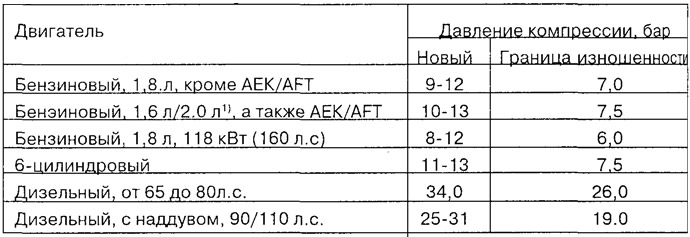
Compression check

1) Except for the 118 kW (160 hp) engine.

Compression testing allows you to draw conclusions about the condition of the engine. Namely, it allows you to determine whether the valves or pistons are in good condition (piston rings), or they are worn out. In addition, the check shows whether the engine should be replaced or completely overhauled. To check, you need a compression tester, which is offered very inexpensively in specialized stores for gasoline engines.

Note: Diesel engines require a compression tester with an extended measurement range.


The most information is provided by the difference in pressure in individual cylinders. It should not exceed 3.0 bar (for diesel engines 5.0 bar). If one or more cylinders have a pressure that differs from the pressure in other cylinders by more than 3.0 bar (for diesel engines 5.0 bar), this indicates a defect in the valves, wear of the piston rings or cylinder working surfaces. If the wear has reached the limit, the engine must be repaired or replaced.

Petrol engines


The compression test must be performed on a warm engine. The engine temperature must be at least 30°C.


Turn off the ignition.

Engine with injection system: remove the fuel pump relay.

Caution: High voltage wire (central wire, terminal 4) remove from the ignition distributor and connect to the vehicle ground using a suitable auxiliary wire. The auxiliary wire must have the same cross-section as the high-tension wire and have alligator clips at both ends. Do not hold the wire with your hands.


Pull out all spark plug tips. There is a special clamp for this, for example HAZET1849. In this case, grip the tips only by the metal sleeves.

After this, blow out the spark plug recesses in the cylinder head with compressed air and unscrew all the spark plugs with a suitable wrench.

Turn the engine over a couple of times with the starter to flush out carbon deposits and soot from the cylinders.

Attention: shift the gearbox into neutral and apply the handbrake.


Press the compression gauge against the spark plug holes or screw it in according to the service manual.

Ask your assistant to fully depress the gas pedal and hold it with his foot throughout the entire test.

View the original on this portal [www.VWMANUAL.ru]

Turn the engine approximately 8 revolutions until the readings on the instrument scale stop changing.

Check all cylinders in sequence and compare the obtained values with the prescribed ones.

After this, screw in the spark plugs and insert the spark plug wire, see chapter "Ignition system".

Diesel engine


Engines with power from 65 to 80 hp:


Remove the electrical wire from the fuel supply switch at the high pressure fuel pump.


Remove the injectors, see chapter "Diesel engine".

Screw in a compression gauge instead of the injector. At the same time, install the old heat-insulating gasket between the pressure gauge and the cylinder head.

Note: The given compression values are valid only when checking the compression with a VAG-1381 compression tester and the presence of a VAG-1323/2A adapter.


Tighten the injectors to a torque of 70 Nm. Note: Always replace the heat-insulating gasket between the cylinder head and the injector. The recess in the gasket must face upwards when installing. Tighten the fuel lines to a torque of 25 Nm.

Connect the wire to the fuel switch.

Turbocharged diesel engine with 90 and 110 hp.


Disconnect the fuel shut-off valve plug from the high-pressure fuel pump.

Remove the glow plugs, see chapter "Diesel engine".

Screw in the compression gauge instead of the glow plug. At the same time, install the old heat-insulating gasket between the pressure gauge and the cylinder head.

Attention: The given compression values are valid only when checking the compression with the VAG-1763 compression meter and the presence of the VAG-1323/18 adapter.


Check all cylinders in sequence.

Tighten the glow plugs to a torque of 15 Nm.

Connect the electrical wires.

This article is available at russian, bulgarian, belarusian, ukrainian, serbian, croatian, romanian, polish, slovak, hungarian
The text has been checked: Medvedeva Elena

Share information:

Previous articles
Checking the condition and tension of the toothed belt
Checking the V-belt / poly V-belt
Visual inspection for oil leaks
Towing a car
Jump starting from another car
Tensioning/replacing the poly V-belt
Next articles
Engine fault diagnostics


Similar articles from other manuals for VW cars:
Compression check Golf 1 (1974-1984, petrol)
Compression check Polo 3 (1995-2003)
Compression test (3.2L petrol engine) Touareg 1 (2002-2006)
Cylinder Block — Check Sharan 1 (1995-2000)
Checking the compression in the cylinders Transporter T4 (1990-2003)
Compression check LT 2D (1996-2003)
Link to this page in different formats


Visitor comments


No comments yet


How much will 45 + 11 =


Passat B6 
  • General information
  • User manual
  • Maintenance
  • Petrol engine 1.6L
  • Engine repair
  • Cooling and lubrication system
  • Fuel injection system
  • Petrol engine 2.0L
  • Engine repair
  • Lubrication system
  • Cooling system
  • Fuel and exhaust systems
  • Diesel engine 2.0L
  • Engine repair
  • Cooling and lubrication system
  • Fuel and exhaust systems
  • Transmission
  • Clutch
  • Mechanical gearbox
  • Automatic gearbox
  • Drive shafts
  • Chassis
  • Wheels and tires
  • Car suspension
  • Steering
  • Brake system
  • Body
  • Exterior (external elements)
  • Electrical equipment
  • Power devices
  • Lighting and appliances
  • Electrical circuits
Passat B5 
  • General information
  • User manual
  • Weekly checks
  • Maintenance
  • Power unit
  • Engine repair
  • Cooling system
  • Fuel system (petrol)
  • Fuel system (diesel)
  • Engine management
  • Exhaust system
  • Transmission
  • Clutch
  • Car gearbox
  • Drive shafts
  • Chassis
  • Car suspension
  • Wheels and tires
  • Steering
  • Brake system
  • Body
  • Exterior (external elements)
  • Interior (internal elements)
  • Doors and covers
  • Ventilation and heating
  • Electrical equipment
  • Power devices
  • Lighting and appliances
  • Electrical circuits
Passat B4 
  • General information
  • User manual
  • Maintenance
  • Technical data
  • 8-valve engine
  • Engine repair
  • Cooling and lubrication system
  • Supply system
  • Ignition system
  • Fuel injection «Mono-Jetronic»
  • Control system «Mono-Motronic»
  • Control system «Digifant»
  • Control system «Simos»
  • 16-valve engine
  • Engine repair
  • Cooling and lubrication system
  • Fuel injection «K-Jetronic»
  • Control system «KE-Motronic»
  • Control system «Digifant»
  • Diesel engine
  • Engine repair
  • Cooling and lubrication system
  • Power and control system
  • Turbocharging system
  • Digital control system
  • Transmission
  • Clutch
  • Manual gearbox
  • Hydromechanical gearbox
  • Front wheel drive
  • Chassis
  • Car suspension
  • Steering
  • Brake system
  • Body
  • Body elements
  • Electrical equipment
  • Power devices
  • Lighting and appliances
  • Electrical circuits
Passat B3 
  • General information
  • User manual
  • Driving Tips
  • Maintenance instructions
  • Technical data
  • Power unit
  • Engine repair
  • Ignition system
  • Lubrication system
  • Cooling system
  • Supply system
  • Petrol injection system
  • Diesel engine
  • Exhaust system
  • Transmission
  • Clutch
  • Car gearbox
  • Chassis
  • Suspension
  • Steering
  • Brake system
  • Wheels and tires
  • Body
  • Exterior
  • Interior
  • Heating system
  • Electrical equipment
  • Power devices
  • Lighting system
  • Equipment and devices
  • Wiper system
  • Electrical circuits
Passat B2 
  • General information
  • Introduction to instructions
  • User manual
  • Power unit
  • Engines 4-cylinder FZ
  • Engines 4-cylinder
  • Engines 5-cylinder
  • Transmission
  • Clutch
  • Four-speed gearbox
  • Five-speed gearbox
  • Hydromechanical gearbox
  • Front wheel drive
  • Chassis
  • Front suspension
  • Rear suspension
  • Steering
  • Brake system
  • Body
  • Body elements
  • Electrical equipment
  • Equipment and devices
  • Electrical circuits
VWmanual.ru © 2016-2026 | Mobile version | News and articles | Sitemap: EN BG BY UA RS HR RO PL SK HU | Write message | Site search
Passat B2 • Passat B3 • Passat B4 • Passat B5 • Passat B6 • Golf 1, diesel • Golf 1, petrol • Golf 2, petrol • Golf 2 • Golf 3 • Golf 4 • Golf 5 • Polo 3 • Polo 4 • Touareg 1 • Tiguan 1 • Sharan 1 • Transporter T3 • Transporter T4 • LT 28 • LT 2D • Beetle • Caddy 3 •
Our website uses cookies to ensure functionality and convenience.