



The cylinder bores are bored in a cylinder block made of gray cast iron. In a 6-cylinder engine, designated 6VR, the cylinders, like in an in-line engine, are located in one block, but in a V-shape, with an angle between the cylinder planes equal to 15°. In case of significant wear or unevenness of the cylinder walls, the cylinders can be honed and ground in a specialized workshop. Of course, after this, pistons of an increased diameter must be installed. In the lower part of the cylinder block there is a crankshaft, which is attached to the block by means of five (in the 6VR engine - by means of seven) main bearings. Between the crankpins of the crankshaft and the connecting rods connected to the pistons, there are plain bearings. The lower part of the engine is closed by an oil pan, which collects the engine oil necessary for lubrication and cooling. From above, a cylinder head made of light alloy is attached to the cylinder block. Compared with cast iron, the aluminum alloy of the cylinder head has increased thermal conductivity and has a lower specific gravity.
In 4-cylinder engines with two valves per combustion chamber, there is one camshaft in the upper part of the cylinder head to control the valves. In 4-cylinder engines with four valves per combustion chamber, as well as in 6VR engines, there are 2 camshafts. The camshaft is driven from the crankshaft by a toothed belt (in 6VR engines - by a chain). The camshaft controls the vertically located intake and exhaust valves through hydraulic plate tappets. The hydraulic tappets automatically equalize the gaps in the valve drive, thereby eliminating the need for gap adjustment during maintenance.
The engine is lubricated by an oil pump, which is located in the oil pan and is driven from the crankshaft via the intermediate shaft. The oil taken from the oil pan is supplied through channels to the crankshaft and camshaft bearings, as well as to the working surfaces of the cylinders.
The coolant pump is located on the side of the cylinder block and is driven by a V-belt or poly V-belt, which also drives the generator. An additional V-belt drives the power steering pump. It is important to keep in mind that the coolant, regardless of the season, should be a mixture of soft water with antifreeze and anti-corrosion additives.
To prepare a combustible fuel-air mixture, a carburetor or fuel injection system is installed, which, as a rule, does not require maintenance during operation.
The electric spark is generated by a transistor ignition system, which maintains the ignition timing constant. The ignition distributor is attached to the side of the cylinder block and is driven by an intermediate shaft with spline engagement. In turn, the intermediate shaft is driven by a gear from the crankshaft.
When presenting the material in each chapter, it is indicated to which engines it applies, 4-cylinder engines have a great deal of similarity in design, the differences relate primarily to the design of the cylinder heads with eight and sixteen valves. Therefore, it is first necessary to establish, using the table on the next page, what design the given engine has.
Warning: The radiator fan may also turn on when the engine is stopped and the ignition is off. This is caused by the heat build-up in the engine compartment and can happen repeatedly. Therefore, when working in the engine compartment and when the engine is warm, you must always consider the possibility of the radiator fan turning on unexpectedly.
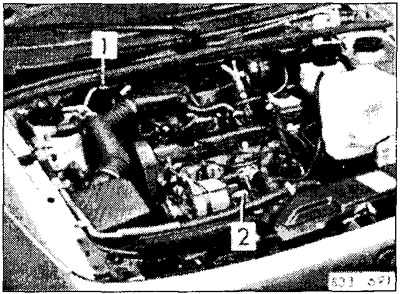
The engine number and letter designation for 4-cylinder engines are stamped on the left side of the cylinder block (2).
The engine number and letter designation for 6VR engines are stamped on the side of the cylinder block opposite the gearbox.
The model identification plate (1) is located in the engine compartment on the right side. The chassis number is stamped on the right side next to the plate on the rear cross wall.
Chassis number decoding

- 1 — international designation of the manufacturer (WVW = VW AG — VW joint-stock company)
- 2 - designation of the version, except for models for delivery to the USA
- 3 — a two-digit abbreviated model designation, composed of the first two positions of the official model designation. 31 = PASSAT4.88-7.93, ZA = PASSAT with 8.93
- 4 — designation of another version
- 5 — year of model manufacture: J = 1989, K = 1990, etc.
- 6 — production locations within the VW concern: W — Wolfsburg, E — Emden, A — Ingolstadt, N — Neckarsulm, K — Osnabrueck, B — Bruessel.
- 7 — serial number of the product; each model year starts with 000001.
Visitor comments