



Contents: Checking cylinder diameters ↓ Checking the clearances between the…↓ Checking the axial clearance of the…↓ Checking the dimensions of pistons…↓ Engine assembly ↓
Checking cylinder diameters
Accurately measure the cylinder diameters. Measurements are taken with a bore gauge in three zones both in the transverse direction "A" and in the longitudinal direction "B", as shown in the diagram in the section "Four-cylinder engines EP, YN, WV, YP, DT, DS".
In cases where wear exceeds the permissible values by more than 0.08 mm, bore the cylinders to the nearest repair size and install pistons of the corresponding repair size.
Checking the clearances between the bearings and the crankshaft journals
Thoroughly clean the working surfaces of the bearings and the corresponding crankshaft journal. Place a piece of calibrated plastic wire equal in width to the bearing on the surface of the journal.
Depending on the type of journal being checked, install a connecting rod with a cap or a main bearing cap on the journal and tighten the nuts or mounting bolts accordingly. Tighten the connecting rod bolt nuts to a torque of 5.0 kgf·m, and the main bearing cap mounting bolts to a torque of 6.5 kgf·m. Do not allow the engine crankshaft to turn.
Carefully remove the lid and use the scale on the package to determine the gap size by flattening the wire. More detailed information is provided in the accompanying documentation from the manufacturer of the calibrated wire.
The nominal design gap is 0.016-0.075 mm (maximum permissible 0.16 mm) for root and 0.015-0.062 mm (maximum permissible 0.12 mm) for connecting rod journals.
If the gap is greater than the maximum, replace the liners on these journals with new ones. If the crankshaft journals are worn and ground to the repair size, replace the liners with repair ones (increased thickness).
Checking the axial clearance of the crankshaft
Check the axial clearance of the crankshaft using a feeler gauge on the fourth support, which should be no more than 0.25 mm.
If necessary, achieve the proper clearance by placing thicker thrust half rings on the fourth support.
Checking the dimensions of pistons and piston rings
Determine the degree of piston wear by measuring the diameter 10 mm from the edge of the piston skirt perpendicular to the axis of the piston pin. The piston is subject to replacement if its diameter differs by more than 0.04 mm from the permissible values (see subsection "Design and technical characteristics").
Replace piston rings or pistons if the clearances between piston rings and grooves exceed the permissible values (see subsection "Design and specifications").
Engine assembly
Install the main bearing shells in the block bed, lubricate with engine oil and place the crankshaft in the bearing;.. Lubricate the crankshaft main journals with engine oil.
The axial displacement of the crankshaft is selected on the fourth support, the bearing shells of which have two thrust flanges.
Assemble the main bearing caps with the liners and install them on the block bed. Tighten the cap mounting bolts to a torque of 6.5 kgf·m.
Install three piston rings into the corresponding grooves in the pistons, arranging their locks at 120° intervals (see photo).
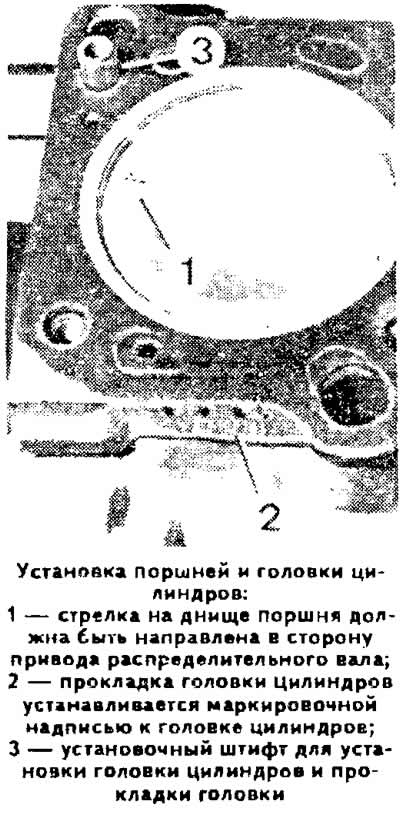
Orient the piston ring locks forward or backward in the direction of the vehicle. The lower compression and oil release rings are marked "top" or "oben" ("top"), which should be turned up when installing the ring in the groove. Install the pistons, orienting the arrow pressed on the bottom of the piston, forward in the direction of the car (towards the camshaft drive).
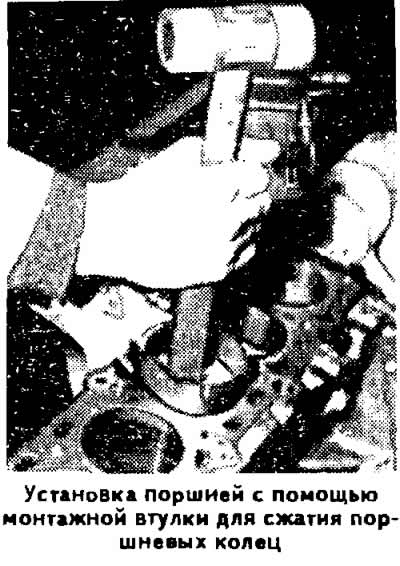
Lubricate the pistons and piston rings with engine oil, compress the piston rings in the grooves of the corresponding mounting sleeve and insert the pistons with connecting rods into the cylinders.
Install the bearing shells into the connecting rods and connecting rod caps in accordance with the marks made during disassembly if worn bearing shells are used.
Install the connecting rods and caps on the crankshaft journals, with the ridges on the caps facing the intermediate shaft.
Lightly tighten the connecting rod bolt nuts, then tighten them finally to a torque of 5.0 kgf·m.
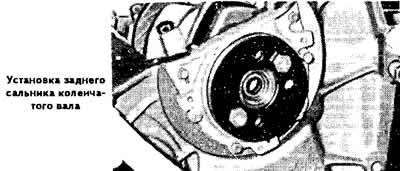
Install the rear oil seal holder with a new cardboard gasket. Press the oil seal into the holder using mandrel 2003/1.
Install the flywheel.
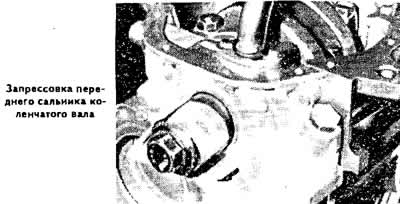
Install a new front oil seal retainer and crankshaft gasket. Install the retainer with the oil pump so that the pinion lugs engage with the clutch flats on the crankshaft.
Install the oil receiver with the tube.
Install the oil pan with a new gasket.
Install the water pump, thermostat and thermostat housing.
The original text can be found on the portal [VWmanual]
Install the cylinder head.
Install the camshaft drive belt.
Visitor comments