



Contents: Drive shaft with CV joint "Tripod"…↓ Drive shaft with CV joint "Tripod"…↓ Intermediate shaft ↓
Golf cars can be equipped with different types of drive shafts, which differ in the internal CV joints.
The inner CV joint can be ball bearing or roller, which is also called "Tripod".
Attention! When performing any work that requires disconnecting the drive shaft from the hub or gearbox, the shaft should be pulled by the CV joint.
Attention! After dismantling the drive shaft, the car should not stand on its wheels, because the lack of axial load causes damage to the hub bearing.
Attention! Do not move the vehicle after removing the drive shaft. If necessary, instead of the drive shaft, you can install the outer CV joint tailstock in the hub and screw in the hub bolt with a force of 120 Nm.
Drive shaft with CV joint "Tripod" AAR 3300i
1. Unscrew the hub bolt.
Attention! At the moment of final unscrewing of the hub bolt the car should not stand on its wheels.
2. Indicate the direction of rotation of the wheel by drawing an arrow on its sidewall with chalk.
3. Unscrew the wheel mounting bolts and remove the wheel from the hub.
4. Remove the engine splash guard, see the relevant chapter.
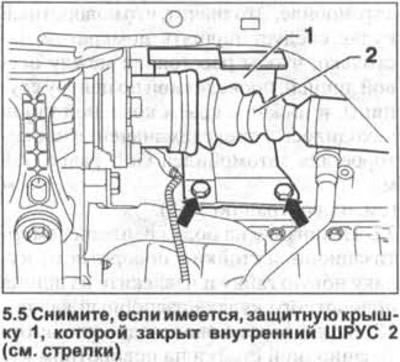
5. Right drive shaft. Remove, if present, the protective cover 1, which covers the inner CV joint 2 (see arrows in the illustration).
6. Unscrew the bolts that secure the inner CV joint 1 to flange 2 on the gearbox or intermediate shaft (see illustration).
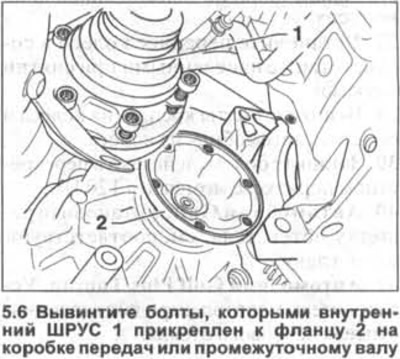
To unscrew the bolts, you need a multi-sided socket wrench, for example, HAZET 990 Lg-8/10.
7. Slide the outer CV joint tail out of the hub, holding it by the housing, not the shaft.
Attention! If the drive shaft fits tightly in the hub, press it out using a puller, for example, HAZET2515-1.
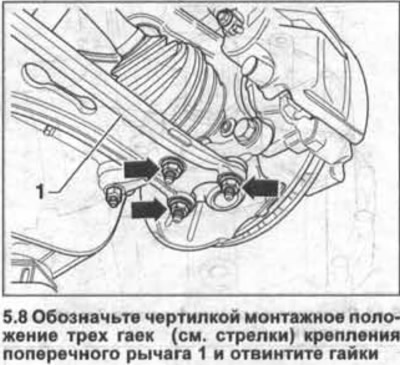
8. Use a scriber to mark the mounting position of the three nuts (see arrows in the illustration) mount the transverse arm 1 and unscrew the nuts.
9. Disconnect the steering knuckle and the pivot arm from the transverse arm.
10. Remove the drive shaft completely from the hub.
Installation
Caution: Remove any corrosion or sealant residue from the threads on the shank, as well as from its splines and the splines on the hub.
11. Insert the drive shaft end into the hub.
12. Secure the articulated arm to the wishbone, being careful not to damage the ball joint cap or twist it.
13. Screw new self-locking nuts onto the ball joint pins of the lever mount and tighten them to 75 Nm.
14. Bolt the inner CV joint to the gearbox flange or to the intermediate shaft. Tighten the mounting bolts in two passes.
- 1st pass 10 Nm;
- 2nd pass. Bolts M8 40 Nm;
- 2nd pass. Bolts M10 70 Nm.
15. Reinstall the engine splash guard, see the relevant chapter.
16. Screw in the hub bolt. When screwing in the bolt, the car should not stand on its wheels.
17. Install the removed wheel in place in accordance with the marks applied and screw in the wheel bolts.
18. Lower the vehicle onto its wheels and tighten the wheel bolts to 120 Nm, using a criss-cross pattern.
Drive shaft with CV joint "Tripod" AAR 2600i
Attention! The drive shaft with the internal CV joint "Tripod" AAR 2600i does not have a flange connection to the gearbox. The CV joint tail is inserted into the corresponding splined hole on the gearbox.
Removal
19. Unscrew the hub bolt.
Attention! At the moment of final unscrewing of the hub bolt the car should not stand on its wheels.
20. Indicate the direction of rotation of the wheel by drawing an arrow on its sidewall with chalk.
21. Unscrew the wheel mounting bolts and remove it from the hub.
22. Remove the engine splash guard, see the relevant chapter.
23. Use a scriber to mark the mounting position of the three wishbone mounting nuts and unscrew the nuts.
24. Disconnect the pivot arm from the transverse arm.
25. Remove the drive shaft from the hub.
Attention! If the drive shaft fits tightly in the hub, press it out using a puller, for example, HAZET 2515-1.
26. Secure the drive shaft, disconnected from the hub, to the body or suspension components. If it is left unsecured, the inner constant velocity joint will be damaged due to the deflection of the shaft.
27. Insert the crowbar 1 between the gearbox housing and the inner CV joint 2 and release the CV joint from the gearbox by hitting the crowbar with a hammer (see illustration).
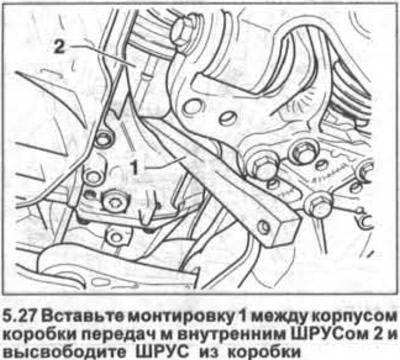
Warning! After disconnecting the drive shaft, oil will leak from the gearbox. Place a suitable container under the gearbox and close the hole with a suitable plug, such as a clean rag.
Installation
28. Clean the splines and threads of the drive shaft end, as well as the splined hole in the gearbox and in the hub, removing any possible rust and other contaminants, and lubricate them with transmission oil.
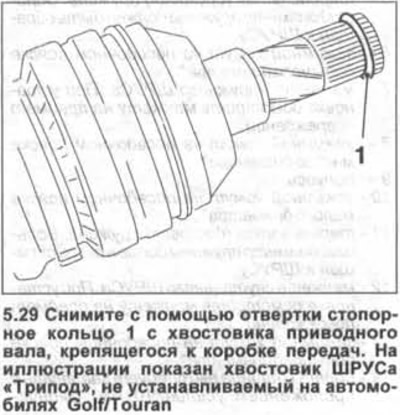
29. Using a screwdriver, remove the retaining ring 1 from the drive shaft end that is attached to the gearbox (see illustration).
30. Install a new retaining ring onto the shank, being careful not to stretch it.
31. Remove the plug that was used to close the hole on the gearbox and insert the drive shaft end into the splined hole on the gearbox. Be careful not to damage the drive shaft seal in the gearbox.
32. Press down on the drive shaft until its retaining ring is secured in the gearbox.
Caution! Do not hammer the drive shaft into the gearbox.
33. Check the strength of the shaft fit in the gearbox by pulling on the CV joint housing.
34. Install the other end of the drive shaft into the hub.
35. Secure the articulated arm to the wishbone, being careful not to damage the ball joint cap or twist it.
36. Screw new self-locking nuts onto the ball joint pins of the lever mount and tighten them to 75 Nm.
37. Reinstall the engine splash guard, see the relevant chapter.
38. Screw in the hub bolt. When screwing in the bolt, the car should not stand on its wheels.
39. Install the removed wheel in place in accordance with the marks applied and screw in the wheel bolts.
40. Lower the vehicle onto its wheels and tighten the wheel bolts to 120 Nm, using a criss-cross pattern.
Intermediate shaft
Depending on the vehicle model, the right drive shaft may consist of an intermediate shaft, which is attached to the gearbox, and the axle shaft itself.
This ensures that torque is transmitted without torsional vibrations. The axle shaft and intermediate shaft are flanged to each other.
Removal
41. Remove the right axle shaft 1 (see illustration).
[The information is posted on this resource: VWmanual]
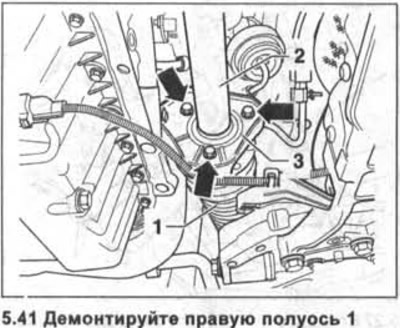
42. Unscrew the three bolts securing the intermediate support 3 of the shaft (see arrows in illustration 5.41).
43. Disconnect intermediate shaft 2 from the gearbox (see illustration 5.41).
Installation
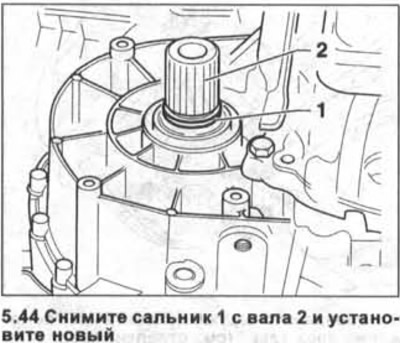
44. Remove oil seal 1 from shaft 2 and install a new one (see illustration).
45. Clean the splines and threads of the drive shaft end, as well as the splined hole in the gearbox and in the hub, removing any possible rust and other contaminants, and lubricate them with transmission oil.
46. Screw in the three intermediate shaft support mounting bolts and tighten them to 20 Nm.
47. Install the right axle shaft in place.
Visitor comments