



Attention! Depending on the power plant, the inner CV joint can be ball bearing or roller "Tripod". The "Tripod" CV joint has three rollers installed on the sprocket instead of six balls, located at an angle of 120° relative to each other.
1. Remove the drive shaft.
2. Clamp the removed drive shaft in a vice, having first installed protective plates on the vice jaws.
3. Mark where the edge of the CV joint boot is located on the drive shaft so that you can later install the boot in its original place.
When applying marks, do not damage the protective varnish layer that covers the drive shaft.
4. Use side cutters to cut the steel clamps that secure both cuffs and remove them. Move the cuff onto the shaft. If necessary, knock it off with a punch.
Outer CV joint
Removal
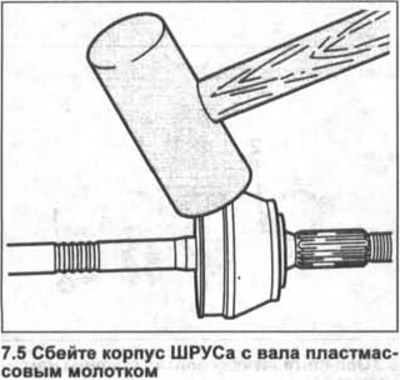
5. Knock the CV joint housing off the shaft with a plastic hammer (see illustration).
6. Remove the retaining ring 3 with suitable needle-nose pliers (see illustrations 6.0, 6.0a).
7. Remove the thrust ring 4 and disc spring 5 from the drive shaft (see illustrations 6.0, 6.0a).
8. Remove the CV joint seal from the shaft.
Installation
9. Place a clamping collar on the drive shaft, which is installed on the seat belt of the small diameter cuff.
10. Install a new cuff on the shaft if the old one is damaged or its rubber has become brittle.
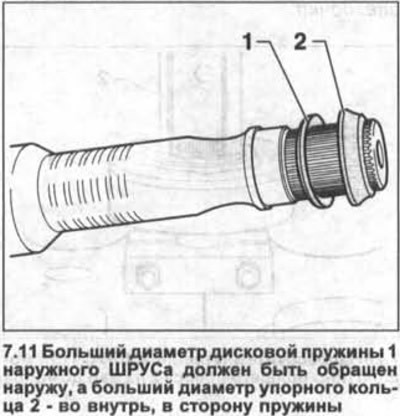
11. Install the disc spring and thrust ring on the drive shaft. The larger diameter of the disc spring 1 of the outer CV joint should be facing outward, towards the splined tailpiece, and the larger diameter of the thrust ring 2 should be facing inward, towards the spring (see illustration).
12. Install a new retaining ring into the groove on the drive shaft.
13. Tap the outer CV joint onto the shaft with a plastic hammer until it stops, so that it is fixed on the retaining ring.
14. Fill the CV joint with "eternal" grease, for example, LM47 Liqui Moly. Half of the grease is filled into the cuff, and the other half - into the joint.
15. Place the cuff on the CV joint housing and secure it with a new clamp.
16. Tighten the stainless steel clamps to secure the CV joint boots to the drive shaft using the HAZET 1847 pliers.
If the clamps are tightened in any other way, the required tightening torque will not be ensured (see illustration).
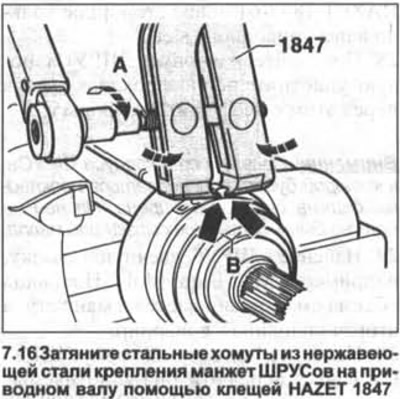
17. Position the HAZET 1847 pliers so that their edges extend into the corners as shown by the arrows B in Figure 7.16. In this position of the pliers, tighten the clamping bolt A with a torque wrench to 25 Nm. The steel clamp will also be tightened at the same time.
Caution! The thread of the hole for the clamping bolt on the pliers must be spread out and the bolt must be easy to screw in. If necessary, apply molybdenum grease MoS2 to the thread.
18. Install the assembled drive shaft into place.
Inner CV joint
Removal
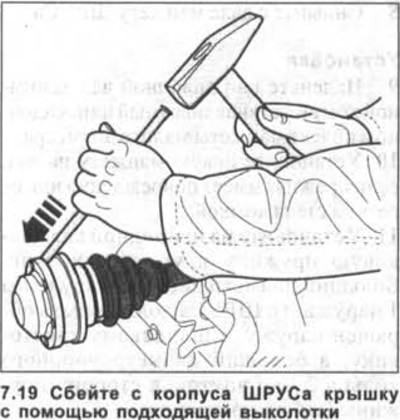
19. Inner CV joint VL 100/107. Knock the cover off the CV joint housing using a suitable punch (see illustration).
20. Remove the sealing strip 18 from the joint (see illustration 6.0).
21. Remove the retaining ring 19 with suitable needle-nose pliers, e.g. HAZET 1847-61 (see illustration 6.0).
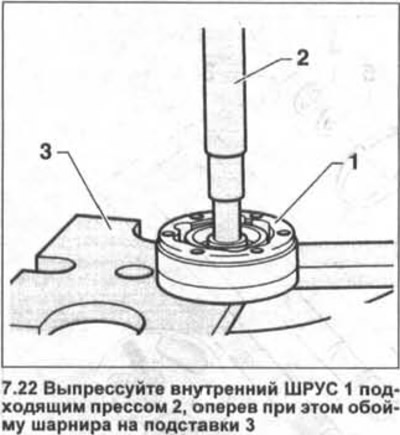
22. Press out the inner CV joint 1 with a suitable press 2, while resting the joint cage on supports 3 (see illustration).
Installation
23. Place a clamping collar on the drive shaft, which is installed on the seat belt of the small diameter cuff.
24. Install a new cuff on the shaft if the old one is damaged or its rubber has become brittle.
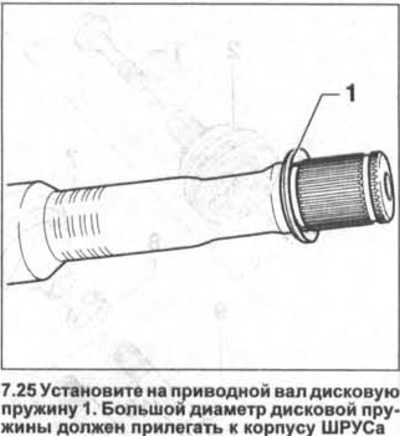
25. Install disc spring 1 on the drive shaft. The large diameter of the disc spring must be flush with the CV joint housing (see illustration).
26. Press the inner CV joint 1 onto the shaft using a suitable press 2 until it stops (see illustration).
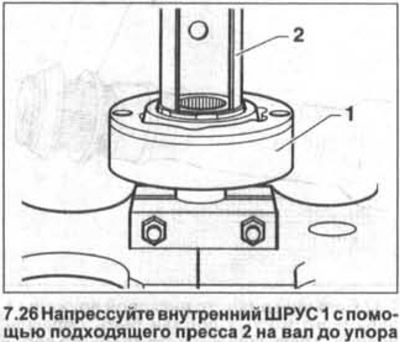
Attention! The chamfered side on the inner diameter of the CV joint cage must face the thrust flange on the drive shaft.
27. Using the HAZET 1847-61 pliers, install the new retaining ring into the groove of the drive shaft.
28. Glue a new sealing gasket to the CV joint housing, having first removed the protective foil from it.
Attention! The surface of the CV joint housing to which the gasket will be glued must be degreased. There should be no residue of grease or oil on it.
29. Fill the CV joint with "eternal" grease, for example, LM47 Liqui Moly. Half of the grease is filled into the cuff, and the other half - into the joint.
30. Place the cuff on the CV joint housing, having first applied VW-D454 300 A2 sealant to the sealing surfaces.
31. Secure the cuff with new clamps, tightening them with special pliers, for example, HAZET 1847.
32. CV joint VL 100/107 Place a new cover on the CV joint housing.
33. Install the drive shaft into place.
Inner CV joint "Tripod"
Removal
34. Remove the CV joint housing from the drive shaft.
35. Remove the retaining ring 15 with suitable needle-nose pliers, e.g. HAZET 1846, from the drive shaft (see illustration 6.0a).
36. Remove the sprocket with rollers from the drive shaft using a suitable press.
37. Remove the CV joint seal from the drive shaft.
Installation
38. Place a clamping collar on the drive shaft, which is installed on the seat belt of the small diameter cuff.
39. Install a new cuff on the shaft if the old one is damaged or its rubber has become brittle.
40. Place the sprocket with rollers on the drive shaft with the chamfered side on the mounting hole and press it on with a suitable press until it stops.
Caution! Before doing this, lubricate the splines on the shaft and in the sprocket mounting hole.
41. Install a new retaining ring into the groove of the drive shaft.
42. Fill half of the grease from the repair kit into the CV joint and into the CV joint housing.
43. Place the cuff on the CV joint and secure it with new clamps.
44. Tighten the fastening clamps on the cuff seat belts.
Attention! When installing the AAR 3300i Tripod CV joint, make sure that the holes for the bolts that secure the CV joint to the flange on the gearbox are aligned.
45. Install the drive shaft in place.
Visitor comments