



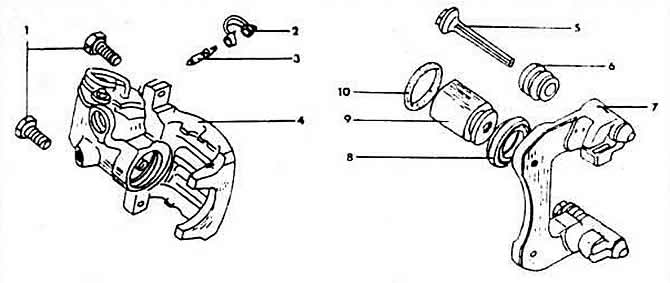
1 - self-locking screws, 35 Nm
2 - dust cap
3 - threaded plug to the air outlet hole
4 - brake seat cylinder
5 - guide bolt
6 - protective cap
7 - brake saddle support
8 - anti-dust ring
9 - brake seat piston
10 - cylinder sealing ring
The piston is unscrewed using a special tool.
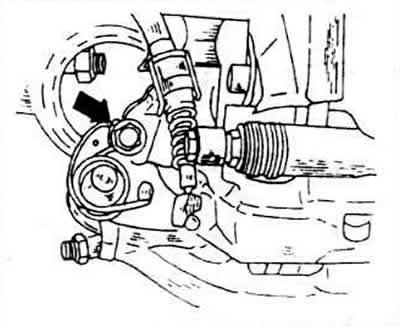
Clamp the cylinder in a vice and unscrew the handbrake cable mounting assembly.
Using a special key, unscrew the piston from the brake seat.
Using a screwdriver, carefully lift the sealing ring located on the inside of the cylindrical hole.
Clean all parts thoroughly and, if the cylinder is in good condition, use the parts from the spare parts kit when assembling. If the brake seat support is replaced, it is well sealed and moved to the guide pin, the support must be replaced if the protective cuffs or guide pin are damaged, the supports are supplied as spare parts.
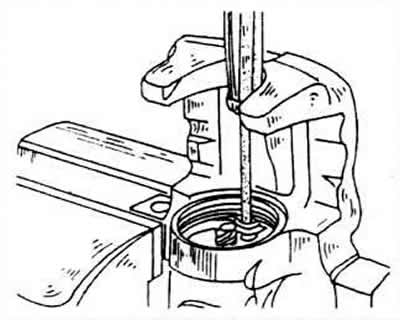
Insert the new O-ring into the groove, coating it with brake fluid or brake grease.
Place the dust ring with the outer sealing edge toward the piston and insert the piston into the cylinder bore. Lubricate the piston surface with fluid or brake grease.
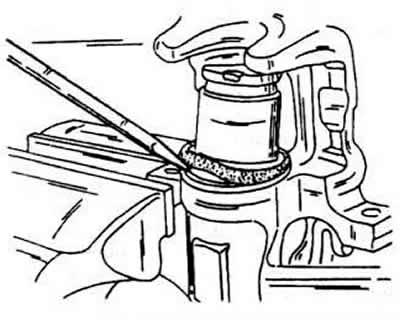
Using a screwdriver, carefully insert the inner sealing lip of the dust ring into the groove of the cylinder.
Insert the special key into the piston and turn the piston inward. When screwing in, apply even pressure to the piston. When the piston is in place, the outer sealing edge of the dust ring will enter the groove of the piston.
Lubricate the air valve with brake grease and screw it in. Air should be removed from the brake seat beforehand, to do this, attach a hose for removing air to the air valve, and put the other end of the hose on a syringe filled with brake fluid. You can, for example, use a siphon with acid, used to check the battery acid; it must, of course, be thoroughly cleaned beforehand. Inject brake fluid until bubbles appear at the point of connection with the brake hose.
The brake saddle is now ready for installation again.
Visitor comments