
English Русский
Български
Беларускі
Український
Српски
Hrvatski
Română
Polski
Slovenský
Magyar
  |  Articles  |  Sitemap  |  Contacts  |    |
Car maintenance Ford Car maintenance Hyundai Car maintenance Chevrolet Car maintenance BMW Car maintenance Audi Car maintenance Opel Car maintenance AvtoVAZ
VWmanual.ru


Main   Passat   Golf   Polo   Touareg   Tiguan   Sharan   Transporter   Others  
Golf 1 (1974-1984, diesel) Golf 1 (1974-1984, petrol) Golf 2 (1984-1993, petrol) Golf 2 (1984-1993) Golf 3 (1991-1997) Golf 4 (1997-2004) Golf 5 (2003-2008)

Anti-lock device (VW Golf 3)

  • Main
  • Golf
  • Golf 3
  • Chassis
  • Brake system
  • Anti-lock device
            0


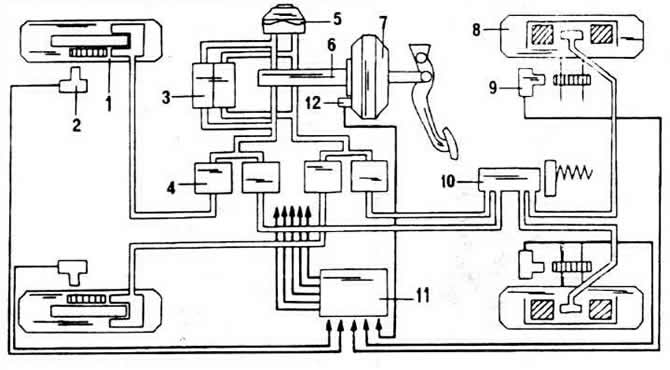
1 - front wheel

1 - front wheel
2 - electronic sensor for determining the number of wheel revolutions
3 - dual-circuit pump with electric motor
4 - hydraulic valves
5 - compensation tank
6 - master brake cylinder
7 - vacuum controlled brake booster
8 - rear wheel
9 - electronic sensor for determining the number of wheel revolutions
10 - pressure distribution valve depending on the load
11 - electronic control device
12 - brake pedal travel sensor


Usually, if a car is equipped with an anti-lock device, disc brakes are mounted on its rear axle. However, in the Golf version, this device (depending on the model) can also function when drum brakes are placed on the rear axle.

The decisive safety factor provided by the anti-lock braking system is its ability to prevent the wheels from locking when the vehicle brakes sharply; thanks to this, the possibility of further control of the car in this situation is guaranteed. Even with emergency braking, there is still a chance that the obstacle can be driven around, maintaining control over the rear wheels. But we must never forget that the anti-lock device cannot perform miracles. If the physical capabilities of the device are exceeded, i.e. the speed is too high, then the car with the anti-lock device will also begin to slip.

The decisive safety factor provided by the anti-lock braking system is its ability to prevent the…


The decisive safety factor provided by the anti-lock braking system is its ability to prevent the…


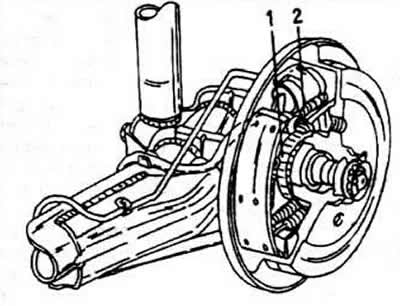
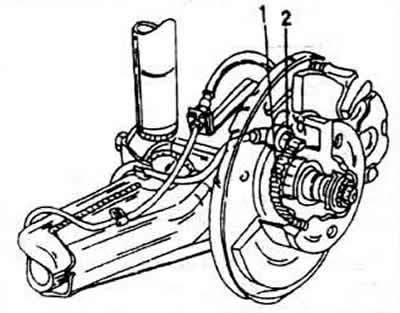
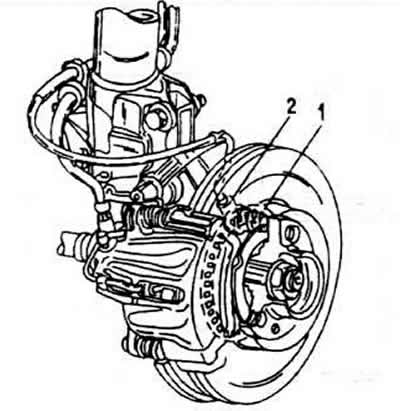
The rotation speed of each wheel is controlled independently by four electronic sensors that record the wheel speed readings. The sensors are mounted on the pivot pin or rear support of the wheel hub and actually "monitor" the speed of the toothed rims located at the end of the axle. The figure shows where the sensors and toothed rims are located in the versions with disc and drum brakes, respectively.
The rotation speed of each wheel is controlled independently by four electronic sensors that record…


Shown is what a disc brake looks like when fitted to the front of a car, if an anti-lock device is fitted. The computer records these signals indicating the number of revolutions and evaluates any deviations in relation to the pre-programmed values. Thanks to this process, in combination with the hydraulic device, the brake pressure on the corresponding wheel can be increased or decreased 4-10 times per second, which is much faster than can be achieved by "intermittent" pressing of the brake pedal. In addition, the brake adjustment can be made on each wheel separately, rather than all four wheels simultaneously, which is the case when pressing the brake pedal in cars that do not have an anti-lock device.


Two hydraulic valves distribute the required pressure to the front brakes precisely depending on the road conditions. Another control valve controls the rear brakes. In this case, the electronic control system first reacts to the wheel that is locked first. With optimal braking, the vehicle remains steerable.

Since the anti-lock device is supposed to provide you with additional safety, we do not recommend carrying out any other work on it, although some operations will not cause you any trouble. However, a workshop will be able to better understand the situation. Nevertheless, the car is always subject to some work that will undoubtedly affect the anti-lock device, since even during normal work carried out on the braking system, for example, bleeding air from the system is carried out in different ways. For this reason, when carrying out any work on the braking system, the following requirements must be taken into account.

Clean all connecting elements and their surrounding areas thoroughly before disconnecting them.

Place dismantled parts on a clean surface and cover with plastic film or clean paper. Do not use any fibrous rags for this purpose.

Carefully cover or close open parts of the device if the repair will be done at a later date. This is especially important when the car is parked outdoors.

Mount only completely clean parts; never use parts that have been lying around for a long time.

If you have air compressors that can be connected instead of the cigarette lighter, you can always successfully use compressed air to clean the parts. Never carry out this operation with the connecting elements of the device open.

After the ignition system is switched on, the hydraulic pump establishes the required operating pressure in the device within 60 seconds. The special lighting of the anti-lock device flashes for 2-20 seconds, depending on the pressure in the device. Now the electronic control device checks the individual components of the anti-lock device. If any deviations are noticed, the braking system will work as a traditional system without an anti-lock device. In this case, i.e. if the signal light continues to burn, you should contact the workshop. Specialists, using the failure diagnostic system, will be able to find a malfunction in the device caused by failures in the electronics or hydraulics.

This article is available at russian, bulgarian, belarusian, ukrainian, serbian, croatian, romanian, polish, slovak, hungarian
The text has been checked: Medvedeva Elena

Share information:

Previous articles
Dismantling and installation of the handbrake lever
Dismantling and installation of handbrake cables
Handbrake
Modification of brake discs of rear wheel brakes
Repair of the brake saddle of the rear disc brake
Removal and installation rear disc brake pads
Next articles
Removal anti-lock braking system components


Similar articles from other manuals for VW cars:
Anti-lock braking system Passat B4 (1988-1996)
Anti-lock braking system ABS Polo 3 (1995-2003)
Anti-lock braking system (ABS) Touareg 1 (2002-2006)
General instructions regarding the anti-lock braking system Tiguan 1 (2007-2015)
ABS (Anti-lock Braking System) Sharan 1 (1995-2000)
Anti-lock braking system (ABS) Transporter T4 (1990-2003)
Ignition and instrument switch with anti-theft device Caddy 3 (2003-2010)
Link to this page in different formats


Visitor comments


No comments yet


How much will 37 + 16 =


Golf 5 
  • General information
  • User manual
  • Maintenance
  • Troubleshooting
  • Power unit
  • Engine repair
  • Cooling and ventilation system
  • Fuel system
  • Ignition system
  • Transmission
  • Clutch
  • Mechanical gearbox
  • Automatic gearbox
  • Chassis
  • Brake system
  • Car suspension
  • Steering
  • Body
  • Interior (internal elements)
  • Exterior (external elements)
  • Doors and covers
  • Electrical equipment
  • Power devices
  • Washers and wipers
  • Lighting and appliances
  • Electrical circuits
Golf 4 
  • General information
  • User manual
  • Weekly checks
  • Maintenance
  • Power unit
  • Petrol engines
  • Diesel engines
  • Cooling system
  • Fuel system (petrol)
  • Control system (petrol)
  • Fuel system (diesel)
  • Exhaust system
  • Transmission
  • Clutch
  • Car gearbox
  • Drive shafts
  • Chassis
  • Car suspension
  • Steering
  • Wheels and tires
  • Brake system
  • Body
  • Exterior (external elements)
  • Interior (internal elements)
  • Ventilation and heating
  • Car doors and sunroof
  • Washers and glass cleaners
  • Electrical equipment
  • Power devices
  • Lighting and appliances
  • Electrical circuits
Golf 3 
  • Petrol engine
  • Engine repair
  • Lubrication system
  • Cooling system
  • Ignition system
  • Diesel engine
  • Engine repair
  • Diesel injection system
  • Pre-glow system
  • Transmission
  • Clutch
  • Gearbox and drive shafts
  • Chassis
  • Steering
  • Wheels and suspension
  • Brake system
  • Electrical equipment
  • Lighting and appliances
  • Electrical circuits
Golf 2 
  • General information
  • Introduction to guide
  • User manual
  • Petrol engines 1.3 l
  • Engine repair
  • Lubrication system
  • Cooling system
  • Carburetors
  • Supply system
  • Ignition system
  • Petrol engines 1.6/1.8 l
  • Engine repair
  • Supply system
  • Ignition system
  • Diesel engines
  • Engine repair
  • Lubrication system
  • Cooling system
  • Power and exhaust system
  • Transmission
  • Clutch
  • 4-speed gearbox 084
  • 5-speed gearbox 085
  • 4-speed gearbox 020/4R
  • 5-speed gearbox 020/4T
  • Automatic gearbox
  • Drive shafts
  • Chassis
  • Steering
  • Car suspension
  • Brake system
  • Body
  • Body elements
  • Doors, locks and windows
  • Electrical equipment
  • Equipment and devices
  • Power devices
Golf 2 (petrol) 
  • General information
  • Characteristics
  • Car care
  • Maintenance
  • Power unit
  • Engine repair
  • Engine 1.05/1.30
  • Engine 1.60/1.80
  • Cooling and lubrication system
  • Power and exhaust system
  • Transmission
  • Clutch
  • Car gearbox
  • Drive shafts
  • Chassis
  • Brake system
  • Steering
  • Suspension
  • Body
  • Body and equipment
  • Electrical equipment
  • Lighting and appliances
  • Electrical circuits
Golf 1 (petrol) 
  • General information
  • Characteristics
  • User manual
  • Maintenance
  • Power unit
  • Engine adjustment
  • Engine 1.1/1.3
  • Engine 1.5/1.6/1.8
  • Engine electrical equipment
  • Cooling system
  • Fuel system
  • Transmission
  • Clutch and manual gearbox
  • Automatic gearbox
  • Chassis
  • Steering
  • Front suspension
  • Rear suspension
  • Brake system
  • Electrical equipment
  • Lighting and appliances
  • Electrical circuits
  • Body
  • Body and equipment
  • Optional equipment
Golf 1 (diesel) 
  • General information
  • Specifications
  • Maintenance
  • Power unit
  • Engine repair
  • Exhaust and turbocharger
  • Cooling system
  • Fuel system
  • Fuel injection system
  • Transmission
  • Clutch and drive shafts
  • Car gearbox
  • Chassis
  • Suspension and wheels
  • Steering
  • Brake system
  • Wheels and tires
  • Body
  • Heating and ventilation
  • Exterior (external elements)
  • Interior (internal elements)
  • Doors and windows
  • Electrical equipment
  • Equipment and devices
  • Lighting system
  • Power devices
  • Electrical circuits
VWmanual.ru © 2016-2026 | Mobile version | News and articles | Sitemap: EN BG BY UA RS HR RO PL SK HU | Write message | Site search
Passat B2 • Passat B3 • Passat B4 • Passat B5 • Passat B6 • Golf 1, diesel • Golf 1, petrol • Golf 2, petrol • Golf 2 • Golf 3 • Golf 4 • Golf 5 • Polo 3 • Polo 4 • Touareg 1 • Tiguan 1 • Sharan 1 • Transporter T3 • Transporter T4 • LT 28 • LT 2D • Beetle • Caddy 3 •
Our website uses cookies to ensure functionality and convenience.