



Contents: Features of the device ↓ System check ↓
The Teves electronically controlled anti-lock braking system consists of a hydraulic unit, wheel speed sensors and an electronic control unit.
The hydraulic brake drive includes a master brake cylinder and a hydraulic brake booster. The front brake hydraulic drive is separate for the right and left wheels, controlled by the master brake cylinder. The rear wheel brake hydraulic drive with a Y-shaped connection is controlled by a booster. The front brake discs are ventilated, and the rear ones are solid.
Some Passat vehicles produced since July 1995 are equipped with the ITT Automotive Europe Teves 20 Gi anti-lock braking system and the Teves 20 Gi ABS/EDS system, which is a combination of the ABS system and the differential lock system.
The brake system with ABS consists of two independent circuits, divided diagonally. A vacuum booster is included in the brake drive. The brake drive of cars with ABS and the ABS/EDS Teves 20 Gi system does not have a mechanical pressure regulator, since the pressure in the wheel cylinders of the rear wheel brake mechanisms is regulated by the electronic ABS control unit according to a specially developed program. The hydraulic unit and the electronic ABS control unit (Fig. 7-5) are combined into one unit. Their separation is possible only after removing this unit.
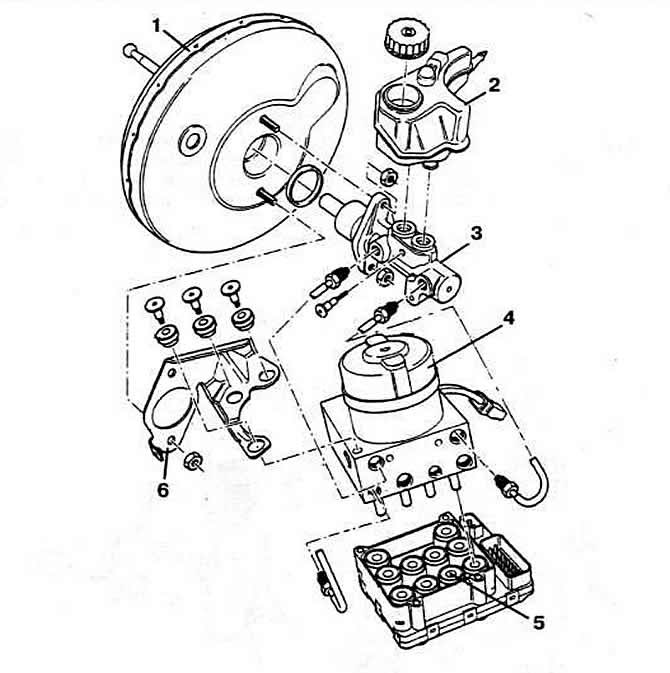
Fig. 7-5. Details of the hydraulic unit with the electronic control unit of the ABS brakes of the ITT ATE 20 GI brand:
1 - brake booster;
2 — tank;
3 - main brake cylinder with two coaxial pistons;
4 — ABS hydraulic unit;
5 — electronic control unit;
6 — bracket.
Features of the device
The anti-lock braking system consists mainly of wheel pulse generators (rotation speed sensors), hydraulic unit (Fig. 7-6) and electronic control unit.
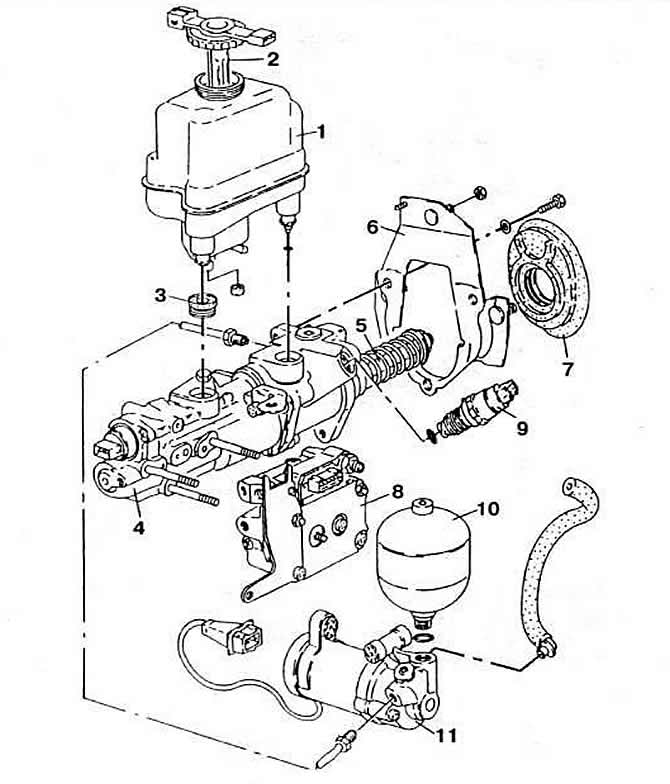
Fig. 7-6. ABS system hydraulic unit parts:
1 — valve body tank;
2 - tank cap;
3 - sealing gasket;
4 — brake booster and master cylinder assembly;
5 - pusher;
6 — mounting bracket;
7 - rubber seal;
8 - valve box;
9 - excess pressure sensor;
10 — pressure accumulator;
11 — high pressure pump.
Pulse generators installed on each wheel send wheel speed signals to the electronic control unit.
The electronic control unit, installed under the rear seat, issues signals to control the electromagnetic valves of the hydraulic unit depending on the signals received from each wheel sensor. In addition, it has a self-monitoring circuit that warns the driver of a system malfunction by turning on the control lamp on the instrument panel.
The hydraulic unit, installed instead of the usual main brake cylinder, includes a main brake cylinder with two coaxial pistons, supplying brake pressure to the front wheels, a hydraulic brake booster, supplying brake pressure to the rear wheels, and six electromagnetic pressure control valves, three of which are connected to the brake hydraulic drive, and the rest - to the pressure circuit.
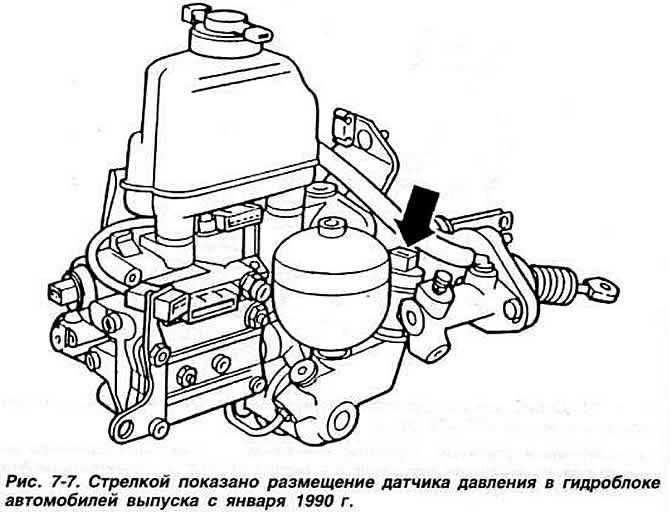
Note. Since January 1990, the pressure sensor is not installed on the end of the master brake cylinder, but on the ABS high-pressure pump (Fig. 7-7), which is supplied as spare parts only with a hole for installing the sensor. On master cylinders supplied as spare parts, the hole for the sensor is closed with a plug. In the case of installing a pump of a modified design with a master cylinder of the previous design, install the pressure sensor on the pump and plug the hole in the master brake cylinder.
System check
The ABS system of 1990 model year vehicles is equipped with a self-diagnostic system, which is identical in principle of operation to the self-diagnostic system of the central fuel injection system "Mono-Jetronic" and KSUD "KE-Motronic" (see the relevant subsection).
The self-diagnosis system memory can only be interrogated using the VAG 1551 reading device.
The ABS electrical circuits are checked through the terminals of the electronic control unit connector. The check is carried out in the following cases:
The original text can be found on the portal: www.vwmanual.ru
- on cars manufactured before January 1990 not equipped with the ABS self-diagnostic system;
- if reading the fault codes does not reveal the location of the fault;
- if a more detailed check is required when determining any fault code.
Visitor comments