
English Русский
Български
Беларускі
Український
Српски
Hrvatski
Română
Polski
Slovenský
Magyar
  |  Articles  |  Sitemap  |  Contacts  |    |
Car maintenance Ford Car maintenance Hyundai Car maintenance Chevrolet Car maintenance BMW Car maintenance Audi Car maintenance Opel Car maintenance AvtoVAZ
VWmanual.ru


Main   Passat   Golf   Polo   Touareg   Tiguan   Sharan   Transporter   Others  
Golf 1 (1974-1984, diesel) Golf 1 (1974-1984, petrol) Golf 2 (1984-1993, petrol) Golf 2 (1984-1993) Golf 3 (1991-1997) Golf 4 (1997-2004) Golf 5 (2003-2008)

Oil pressure warning light (VW Golf 1)

  • Main
  • Golf
  • Golf 1
  • Electrical equipment
  • Equipment and devices
  • Oil pressure warning light
            0


Contents: Malfunctions ↓ Replacing the oil pressure sensor ↓
When the ignition is on, the oil pressure indicator lamp is energized. As long as the oil pressure does not increase, the corresponding current circuit is closed through the oil pressure sensor.

When the oil pressure starts to rise, the oil pressure sensor contact in the engine is triggered. The current circuit is broken. The control lamp goes out. Cold engine oil is quite viscous. This causes high oil pressure, so the control lamp goes out already when the engine is started or after that. In hot summer, the oil in a hot running engine is very thin (low viscosity). Because of this, his pressure, accordingly, becomes lower; the indicator light goes out only at higher speeds.
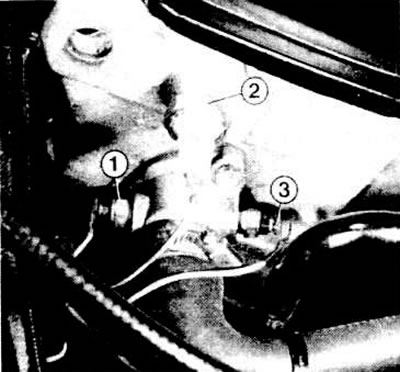
The illustration shows the left front side near the cylinder head of a diesel Volkswagen: 1 -…

The illustration shows the left front side near the cylinder head of a diesel Volkswagen: 1 - temperature sensor; 2 - oil pressure sensor; 3 - engine temperature sensor; to determine the required pre-heating time, the sensor sends a signal to the pre-heating relay.


Malfunctions


If the oil pressure warning light suddenly comes on while driving, it is dangerous for the engine.


If it lights up briefly during sudden braking or fast driving on a curved road, the oil level has obviously dropped below the minimum mark. Check the level and top up with oil if necessary.

If the light stays on for a long time, you must stop the car immediately!

Then first of all check: is there a short circuit in the blue-black wire going from the oil pressure sensor to the LED. Turn on the ignition, remove the wire from the oil pressure sensor. The indicator light should go out when the engine is off. It is best if an assistant observes this. If it continues to burn, then the wire has worn through somewhere and has a contact "to ground". This will not cause damage to the engine; you can go further.

(The original information is posted on the resource VWManual.ru)

However, the oil pressure warning light usually lights up to indicate that there is not enough pressure in the engine's lubrication points. In most cases, this is not caused by a defect in the oil pump, but most often by a sudden loss of oil. For example, a drain plug has come loose. If the malfunction poses a danger to the engine, the car should be towed.

If the oil pressure indicator light is constantly on, the cause is often a faulty sensor. But only by replacing the sensor can this be determined.

When turning the ignition key, the oil pressure light does not light. Turn on the ignition, remove the wire from the oil pressure sensor and press it to the "ground"; if the lamp now lights up, then there is a fault in the oil pressure sensor. Replace the sensor. If the lamp does not light up, then there is a fault in the power supply wire, in the lamp itself, or in the LED.


Note: If the oil pressure warning light comes on after driving through a large puddle of water, this is usually due to the following reason. The oil pump is driven by the intermediate shaft, which in turn is driven by the smooth back of the toothed belt. If the toothed belt tension is too low, it is oiled, or, for example, water has entered this drive, the toothed belt briefly slips on the intermediate shaft. As a result, too little oil is supplied. The toothed belt tension and condition must be checked immediately. See chapter "Engine".


Replacing the oil pressure sensor


The oil pressure sensor is located in an accessible location on the left side of the cylinder head (if you look in the direction of movement)

When replacing the sensor, tighten it with a new sealing ring. The torque is 25 Nm.

This article is available at russian, bulgarian, belarusian, ukrainian, serbian, croatian, romanian, polish, slovak, hungarian
The text has been checked: Medvedeva Elena

Share information:

Previous articles
Brake, high beam and battery warning lights
Clock and direction indicator control
Removal the flexible shaft of the speedometer drive
Speedometer (speed indicator)
Shift indicator
Coolant temperature gauge
Next articles
Pre-incandescent warning light
Key switch — removal and installation
Steering column switch — removal and installation
Starter and glow switch
Driving with a faulty starter and glow switch
Checking the switch


Similar articles from other manuals for VW cars:
Oil pressure, temperature, buzzer warning lights Passat B5 (1996-2005)
Hazard warning light system (since 11.1995) Polo 3 (1995-2003)
Seat belt warning light Touareg 1 (2002-2006)
Relieving pressure in the high pressure area of the fuel system Tiguan 1 (2007-2015)
Checking tire pressure Sharan 1 (1995-2000)
Turn signal, hazard warning, parking light switches Transporter T4 (1990-2003)
Warning light indicators Caddy 3 (2003-2010)
Link to this page in different formats


Visitor comments


No comments yet


How much will 10 + 21 =


Golf 5 
  • General information
  • User manual
  • Maintenance
  • Troubleshooting
  • Power unit
  • Engine repair
  • Cooling and ventilation system
  • Fuel system
  • Ignition system
  • Transmission
  • Clutch
  • Mechanical gearbox
  • Automatic gearbox
  • Chassis
  • Brake system
  • Car suspension
  • Steering
  • Body
  • Interior (internal elements)
  • Exterior (external elements)
  • Doors and covers
  • Electrical equipment
  • Power devices
  • Washers and wipers
  • Lighting and appliances
  • Electrical circuits
Golf 4 
  • General information
  • User manual
  • Weekly checks
  • Maintenance
  • Power unit
  • Petrol engines
  • Diesel engines
  • Cooling system
  • Fuel system (petrol)
  • Control system (petrol)
  • Fuel system (diesel)
  • Exhaust system
  • Transmission
  • Clutch
  • Car gearbox
  • Drive shafts
  • Chassis
  • Car suspension
  • Steering
  • Wheels and tires
  • Brake system
  • Body
  • Exterior (external elements)
  • Interior (internal elements)
  • Ventilation and heating
  • Car doors and sunroof
  • Washers and glass cleaners
  • Electrical equipment
  • Power devices
  • Lighting and appliances
  • Electrical circuits
Golf 3 
  • Petrol engine
  • Engine repair
  • Lubrication system
  • Cooling system
  • Ignition system
  • Diesel engine
  • Engine repair
  • Diesel injection system
  • Pre-glow system
  • Transmission
  • Clutch
  • Gearbox and drive shafts
  • Chassis
  • Steering
  • Wheels and suspension
  • Brake system
  • Electrical equipment
  • Lighting and appliances
  • Electrical circuits
Golf 2 
  • General information
  • Introduction to guide
  • User manual
  • Petrol engines 1.3 l
  • Engine repair
  • Lubrication system
  • Cooling system
  • Carburetors
  • Supply system
  • Ignition system
  • Petrol engines 1.6/1.8 l
  • Engine repair
  • Supply system
  • Ignition system
  • Diesel engines
  • Engine repair
  • Lubrication system
  • Cooling system
  • Power and exhaust system
  • Transmission
  • Clutch
  • 4-speed gearbox 084
  • 5-speed gearbox 085
  • 4-speed gearbox 020/4R
  • 5-speed gearbox 020/4T
  • Automatic gearbox
  • Drive shafts
  • Chassis
  • Steering
  • Car suspension
  • Brake system
  • Body
  • Body elements
  • Doors, locks and windows
  • Electrical equipment
  • Equipment and devices
  • Power devices
Golf 2 (petrol) 
  • General information
  • Characteristics
  • Car care
  • Maintenance
  • Power unit
  • Engine repair
  • Engine 1.05/1.30
  • Engine 1.60/1.80
  • Cooling and lubrication system
  • Power and exhaust system
  • Transmission
  • Clutch
  • Car gearbox
  • Drive shafts
  • Chassis
  • Brake system
  • Steering
  • Suspension
  • Body
  • Body and equipment
  • Electrical equipment
  • Lighting and appliances
  • Electrical circuits
Golf 1 (petrol) 
  • General information
  • Characteristics
  • User manual
  • Maintenance
  • Power unit
  • Engine adjustment
  • Engine 1.1/1.3
  • Engine 1.5/1.6/1.8
  • Engine electrical equipment
  • Cooling system
  • Fuel system
  • Transmission
  • Clutch and manual gearbox
  • Automatic gearbox
  • Chassis
  • Steering
  • Front suspension
  • Rear suspension
  • Brake system
  • Electrical equipment
  • Lighting and appliances
  • Electrical circuits
  • Body
  • Body and equipment
  • Optional equipment
Golf 1 (diesel) 
  • General information
  • Specifications
  • Maintenance
  • Power unit
  • Engine repair
  • Exhaust and turbocharger
  • Cooling system
  • Fuel system
  • Fuel injection system
  • Transmission
  • Clutch and drive shafts
  • Car gearbox
  • Chassis
  • Suspension and wheels
  • Steering
  • Brake system
  • Wheels and tires
  • Body
  • Heating and ventilation
  • Exterior (external elements)
  • Interior (internal elements)
  • Doors and windows
  • Electrical equipment
  • Equipment and devices
  • Lighting system
  • Power devices
  • Electrical circuits
VWmanual.ru © 2016-2026 | Mobile version | News and articles | Sitemap: EN BG BY UA RS HR RO PL SK HU | Write message | Site search
Passat B2 • Passat B3 • Passat B4 • Passat B5 • Passat B6 • Golf 1, diesel • Golf 1, petrol • Golf 2, petrol • Golf 2 • Golf 3 • Golf 4 • Golf 5 • Polo 3 • Polo 4 • Touareg 1 • Tiguan 1 • Sharan 1 • Transporter T3 • Transporter T4 • LT 28 • LT 2D • Beetle • Caddy 3 •
Our website uses cookies to ensure functionality and convenience.