



1. Check the condition of the thick wire between the battery and the retractor (solenoid) starter. Connections must be securely tightened, clean and make good electrical contact.
2. The starter pinion must not remain engaged with the flywheel ring gear. Engage the gearbox in a higher gear and push the car back and forth several times - this should release the starter drive gear. Inspect the flywheel ring gear and starter gear for possible broken teeth.
3. Check the operation of the retractor relay, including the starter by turning the ignition key and at the same time listening to the solenoid. When the starter is turned on, a characteristic click should be heard
4. If there is no click, check the voltage supply to the solenoid. Disconnect a thin wire from the solenoid and connect a 12-volt lamp to it, connect its second wire to "weight". The lamp should illuminate brightly when the ignition key is turned to the starter position. If this does not happen, the ignition switch or wires are faulty. Connect the wires correctly (pic. D:26).
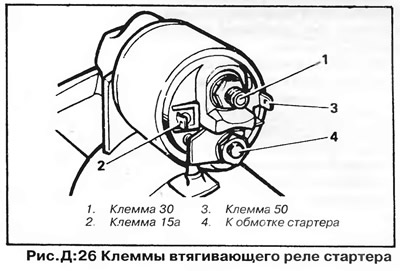
5. Check the operation of the power contacts of the retractor relay by connecting a test lamp to the two main contacts.
If the lamp does not light up brightly, check the reliability of the fastening of the starter and the connection of the contacts of the solenoid relay with thick wires coming from the battery and to the starter winding. If the connections are reliable, you can assume a malfunction of the brushes and starter windings.
If the lamp is on, turn on the starter by turning the ignition key, while the lamp should go out, because. the solenoid relay closes the contacts, and the current flows through the circuit of least electrical resistance. If the lamp continues to burn, replace the solenoid relay contacts.
6. If these checks do not reveal a problem, replace or repair the starter itself.
Visitor comments