



Removal and installation
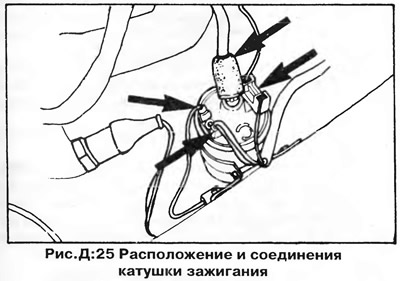
The ignition coil is mounted at the rear of the engine compartment (figure D:25). To remove the coil, disconnect the low-voltage wire connectors from the coil terminals, disconnect the high-voltage wire going to the distributor cap, and remove the mounting bolts. Installation is done in reverse order.
Checking the ignition coil
Ignition coil faults are difficult to detect. To confirm that the ignition coil is completely faulty, perform the following check:
1. Check for low voltage at the ignition coil positive (+) terminal using a test lamp (with ignition on). If there is no low voltage, check the ignition switch and wiring.
2. If there is voltage at the positive terminal of the coil, check the voltage at the negative terminal. If there is no voltage at the negative terminal, the coil is faulty.
3. If this test does not reveal a fault, the ignition coil is sufficiently functional to start the engine, but after some time, when the coil warms up, the fault may reappear. Constant misfires at high speeds and under load may indicate a faulty ignition coil, if the rest of the ignition system is known to be sufficiently reliable.
4. The best way to test a coil is to replace it with a known good one and make a comparison.
Visitor comments