English Русский
Български
Беларускі
Український
Српски
Hrvatski
Română
Polski
Slovenský
Magyar
  |  Articles  |  Sitemap  |  Contacts  |    |
Car maintenance Ford Car maintenance Hyundai Car maintenance Chevrolet Car maintenance BMW Car maintenance Audi Car maintenance Opel Car maintenance AvtoVAZ
VWmanual.ru


Main   Passat   Golf   Polo   Touareg   Tiguan   Sharan   Transporter   Others  
Golf 1 (1974-1984, diesel) Golf 1 (1974-1984, petrol) Golf 2 (1984-1993, petrol) Golf 2 (1984-1993) Golf 3 (1991-1997) Golf 4 (1997-2004) Golf 5 (2003-2008)

Ignition distributor (VW Golf 1)

  • Main
  • Golf
  • Golf 1
  • Power unit
  • Engine electrical equipment
  • Ignition distributor
            0


Contents: Removal - all engines ↓ Installation - engines 1.1/1.3 ↓ Installation - engines 1.5/1.6/1.8 l ↓ Repair ↓

Removal - all engines


1. Disconnect the ground wire from the battery, turn the crankshaft so as to bring the piston of cylinder No.1 to TDC at the end of the compression stroke (see chapter "Engine adjustment"), then remove the distributor cap. The rotor should be directed towards the contact of the spark plug wire of the 1st cylinder.

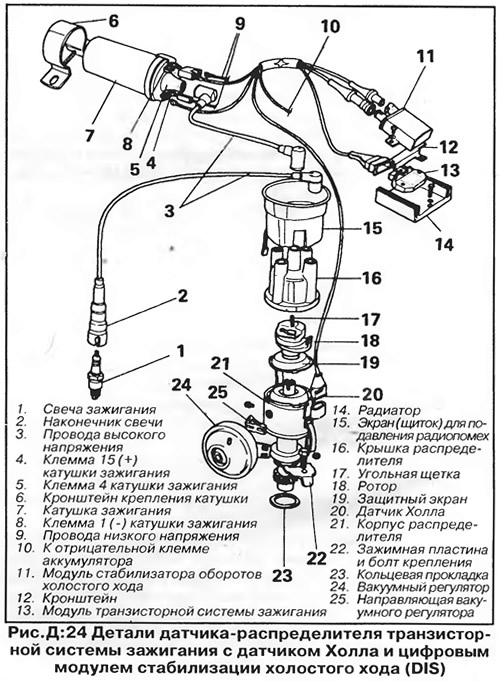
2. Disconnect the condenser wires and vacuum tube. On vehicles with electronic ignition, disconnect the connector of the idle speed stabilizer (module) and transistor unit.

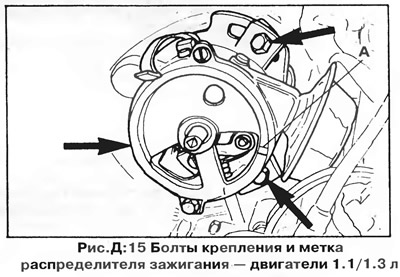
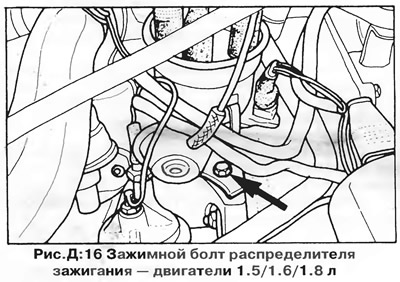
3. Unscrew the ignition distributor mounting bolts - three bolts on the 1.1/1.3 l engine (figure D:15) or one clamp bolt on 1.5/1.6/1.8L engines (figure D:16). Carefully remove the distributor from the engine, noting the position of the rotor - if necessary, mark the housing before removing.
3. Unscrew the ignition distributor mounting bolts - three bolts on the 1.1/1.3 l engine (figure…


3. Unscrew the ignition distributor mounting bolts - three bolts on the 1.1/1.3 l engine (figure…


CAUTION: It may be necessary to rotate the distributor housing to remove it.


Installation - engines 1.1/1.3


1. Make sure that the piston of cylinder No.1 is in the TDC position at the end of the compression stroke.

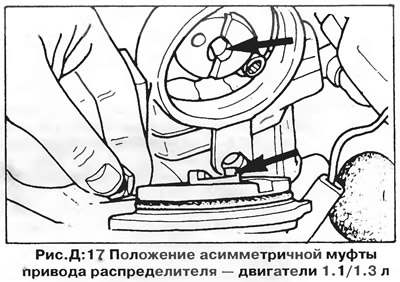
2. Mark the position of the asymmetrical distributor drive coupling in the cylinder head and turn the distributor shaft so that during installation the coupling slot aligns with the protrusions on the distributor shaft (figure D:17).
2. Mark the position of the asymmetrical distributor drive coupling in the cylinder head and turn…


3. Insert the distributor, aligning its shaft with the asymmetric drive coupling.

4. After installation, the rotor should point to the spark plug wire contact of cylinder #1 on the cover, as well as to the mark on the distributor housing (A, figure D:15).

5. Fix the distributor in this position, replace the distributor cover and connect the capacitor and wires.

6. Connect the battery, start the engine and adjust the ignition timing using a strobe lamp (see chapter "Engine adjustment").

7. Fully tighten the distributor mounting bolts and connect the vacuum pipe.

The information is posted on this website: www.vwmanual.ru

Installation - engines 1.5/1.6/1.8 l


If the crankshaft position has been changed, the timing marks must be aligned before installing the distributor. Remove the TDC sensor or plastic plug from the hole in the upper part of the clutch housing. Turn the crankshaft until the TDC mark ("0") on the flywheel or drive disk is aligned with the pointer in the hole. The mark on the camshaft sprocket should be level with the upper edge of the cylinder head, as shown in Figure D:18. If this is not the case, turn the crankshaft one full revolution and check the alignment again. When the marks are aligned, the piston of cylinder No.1 is set to the TDC position at the end of the compression stroke.
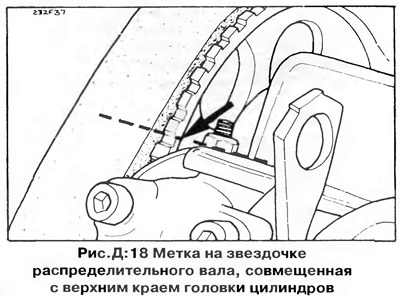

If the crankshaft position has been changed, the timing marks must be aligned before installing the…


On early models, there is no mark on the camshaft sprocket. Remove the valve cover and rotate the engine so that the lobes of both cylinder #1 cams on the camshaft are facing up.

Install the oil pump drive shaft so that the slot on the end of the shaft is parallel to the crankshaft axis.

Make sure the gasket (sealing washer) on the distributor flange in good condition and correctly positioned. Install the distributor rotor so that it aligns with the mark on the housing made when removing the distributor, then install the distributor by inserting the projection on the end of the distributor shaft into the slot in the drive shaft of the oil pump. When installing, the rotor should turn slightly and align with the groove on the edge of the distributor housing (figure D:19). If alignment does not occur, remove the distributor and install it again, after slightly turning the rotor.
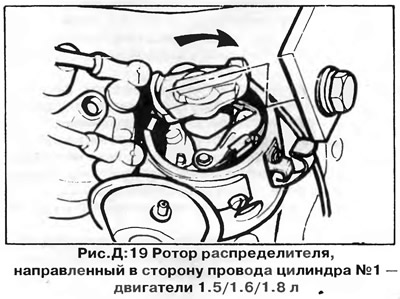
Make sure the gasket (sealing washer) on the distributor flange in good condition and correctly…


Secure the distributor with the clamp plate and bolt. Attach the vacuum hose and the high and low voltage wires. On contactless ignition distributors, connect the connector of the wires coming from the control unit, then set the ignition timing as described in Chapter "Engine adjustment". Finally tighten the clamp plate bolt.

Repair


All early model engines are fitted with a standard Bosch breaker distributor (except for some 1.1L engines with Ducellier distributor). Later models of 1.5, 1.6 and 1.8 L engines are equipped with an electronic ignition system with a Hall sensor.

In most cases of wear or damage to distributor parts (shaft, centrifugal ignition timing adjuster weights), especially after a high mileage of the car, it is most economical to replace the distributor assembly.

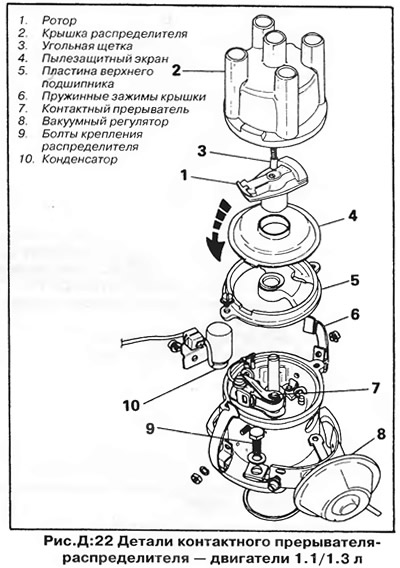
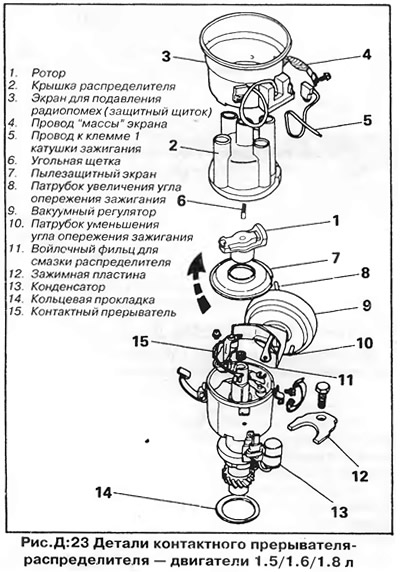
The only easily replaceable part of the distributor is the upper bearing plate, located at the top of the distributor and secured with two screws to the distributor housing or to a plate held in the housing by a retaining ring (drawing D:20 and D:21). The upper bearing plate must be removed to replace the breaker contacts - see chapter "Engine adjustment".
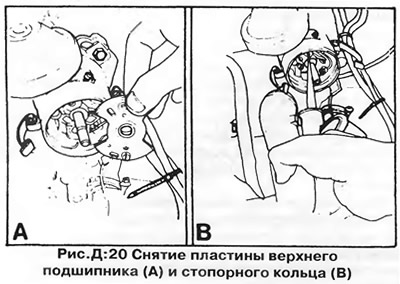
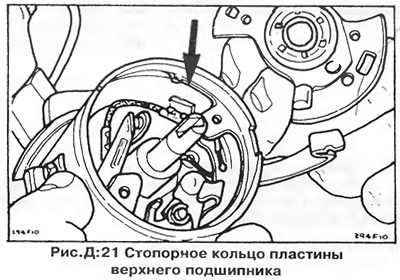
The only easily replaceable part of the distributor is the upper bearing plate, located at the top…


The only easily replaceable part of the distributor is the upper bearing plate, located at the top…


The rest of the distributor is a non-separable unit, and if worn, the distributor should be replaced with a new one.
The rest of the distributor is a non-separable unit, and if worn, the distributor should be…


The rest of the distributor is a non-separable unit, and if worn, the distributor should be…


The rest of the distributor is a non-separable unit, and if worn, the distributor should be…

This article is available at russian, bulgarian, belarusian, ukrainian, serbian, croatian, romanian, polish, slovak, hungarian
The text has been checked: Tarasov Ivan

Share information:

Previous articles
Generator repair
Removal and installation the generator
Checking the charging circuit
Tools and equipment
General information about the engine electrical equipment
Next articles
Ignition coil
Checking the starter
Removal and installation the starter
Starter repair
Replacing sensors
Possible malfunctions of the engine electrical equipment


Similar articles from other manuals for VW cars:
Distributor of ignition systems TSZ and Digifant Passat B3 (1988-1993)
Installing the ignition distributor Polo 3 (1995-2003)
Emergency removal of the ignition key Touareg 1 (2002-2006)
Ignition system repair Tiguan 1 (2007-2015)
Ignition distributor for 2.0 liter engine Sharan 1 (1995-2000)
Ignition distributor — design description Transporter T4 (1990-2003)
Removal and installation the ignition distributor Beetle (1960-1986)
Link to this page in different formats


Visitor comments


No comments yet


How much will 43 + 27 =


Golf 5 
  • General information
  • User manual
  • Maintenance
  • Troubleshooting
  • Power unit
  • Engine repair
  • Cooling and ventilation system
  • Fuel system
  • Ignition system
  • Transmission
  • Clutch
  • Mechanical gearbox
  • Automatic gearbox
  • Chassis
  • Brake system
  • Car suspension
  • Steering
  • Body
  • Interior (internal elements)
  • Exterior (external elements)
  • Doors and covers
  • Electrical equipment
  • Power devices
  • Washers and wipers
  • Lighting and appliances
  • Electrical circuits
Golf 4 
  • General information
  • User manual
  • Weekly checks
  • Maintenance
  • Power unit
  • Petrol engines
  • Diesel engines
  • Cooling system
  • Fuel system (petrol)
  • Control system (petrol)
  • Fuel system (diesel)
  • Exhaust system
  • Transmission
  • Clutch
  • Car gearbox
  • Drive shafts
  • Chassis
  • Car suspension
  • Steering
  • Wheels and tires
  • Brake system
  • Body
  • Exterior (external elements)
  • Interior (internal elements)
  • Ventilation and heating
  • Car doors and sunroof
  • Washers and glass cleaners
  • Electrical equipment
  • Power devices
  • Lighting and appliances
  • Electrical circuits
Golf 3 
  • Petrol engine
  • Engine repair
  • Lubrication system
  • Cooling system
  • Ignition system
  • Diesel engine
  • Engine repair
  • Diesel injection system
  • Pre-glow system
  • Transmission
  • Clutch
  • Gearbox and drive shafts
  • Chassis
  • Steering
  • Wheels and suspension
  • Brake system
  • Electrical equipment
  • Lighting and appliances
  • Electrical circuits
Golf 2 
  • General information
  • Introduction to guide
  • User manual
  • Petrol engines 1.3 l
  • Engine repair
  • Lubrication system
  • Cooling system
  • Carburetors
  • Supply system
  • Ignition system
  • Petrol engines 1.6/1.8 l
  • Engine repair
  • Supply system
  • Ignition system
  • Diesel engines
  • Engine repair
  • Lubrication system
  • Cooling system
  • Power and exhaust system
  • Transmission
  • Clutch
  • 4-speed gearbox 084
  • 5-speed gearbox 085
  • 4-speed gearbox 020/4R
  • 5-speed gearbox 020/4T
  • Automatic gearbox
  • Drive shafts
  • Chassis
  • Steering
  • Car suspension
  • Brake system
  • Body
  • Body elements
  • Doors, locks and windows
  • Electrical equipment
  • Equipment and devices
  • Power devices
Golf 2 (petrol) 
  • General information
  • Characteristics
  • Car care
  • Maintenance
  • Power unit
  • Engine repair
  • Engine 1.05/1.30
  • Engine 1.60/1.80
  • Cooling and lubrication system
  • Power and exhaust system
  • Transmission
  • Clutch
  • Car gearbox
  • Drive shafts
  • Chassis
  • Brake system
  • Steering
  • Suspension
  • Body
  • Body and equipment
  • Electrical equipment
  • Lighting and appliances
  • Electrical circuits
Golf 1 (petrol) 
  • General information
  • Characteristics
  • User manual
  • Maintenance
  • Power unit
  • Engine adjustment
  • Engine 1.1/1.3
  • Engine 1.5/1.6/1.8
  • Engine electrical equipment
  • Cooling system
  • Fuel system
  • Transmission
  • Clutch and manual gearbox
  • Automatic gearbox
  • Chassis
  • Steering
  • Front suspension
  • Rear suspension
  • Brake system
  • Electrical equipment
  • Lighting and appliances
  • Electrical circuits
  • Body
  • Body and equipment
  • Optional equipment
Golf 1 (diesel) 
  • General information
  • Specifications
  • Maintenance
  • Power unit
  • Engine repair
  • Exhaust and turbocharger
  • Cooling system
  • Fuel system
  • Fuel injection system
  • Transmission
  • Clutch and drive shafts
  • Car gearbox
  • Chassis
  • Suspension and wheels
  • Steering
  • Brake system
  • Wheels and tires
  • Body
  • Heating and ventilation
  • Exterior (external elements)
  • Interior (internal elements)
  • Doors and windows
  • Electrical equipment
  • Equipment and devices
  • Lighting system
  • Power devices
  • Electrical circuits
VWmanual.ru © 2016-2026 | Mobile version | News and articles | Sitemap: EN BG BY UA RS HR RO PL SK HU | Write message | Site search
Passat B2 • Passat B3 • Passat B4 • Passat B5 • Passat B6 • Golf 1, diesel • Golf 1, petrol • Golf 2, petrol • Golf 2 • Golf 3 • Golf 4 • Golf 5 • Polo 3 • Polo 4 • Touareg 1 • Tiguan 1 • Sharan 1 • Transporter T3 • Transporter T4 • LT 28 • LT 2D • Beetle • Caddy 3 •
Our website uses cookies to ensure functionality and convenience.