



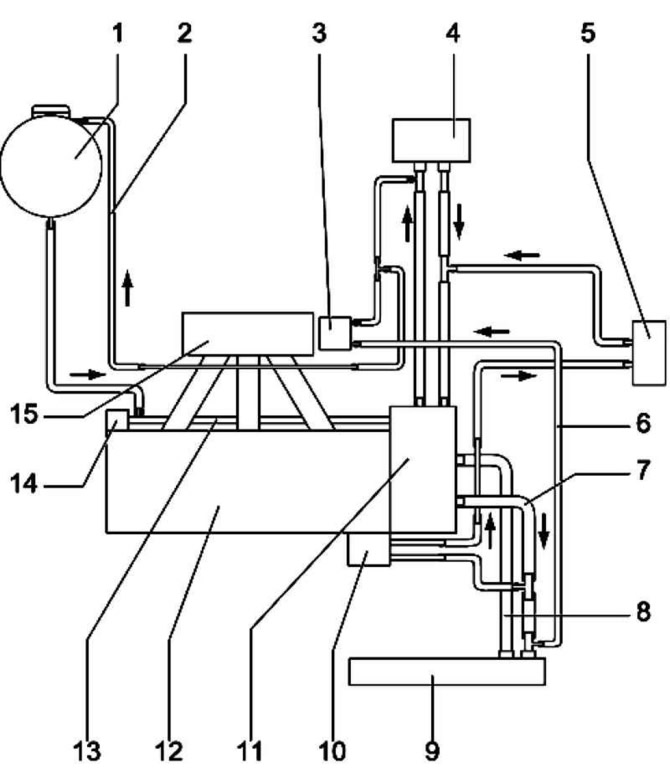
Fig. 2.62. Cooling system hose connection diagram: 1 – expansion tank; 2 – cooling system hose; 3 – EGR valve with EGR potentiometer; 4 – heater heat exchanger; 5 – transmission oil cooler; 6 – cooling system hose; 7 – coolant hose, upper; 8 – coolant hose, lower; 9 – radiator; 10 – Engine oil cooler; 11 – thermostat housing; 12 – cylinder head/cylinder block; 13 – coolant supply pipe; 14 – water pump; 15 – intake manifold
Drain
Open the expansion tank cap.
Warning: Hot steam may escape from the expansion tank when opened. Wear protective goggles and clothing to avoid eye injury and scalding. Cover the tank cap with a rag and carefully open it.
Remove the crankcase guard.
Remove the retaining clip and remove the connecting pipe from the radiator.
Note: Please follow the disposal rules
Bay
The freezing temperature of the coolant must be at least –25°C (in countries with an arctic climate – at least –35°C).
Note: Only G 12 plus is permitted to be used as a concentrate according to the standard "TL VW 774 F". Characteristic feature - lilac color
Note: G 12 plus is standard "TL VW 774 F" can be mixed with previously used concentrate G 12 - red
Note: G 12 plus and concentrates marked in accordance with "TL VW 774 F" prevent the cooling liquid from freezing and the formation of corrosion and scale. In addition, they increase the boiling point of the cooling liquid. Therefore, the cooling system must operate with an antifreeze and anticorrosive concentrate throughout the year.
It is also prohibited to reduce the proportion of concentrate in the coolant during the warm season or when operating in countries with a warm climate by adding water to the cooling system. The proportion of concentrate must be at least 40%.
If the freezing point must be lowered due to climatic conditions, the proportion of G 12 plus concentrate can be increased, but not more than to 60% (the freezing point in this case will be approximately –40°C). If this limit is exceeded, the freezing point will increase again and, in addition, the heat capacity of the coolant will decrease.
When replacing the radiator, heater heat exchanger, cylinder head or cylinder head gasket, reusing the drained coolant is prohibited.
Recommended mixing proportions
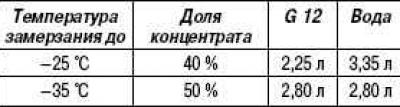
Note: The amount of coolant to be added may vary depending on the vehicle configuration.
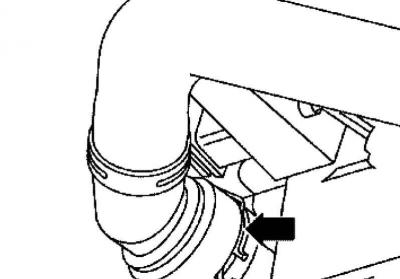
Fig. 2.63. Mounting bracket
Press the connecting pipe against the radiator and slide the mounting bracket in the direction of the arrow (Fig. 2.63).
Install the crankcase guard.
With a device for filling the cooling system.
Fill the coolant using a cooling system filling device.
Without a device for filling the cooling system.
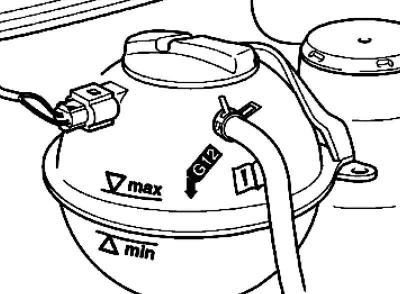
Fig. 2.64. Expansion tank
Fill the coolant to the Max. mark on the expansion tank (Fig. 2.64).
With and without a device for filling the cooling system.
Close the expansion tank.
Turn off the heater.
Start the engine and maintain the speed at 2000 rpm for about 3 minutes.
Leave the engine running until the fan comes on.
Warning: Hot steam may escape from the expansion tank when opened. Wear protective goggles and clothing to avoid eye injury and scalding. Cover the tank cap with a rag and carefully open it.
[The information is posted on this resource: VWmanual.ru]
Check the coolant level and top up if necessary. When the engine is warm, the coolant level should be at the Max mark, and when the engine is cold, between the Min and Max marks.
Visitor comments