



If the coolant temperature is between +92° and +97°C, the thermal switch turns on the fan. The fan is driven by an electric motor and rotates until the coolant temperature drops to +84° - +91°C.
Note: The electric fan may also switch on when the ignition is off. Due to heat generation in the engine compartment, it may switch on multiple times.
Thanks to the fan not always working, the useful engine power increases and fuel consumption decreases.
Vehicles with air conditioning or a trailer towing hitch are additionally equipped with a second fan due to the engine's greater cooling requirements. The second fan is driven by a V-belt from the first fan, so when the thermal switch is on, both operate simultaneously.
Note: If a trailer towing hitch is installed additionally and this will increase the load on the engine, it is recommended to install a second fan at the same time.
Cooling system capacity, l:
- 4-cylinder petrol engine - 6.0
- Diesel engine and 100 kW (136 hp) engine - 8.5
- Engine power 118 kW (160 hp) - 5.5
- 6-cylinder engine - 10.0
The figure shows a 4-cylinder engine with a fuel injection system.
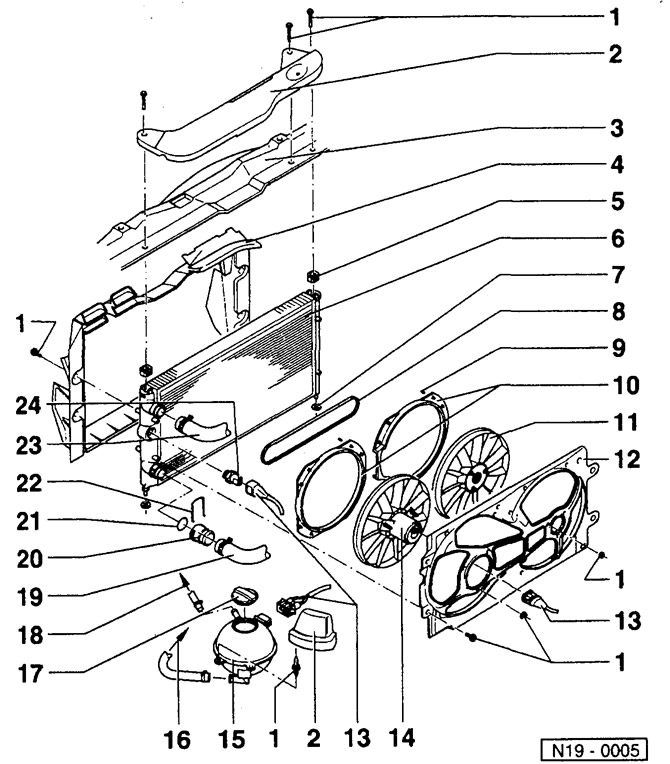
Note: The coolant hoses are secured with expansion clamps. In the event of repair, these clamps can be reinstalled. If damaged, these clamps can be replaced with clamps tightened with screws.
- 1 - bolt, 10 Nm
- 2 — casing
- 3 - castle beam
- 4 — air duct casing
- 5 — holder
- 6 — radiator
- 7 - rubber washer
- 8 - V-belt
Only with additional equipment.
- 9 - expansion pin
- 10 - guide ring
Pay attention to the installation position, it is secured with clamps to the fan bracket.
- 11 - additional fan
Only with additional equipment.
- 12 — fan bracket
- 13 - connecting plug
- 14 — fan
- 15 - expansion tank
- 16 - to the coolant pipeline
- 17 — expansion tank cap
Control overpressure: 1.3-1.5 bar
- 18 - to the connecting pipe
- 19 — lower coolant hose
- 20 — connecting pipe
- 21 - sealing ring
Replace.
- 22 — locking bracket
- 23 — upper coolant hose
- 24 — fan thermal switch, 35 Nm
Visitor comments