



At high coolant temperatures, an electric fan is switched on, which provides additional cooling of the radiator. The electric fan is switched on and off as needed by a thermal switch. Depending on the equipment, for example, if there is an air conditioning system, an additional electric fan is installed.
Safety instructions
The electric fan can be switched on automatically even when the ignition is off. Due to the heat support in the engine compartment, multiple switching on is possible. Before carrying out work in the engine compartment, it is necessary to disconnect the plug connector at the electric fan motor.
Caution: When working on the cooling system, make sure that coolant does not come into contact with the toothed belt under any circumstances. The glycol contained in the coolant can damage the toothed belt cord so that after some time during operation the belt will break, causing serious damage to the engine.
Note: When installing, lay coolant hoses without tension so that they do not touch other parts. If there are marks or arrows on the pipes and ends of the coolant hoses, they must be opposite each other during installation.
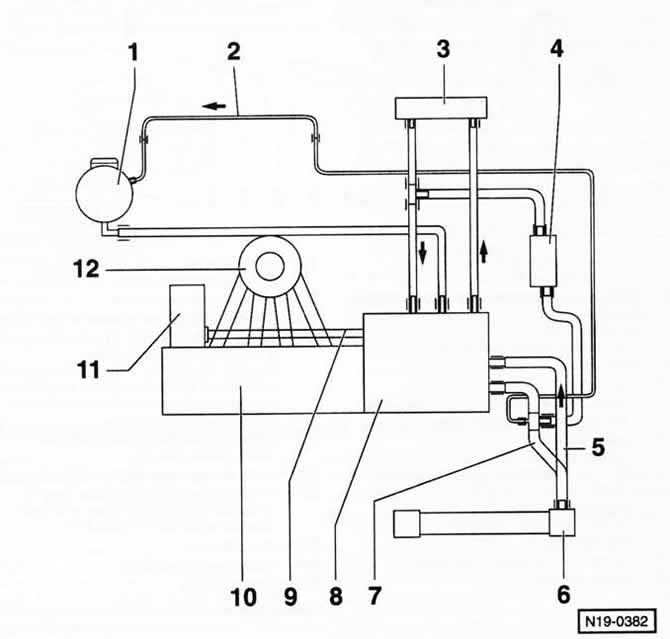
Coolant hose connection diagram
The figure refers to a petrol engine with a displacement of 1.4 l and a power of 55/74 kW (75/100 hp).
1 - expansion tank
2 - Upper coolant pipe
Attaches to the camshaft housing.
3 — heating system heat exchanger
4 - transmission oil cooler
Only available with automatic transmission.
5 - lower coolant hose
6 — radiator
7 - Upper coolant hose
8 — thermostat housing
9 — coolant pipeline
10 — engine cylinder head/block
11 — coolant pump
12 — intake manifold
Dual-circuit cooling system for a 1.4-liter gasoline engine with direct gasoline injection
The FSI engine has a dual-circuit cooling system. Separate coolant flows with different temperatures are directed through the cylinder head and the cylinder block. The coolant flows are controlled by two thermostats located in a common housing. One thermostat is intended for the cylinder block, and the other for the cylinder head.
The dual-circuit cooling system has the following advantages:
- The cylinder block warms up faster because the coolant remains in the block until it reaches a temperature of 105°C.
- Due to the higher temperature level of the cylinder block, friction in the crank mechanism is reduced.
- Better cooling of combustion chambers due to lower cylinder head temperatures.

Visitor comments