



Contents: Extended Life Motor Oil ↓ All-season motor oil ↓ General specification of motor oil ↓ Oil consumption ↓
All-season oils are intended for engine lubrication, so engine oil should not be replaced with the onset of a new season (summer/winter). All-season oils are produced on the basis of low-viscosity seasonal oil (for example, 10 W). Thanks to the so-called thickener, the oil is stabilized in a hot state. As a result, the necessary lubricating ability of the oil is achieved for both a cold and a hot engine.
The SAE classification indicates the viscosity of motor oil. SAE — Society of Automotive Engineers — Society of Automotive Engineers.
For example, the designation SAE 10 W 40 indicates the following:
- 10 — viscosity of oil when cold. The lower this number, the more fluid the cold oil is.
- W - this symbol indicates that the oil is suitable for use in winter.
- 40 - viscosity of oil when hot. The higher this number, the thicker the hot oil.
Extended Life Motor Oil
POLO engines are filled with extended-life engine oil at the factory. To maintain the two-year oil change interval, only extended-life engine oil that meets VW standard requirements must be used when topping up and changing.
Conventional motor oils that meet the VW standard can also be used. However, in this case the service interval indicator must be set to 12 months/15,000 km.
Purpose of VW standard motor oils with extended service life:
VW Standard/Engine Type
- 50300/ Gasoline
- 50600/ Diesel (not with pump-injectors)
- 50601/ Diesel (with pump-nozzles)
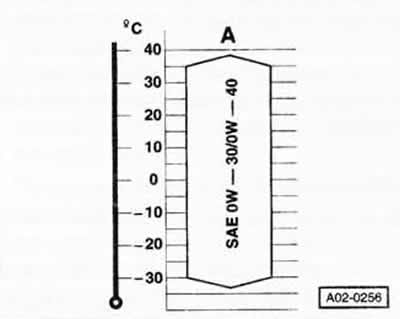
Petrol engines:
A - all-season low-friction oils for unscheduled service intervals. VW 50300.
(The original text can be found on the portal: vwmanual.ru)
Diesel engines:
A — all-season low-friction oils for unscheduled service intervals. VW 50600 for diesel engines without pump-injectors. VW 50601 for diesel engines with pump-injectors.
Note: When driving long distances or abroad in a vehicle with Longlife Service, it is recommended to have a canister with the required supply of standard engine oil in the luggage compartment. If the oil level needs to be topped up and the standard oil with an extended service life is not available, then up to 0.5 l of standard VW 50200 oil can be added to the petrol engine. In this case, standard VW 50500 oil can be added to the diesel engine (VW 50501 for diesel engines with pump-injectors). In this case, the maintenance interval indicator must be reprogrammed to "nicht flexibel" (regulated) no need.
All-season motor oil
IBIZA/CORDOBA engines are filled with all-season motor oil at the factory. The use of such oil is also permitted for POLO engines, but the maintenance interval indicator must be reprogrammed from the "unscheduled" mode to the "scheduled" mode.
Purpose of VW standard motor oils:
VW standard/Engine type
- 50000,50101,50200/ Gasoline
- 50500/ Diesel (not with pump-injectors)
- 50501/ Diesel (with pump-nozzles)
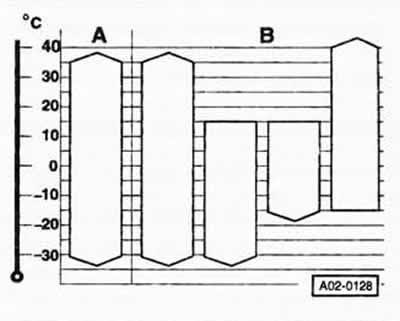
Petrol engines:
A - all-season low-friction oils of the VW 50000 standard. The date after the standard designation must be no earlier than 1.97.
All-season low-friction oils of VW 50200 standard.
B - all-season oils of the VW 50101 standard. The date no earlier than 1.97 should be behind the standard designation.
All-season oils of API-SF or API-SG specification. These oils should only be used if there are no oils approved for use by the VW concern.
Diesel engines
A - All-season low-friction oils of the VW 50000 standard together with the VW 50500 standard. The date after the standard designation must be no earlier than 10.97.
B — all-season oils of standard VW 50500, VW 50501. The date after the standard designation must be no earlier than 1.97. All-season oils of standard WV50101 together with standard VW 50500. The date after the standard designation must be no earlier than 1.97.
All-season oils of API-CD specification. These oils should be used only as a last resort for topping up.
General specification of motor oil
The quality of motor oil is determined by the standards of car and oil manufacturers.
The quality of motor oils from American oil manufacturers is designated by the API system (American Petroleum Institut). The characteristic is given, depending on the circumstances, in two letters. The first letter indicates the area of application: S (Service) - used in gasoline engines: C (Commercial) — used in diesel engines. The second letter indicates the quality in alphabetical order. According to the API specification, the highest quality oils are SL for gasoline engines and CF for diesel engines. European oil manufacturers classify their oils according to the ACEA (Association des Constructeurs Europeens d'Automobiles) specification, which primarily takes into account European engine manufacturing technologies. Depending on their quality, oils for gasoline engines of passenger cars are divided into ACEA classes from A1-96 to AZ-96; motor oils for diesel engines belong to classes from B1-96 to B4-96. The highest quality oils for gasoline engines belong to class 3, and for diesel engines - to class B3. Class B4 oils are intended for diesel engines with direct mixture formation, but can also be used in cases where the operating manual specifies class B3 oil. The number 96 indicates the year the ACEA classification came into effect - 1996. Motor oils with a higher number indicating the year can also be used.
Oil consumption
In the case of an internal combustion engine, oil consumption is the amount of oil consumed as a result of the combustion process. Oil consumption should never be equated with oil loss due to leaks in the oil pan, cylinder head cover, etc. Normal oil consumption occurs due to combustion in smaller quantities, depending on the circumstances, in the cylinder, as well as due to the removal of combustion products and wear particles. In addition, oil ages under the influence of high temperatures and pressures, to which it is constantly exposed in the engine. In addition, oil consumption is affected by external operating conditions, driving mode, and manufacturing tolerances. Oil consumption should not exceed 1.0 l per 1000 km.
Caution: Under no circumstances should the oil level be above the Maximal mark. If too much oil has been added, the excess must be drained. Otherwise, the catalytic converter may be damaged, as unburned oil enters the exhaust system.
Visitor comments