



2. To remove the connecting rods from the pistons, you must first mark their location relative to the pistons. The mark on the connecting rod is on the side that the arrow on the piston bottom points to. If there are no markings on the connecting rod, we stamp a dot on the side of the connecting rod that the arrow on the piston points to. This will make installation easier later.
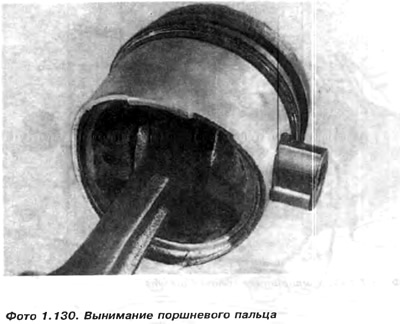
3. Remove the piston ring protectors, then immerse the piston in hot water (about 60°C) and knock out the piston pin.
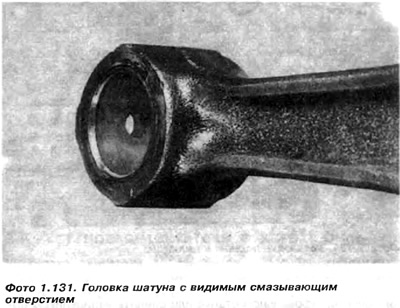
4. If the piston pin extends under its own weight from the horizontally mounted connecting rod, it is necessary to replace the bushing and the pin. We replace the bushing by knocking out the old one and pressing a new one in its place. We make a hole in the bushing for lubrication and ream it to the size of the pin, paying attention to the installation gap of 0.006 mm. During drilling, we install the hole in the connecting rod vertically. After drilling, the pin should fit tightly into the hole. Punch the pin through the hole several times, and carefully scrape off the bushing material in places where there are remaining prints. After this, the connecting rod should rotate freely on the pin, but the pin does not extend from the bushing under its own weight. Before final installation, wipe the surfaces of the bushing, pin and piston hubs, and then lubricate.
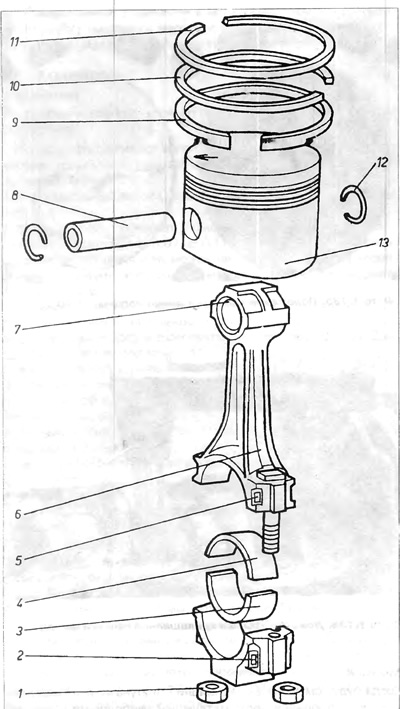
Piston with connecting rod
1 - connecting rod bolt nut; 2 - sign on the connecting rod crank head cover; 3 - lower half-liner; 4 - upper half-insert; 5 - sign on the top of the connecting rod crank head; 6 - connecting rod; 7 - connecting rod head bushing; 8 - piston pin; 9 - oil scraper ring; 10 - sealing ring; 11 - Upper chrome ring; 12 - piston pin guard; 13 - piston.
5. Assemble the pistons with the connecting rods in the reverse order, paying attention to the correct installation of the piston relative to the connecting rod. It is also important to correctly and securely insert the piston pin guards into the grooves.
Note: If it is necessary to check whether the axis of the sleeve made is parallel to the axis of the hole in the crank head of the connecting rod, it is necessary to give the connecting rods with adjusted pins to the plant, where this will be checked on the marking plate and prism using a clock gauge.
If necessary, and practice shows that this is usually necessary, the axles should be adjusted. This is called connecting rod straightening. If the parallelism of the axle is not maintained, after installation the piston will be skewed in the cylinder and will be pressed against one wall. This will cause rapid wear of the cylinder liner on the side of the wall where the piston is pressed, and blow-through will appear again between the piston and the cylinder.
6. Before inserting new rings, it is necessary to place each of them in the cylinder bore, about 15.0 mm from the bottom edge and check whether the gap on the piston ring locks is the same as in "Technical data". If the gap is very large, the ring being checked must be replaced with a new one. If the gap is very small, the ends of the ring must be ground on a special grinding machine or filed with a cloth file. If the gap is very small, the ring cannot expand and may burst.
7. We put the rings on the piston using special pliers or inserting them along three thin plates of the feeler gauge, for example, 0.1 mm, which help to avoid the remaining grooves on the piston.
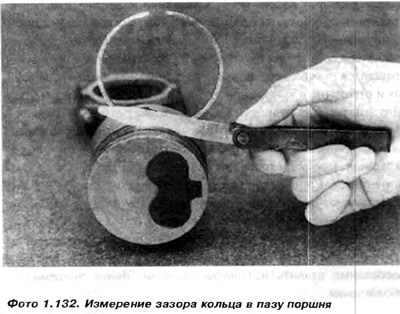
8. When installing the rings, it is necessary to check whether the TOR markings on the rings are facing the piston bottom and set the ring locks to 120°. Use a feeler gauge to check whether the ring gap values in the piston grooves correspond to those specified in "Technical data".
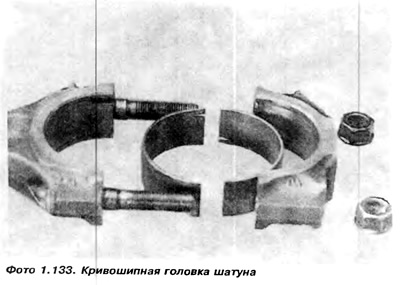
Note: Before installing the pistons with connecting rods in the cylinder, they can be secured on the appropriate lubricated (covered with oil) crankshaft journals. It is known from practice that it is easier to check the fit before installation than, as the manufacturer suggests, after the shaft is installed in the engine. The connecting rods should rotate fairly easily and without nicks. If any rotates with difficulty, it is necessary to remove it and measure both the journal and the hole in the crank head of the connecting rod. The dimensions of the shaft journals are indicated in "Technical data". If the size is incorrect, the journal must be ground again. Do not scrape the connecting rod bearings. When measuring the hole in the bearing, the foot cover must be tightened to the same torque as during installation (see Fig. "Technical data"). If the hole with the insert shows ovalization, remove the insert and after twisting measure the hole without the insert. In case of ovalization of the hole in the crank head of the connecting rod, it is necessary to replace it with a new one. Remember that the connecting rods must be installed on the journals according to the previously entered designation.
Visitor comments