



The car must be cold and must not be moved during the inspection.
The room temperature should be 10-30°C, while the temperature difference should be minimal.
The car must be parked on a level surface.
Start the engine.
Using the front display and control unit J523, set the vehicle level to high and then to normal.
Turn off the engine.
Remove the connector from the level control system control unit J197 to eliminate the possibility of adjustment.
Measure the height of the vehicle at all four wheels (Fig. 4.38).
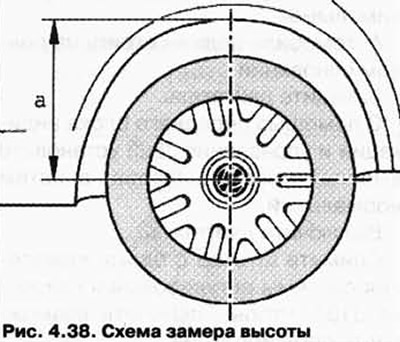
After 2 hours, measure the height again and compare size a with the result of the first measurement.
If the car is not level, this means that there is an air leak in the suspension of the wheel where the greatest difference between the first and second measurements is observed.
Using a standard leak detection spray, check the relevant pneumatic component and air line in the following sequence.
If after 2 hours it is not possible to determine the difference, then repeat the test after 24 hours. After 24 hours, a difference of up to 4 mm is allowed.
Check:
- air duct connections:
- residual pressure valve:
- front air springs (without dismantling), rear air springs (with dismantling).
If the shock absorbers are faulty, oil from them can get into the pneumatic system. For the perfect operation of the pneumatic system, after eliminating the fault, it is necessary to clean it or replace other components.
Unscrew the corresponding air line from the pneumatic element and the magnetic valve block.
Blow the pipeline several times with compressed air, to do this, supply compressed air through the end of the pipeline that is connected to the solenoid valve block.
Check to see if oil from the shock absorber has entered the solenoid valve block.
If shock absorber oil gets into the solenoid valve block, the block will have to be replaced.
Check the internal air duct between the compressor and the valve block.
If oil gets into the internal air duct, the compressor will have to be replaced.
Table 4.7. Troubleshooting the elastic pneumatic element and clearance control system
(View the original on this resource: www.VWManual.ru)
| Signs | Troubleshooting | Possible reasons | Troubleshooting |
| Leakage of the pneumatic element | Repair of front rear elastic pneumatic element | ||
| "Gradual" loss of pressure. After a considerable period of time the car stands unevenly | Monitoring the vehicle height over a long period, detecting leaks with a regular leak aerosol | Air leakage from air ducts | Air Duct Repair |
| Air leak through residual pressure valve | Replacing the front rear elastic pneumatic element | ||
| The car is not level. Leakage is excluded | Perform → Guided Fault Finding with Tester - VAS 5051 | The body level sensor is faulty | Replace body level sensor front rear |
| The lever or mount of the body level sensor is bent | |||
| The car is too high and it is impossible to lower it | 1.) Check if the ground clearance is sufficient | The car "sat down" on its bottom | |
| 2.) Checking the air ducts and their installation | The air duct is clogged, kinked or frozen | Repairing kinked air ducts, Blowing out frozen or clogged air ducts with compressed air | |
| 3.) Perform → Guided Fault Finding with the Tester - VAS 5051 | The drain valve or the valves of the elastic pneumatic elements do not work | ||
| 4.) Follow steps 1-3, if the fault cannot be detected, then the residual pressure valve is "stuck" | It doesn't let out air (the valve is jammed) | Replacing the front rear residual pressure valve | |
| The car is too low and either does not rise or rises very slowly | 5.) Perform → Guided Fault Finding with the Tester - VAS 5051 | Check the relays, plug contacts, wiring harness and fuses of the on-board network | |
| 6.) Search for air leaks on the pneumatic accumulator using a regular leak detection aerosol | The pneumatic accumulator is faulty/leaky | Replacing the pneumatic accumulator | |
| The air duct or air accumulator connections are faulty/leaky | Air Duct Repair | ||
| 7.) Perform → Guided Fault Finding with the Tester - VAS 5051 | The drain valve is faulty/leaky/open | Compressor replacement | |
| 8.) Finding air leaks on a compressor using a regular leak detection spray | The compressor is leaking | Compressor repair | |
| 9.) First check according to points 5-8, if the fault is not found, it means the compressor is faulty | The compressor is faulty | Compressor replacement | |
| "Rapid" loss of pressure | The body level is adjusted unevenly; when trying to change the level, you can hear air coming out of the faulty pneumatic element | Pneumatic element failure | Repair of front rear elastic pneumatic element |
| Air duct break | Air Duct Repair | ||
| Insufficient cushioning | Test drive, change the level of shock absorption while driving. Shock absorption should change noticeably when driving over uneven road surfaces, paying attention to the "noise" | The damping level change valve is faulty | Repair of front rear elastic pneumatic element |
| Shock absorber wear | Repair of front rear elastic pneumatic element Cleaning of air duct system |
Visitor comments