



Checking the oil level in an automatic transmission
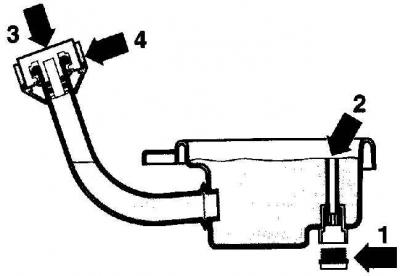
- 1 - threaded plug,
- 2 - bypass (drain) pipe in the oil pan,
- 3 - plug (plug),
- 4 - safety cap
The transmission oil level in the automatic transmission depends on the transmission oil temperature. Since diagnostic equipment is required to accurately measure the temperature, it is recommended that this work be performed at a VW service station. The automatic transmission oil level usually remains constant unless leaks are visually visible. In this case, there is no need to check the oil level.
Automatic 4-speed gearbox 01N (in combination with a 4-cylinder engine, except for engines with a power of 150 hp)
When checking the oil level and changing the oil, it is necessary to use protective glasses. It is also necessary to install a new seal for the screw plug and a new protective cap for the plug.
Checking the oil level
When checking the level, the transmission oil temperature should be slightly below +35°C. This temperature is reached shortly after starting the engine. To determine the temperature, it is necessary to connect the VW diagnostic equipment to the connector. Otherwise, the temperature can only be determined approximately.
1. Place the vehicle on a lift in a horizontal position.
2. Remove the lower engine splash shield.
3. Place the automatic transmission selector lever in position "P" and apply the handbrake.
4. Start the engine at idle speed test.
5. When the automatic transmission temperature is between +35 and +40°C, unscrew the screw plug (1) in the transmission oil pan. The oil level is normal if there is a slight oil leak (conditionally due to the rise in oil level when heated). Otherwise, add oil to the gearbox. Screw the plug back in place until the temperature reaches +45°C and tighten it to 15 Nm.
6. Install the lower engine splash shield.
Oil change
1. Place the vehicle on a lift in a horizontal position.
2. Remove the lower engine splash shield.
3. Place a suitable container under the automatic transmission oil pan.
4. Unscrew the oil level check screw plug (1) and then use a hex key and a drain plug (bypass) pipe (2) from the oil pan (see fig. Checking the oil level in the automatic transmission). Wait until all the oil has drained from the gearbox.
Warning: Do not start or tow the vehicle without automatic transmission fluid.
5. Screw in the drain (bypass) pipe (2) until it stops in the oil pan.
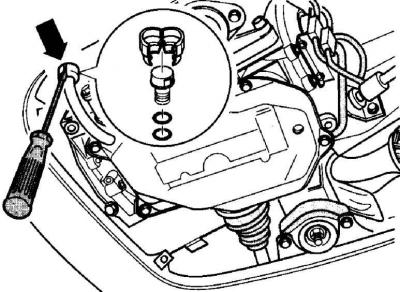
6. Use a screwdriver to remove the protective cap located on the oil filler pipe, this will destroy it. Unscrew the plug.
7. First, pour 3.0 liters of fresh oil into the gearbox through the oil filler pipe.
8. Place the selector lever in position "P", start the engine and let it idle.
9. With the engine idling, apply the brake and move the selector lever through all positions (P, N, R, 3,2,1) holding each position for 2-3 seconds.
10. Check the oil level in the gearbox and correct it if necessary.
11. When the oil level is correct, install the plug and close it with the protective cap.
12. Install the lower engine splash shield.
Checking the oil level in the automatic 5-speed gearbox 01V with a 150 hp engine.
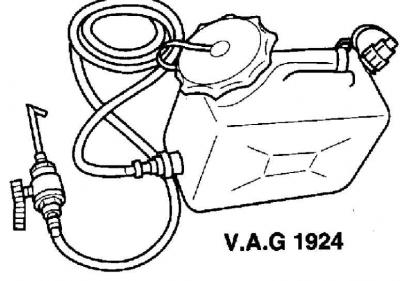
VAG 1924 tool used by VW to fill automatic transmission oil
[The information is posted on this website VWManual.ru]
Checking the oil level in an automatic transmission
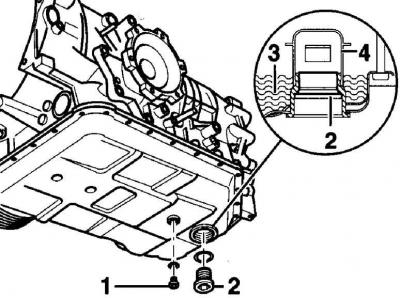
- 1 - bolt;
- 2 - screw plug;
- 3 - oil;
- 4 - oil deflector cap
The 01V automatic 5-speed gearbox does not require oil change, and only the oil level is checked during maintenance.
Usually the oil level in the automatic transmission remains constant unless there are visually visible leaks. In this case, there is no need to check the oil level.
When checking the oil level, it is necessary to use protective glasses. It is also necessary to install a new seal on the threaded plug. To add oil, it is necessary to use a curved grease gun.
When checking the level, the transmission oil temperature should be slightly below +40°C. This temperature is reached shortly after starting the engine. To determine the temperature, it is necessary to connect the VW diagnostic equipment to the connector. Otherwise, the temperature can only be determined approximately.
Execution order
1. Place the vehicle on a lift in a horizontal position.
2. Remove the lower engine splash shield.
3. Place the automatic transmission selector lever in position "P" and apply the handbrake.
4. Start the engine at idle speed test.
5. When the automatic transmission temperature is between +35 and +40°C, unscrew the threaded plug (2) in the gearbox oil pan (see fig. Checking the oil level in the automatic transmission). The oil level is normal if there is a slight leakage of oil (conditionally due to the rise in oil level when heated).
Otherwise, add oil into the screw plug hole.
6. Pour in fresh oil using an oiler until it starts to come out of the screw plug hole (2).
Warning: Do not push the grease gun upwards, as the oil deflector cap (4) may come off. Insert the bend of the oil gun into the side hole of the oil deflector cap. Do not unscrew the bolt (1).
7. Screw the plug (2) back into place until the temperature reaches +45°C and tighten it to a torque of 80 Nm.
Checking the oil condition
When checking the automatic transmission fluid level, also check the condition of the oil. To make it easier to check the condition of the oil, compare the color, smell, and viscosity of the oil with new oil.
If the oil in the gearbox is dark or almost black with a burnt smell, it means that the friction linings of the gearbox are worn out.
If the gearbox oil is milky, it means that water has gotten into it. This can happen when the car is constantly used for short trips. If the oil color does not change after a long trip, it is necessary to change the oil.
If the oil is dark brown and sticky, it may be due to overheating of the gearbox or too much oil in the gearbox. If changing the oil does not help, the car should be taken to a specialized VW workshop.
If dirt particles or metal shavings are present in the oil when checking the oil level or changing the oil in the automatic transmission, the automatic transmission must be diagnosed or repaired at a specialized VW service station.
Visitor comments