



Contents: Checking the oil level ↓ Topping up oil ↓ Removal the safety cap ↓ Topping up oil in automatic…↓ Checking the oil condition ↓
The transmission oil level in the automatic transmission depends on the transmission oil temperature. Since diagnostic equipment is required to accurately measure the temperature, it is recommended that this work be performed at a Volkswagen service station. The oil level in the automatic transmission usually remains constant unless leaks are visually visible. In this case, there is no need to check the oil level.
Warning: Do not start the engine or tow the vehicle without automatic transmission fluid.
Checking the oil level
When checking the level, the transmission oil temperature should not be more than +30°C. This temperature is reached shortly after starting the engine. To determine the temperature, it is necessary to connect the Volkswagen diagnostic equipment to the connector. Otherwise, the temperature can only be determined approximately.
1. Place the vehicle on a lift in a horizontal position.
2. Set the automatic transmission selector lever to position "P" and apply the handbrake. Turn off the air conditioning and heating system.
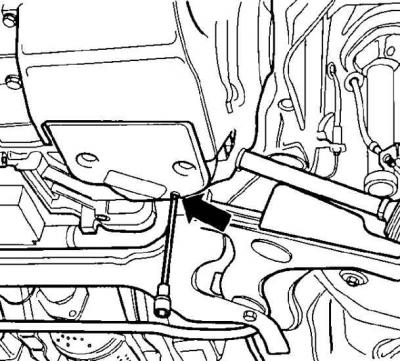
3. Place a suitable container under the screw plug (indicated by the arrow) gearboxes. Oil should drip from the overflow (drain) pipe.
4. Replace the sealing ring on the threaded plug.
5. Start the engine at idle speed test.
(The text is copied from this portal www.VWmanual.ru)
6. At an automatic transmission temperature of +35°C to +45°C, the oil level is normal if there is a slight oil leak (conditionally due to the rise in oil level when heated). Otherwise, add oil to the gearbox. Screw the plug back in until the temperature reaches +45°C and tighten it to 15 Nm.
Topping up oil
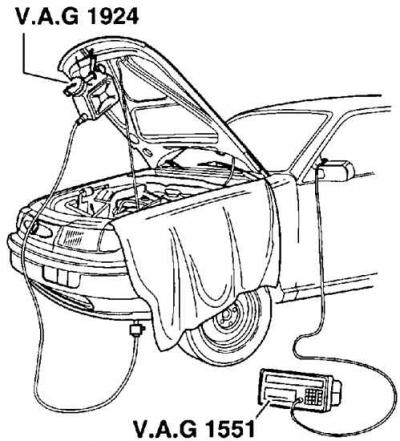
Using the VAG 1924 bonnet mounted reservoir to top up the automatic transmission oil and the VAG 1551 diagnostic tool to check the oil temperature
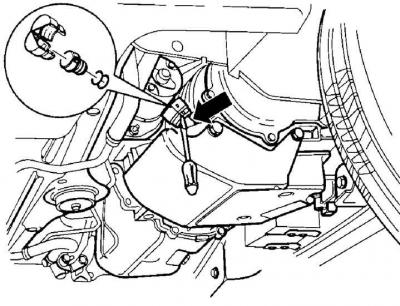
Removal the safety cap
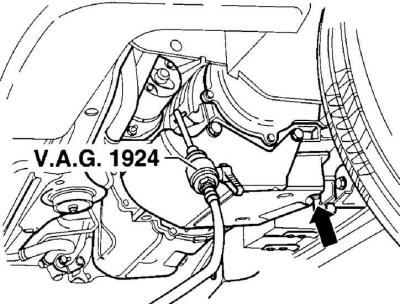
Topping up oil in automatic transmission using VAG 1924 tool
1. Place the vehicle on a lift in a horizontal position.
2. Place a suitable container under the automatic transmission oil pan.
3. Use a screwdriver to remove the protective cap located on the oil filler pipe. This will destroy it (see figure Removing the safety cap). Unscrew the plug.
4. Unscrew the oil level check plug.
5. Using the VAG 1924 tool, add oil to the gearbox through the oil filler pipe until it appears from the oil level check hole (arrow, see figure Topping up oil in automatic transmission using VAG 1924 tool).
6. Place the selector lever in position "P", start the engine and let it idle.
7. With the engine idling, apply the brake and move the selector lever through all positions ("P", "N", "R", "3", "2", "1") holding each position for 2–3 seconds.
8. Check the gearbox oil level and correct it if necessary.
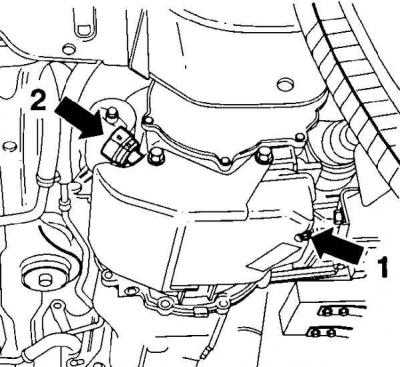
9. When the oil level is correct, screw in the screw plug (1) and install the new safety cap (2).
Checking the oil condition
When checking the automatic transmission fluid level, also check the condition of the oil. To make it easier to check the condition of the oil, compare the color, smell, and viscosity of the oil with new oil.
If the oil in the gearbox is dark or almost black with a burnt smell, it means that the friction linings of the gearbox are worn out.
If the gearbox oil is milky, it means that water has gotten into it. This can happen when the car is constantly used for short trips. If the oil color does not change after a long trip, it is necessary to change the oil.
If the oil is dark brown and sticky, it may be due to overheating of the gearbox or too high oil level in the gearbox. If changing the oil does not help, the car should be brought to a specialized Volkswagen workshop.
If, when checking the oil level or changing the oil in the automatic transmission, there are dirt particles or metal shavings in the oil, it is necessary to carry out diagnostics or repair of the automatic transmission at a specialized Volkswagen service station.
Visitor comments