



However, unlike the system "K-Jetronic", thanks to the presence of additional sensors, the "KE-Jetronic" system allows you to adapt the composition of the combustible mixture to the operating conditions of the engine. Thus, based on information coming from the coolant temperature sensors and the idle and full load contact switches, the electronic control unit (controller) issues commands to the electrohydraulic control pressure regulator, which supplies the required amount of fuel for the given engine operating mode. In addition, the controller provides feedback between the fuel charge at the combustion chamber inlet and the products at the outlet, implemented via the exhaust gas oxygen sensor. In the event of a malfunction of any element of the system, the controller switches to fuel supply control based on basic parameters, which allows the vehicle to continue moving. if the engine is warm. The enrichment of the combustible mixture required for cold starting and warming up the engine is determined by signals from the coolant temperature sensor. The controller processes these signals and issues control signals to the electrohydraulic control pressure regulator, which changes the fuel pressure in the lower chambers of the pressure regulator of the fuel metering unit-distributor. As a result, the combustible mixture is enriched.
During acceleration, the controller generates commands to increase the fuel supply based on the voltage signal from the air flow meter potentiometer, the value of which is proportional to the displacement of the meter's pressure disk.
At forced idle (when releasing the accelerator pedal) the throttle valve returns to its original position. At the same time, the corresponding electrical signal is sent to the controller, which simultaneously receives information about the engine crankshaft speed from the Hall sensor built into the ignition distributor. If the speed is indeed within the range of the number of revolutions at which the fuel supply should be stopped at forced idle, the controller changes the direction of the control current passing through winding 11 (fig. 2-200) electrohydraulic control pressure regulator. As a result, the flap 12 moves away from the nozzle 10, the pressure in the lower chambers 9 of the fuel distributor rises almost to the value of the control pressure and, under the action of the spring of the lower chambers of the diaphragm 8, closes channels 3 and 5 of the fuel supply from the upper chambers of the distributor to the injectors. The moment of stopping the fuel supply at forced idle is determined by the temperature of the coolant. With a warmed-up engine, the fuel supply is stopped as early as possible, which helps to avoid excessive fuel consumption. With an unheated engine, the time before the fuel supply is stopped increases so that the cold engine does not stop when the clutch is abruptly disengaged.
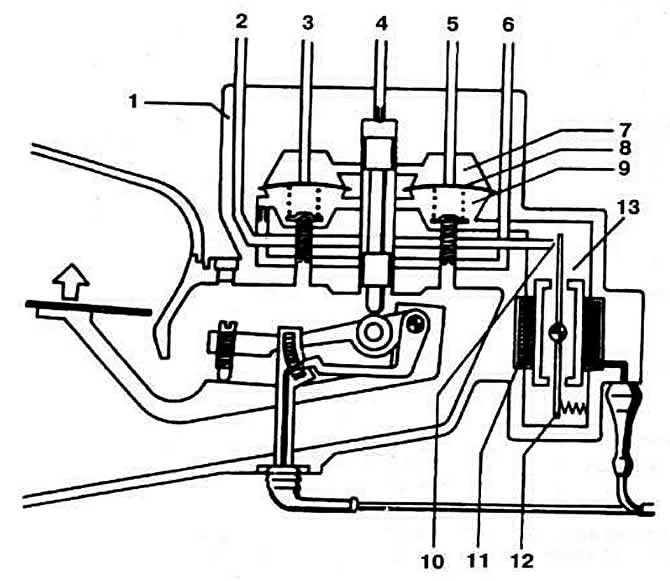
Fig. 2-200. Operating principle of the fuel distributor and electro-hydraulic control pressure regulator at forced idle:
1 - fuel distributor;
2 — fuel supply;
3, 5 — fuel supply to injectors;
4 — fuel supply;
6 - to the pressure regulator;
7 - upper chamber;
8 - diaphragm;
9 - lower chamber;
10 — nozzle;
11 — winding;
12 — damper;
13 — electro-hydraulic control pressure regulator.
Fuel supply is also stopped when the maximum permissible engine crankshaft speed is reached. The engine crankshaft speed at idle is automatically maintained by a rotary regulator within specified limits according to the controller commands.
Idle speed control valve (fig. 2-201, 2-202) is located in the bypass air channel, made parallel to the throttle valve, in place of the additional air supply valve. It is an actuator with a permanent magnet. A valve is installed on the anchor shaft, which rotates, overcoming the force of the spring.
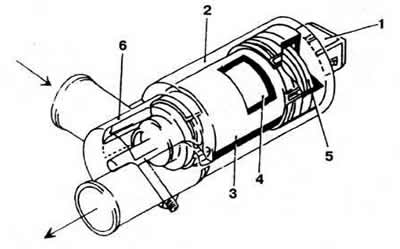
Fig. 2-201. Idle speed control:
1 — shoe;
2 — body;
3 - permanent magnet;
4 - anchor;
5 - follower spring;
6 — rotary valve.
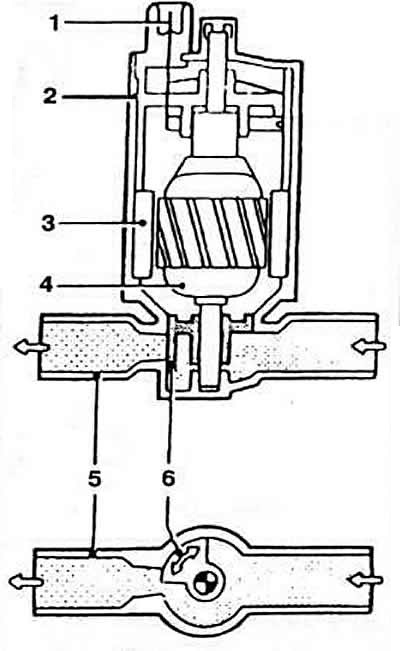
Fig. 2-202. Idle speed control valve diagram:
1 - electrical connection terminal;
2 — body;
3 - permanent magnet;
4 — actuator motor anchor;
5 - air duct;
6 — rotary valve.
When the throttle valve is closed, the air passage is blocked to a certain extent by the governor valve, which ensures the required engine crankshaft speed at idle.
The idle speed regulator is controlled by commands from the controller control units, which determine the degree of opening of the rotary valve depending on the incoming information. At the same time, the controller changes the ignition timing accordingly. When the air conditioner is turned on at idle, the controller receives a signal from the air conditioner switch and, on command, the idle speed increases to 1000 rpm. This increases the efficiency of the air conditioner and ensures uninterrupted engine operation at idle.
When starting a cold engine and during warm-up, the idle speed regulator functions as an additional air supply valve, ensuring that the idle speed is maintained within specified limits regardless of the engine load.
Note: Some components of the system "KE-Jetronic" identical to similar system nodes "K-Jetronic". This applies in particular to the fuel filter, air filter, fuel pump, fuel lift pump, fuel pressure regulator, fuel tank and other components.
The fuel distributor mounted on the air flow meter ensures uniform fuel supply to the injectors depending on the position of the air flow meter pressure disc. Brand and catalog number: Bosch 0 438 101 039.
(The original can be viewed on the portal: «vwmanual.ru»)
The pressure accumulator, installed in the fuel supply line after the fuel pump, ensures that residual fuel pressure is maintained in the system after the engine has stopped and that fluctuations in fuel supply are eliminated. Brand and catalog number: Bosch 0 438 170 061.
The control pressure regulator operates on signals generated by the controller based on information from sensors. Brand and catalog number: Bosch 0 438 161 016.
The injector valves open under the action of fuel pressure. Brand and catalog number: Bosch 0 437 502 043. Injection start pressure, kgf/cm²: 3.7-4.8.
The electromagnetic starting injector serves to enrich the mixture when starting a cold engine according to the controller signals. Brand and catalog number: Bosch 0 280 170 434.
The movable pressure disc of the air flow meter moves depending on the amount of air sucked in. Its movement is transmitted to the distribution plunger of the fuel metering device, thereby changing the amount of fuel injected. Brand and catalog number: Bosch 0 438 121 076.
Bosch idle speed controller based on a permanent magnet electric motor. It is installed in a bypass air channel, made parallel to the throttle valve, and is designed to dose air into the intake manifold during starting, warming up and regulating the idle mode of the engine. Based on information from sensors, the KSUD controller generates an electric current pulse in the primary winding of the ignition coil and controls the control pressure regulator. At the same time, the ignition timing and the amount of injected fuel are automatically stabilized depending on the engine operating mode. Brand and catalog number: Bosch 0 261 200 222.
Visitor comments