



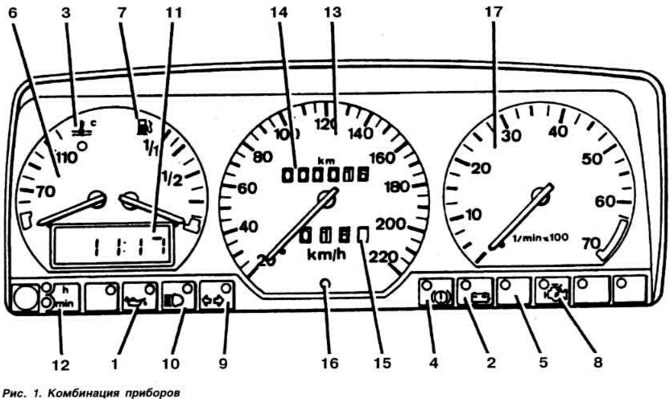
1. Oil pressure warning light
The oil pressure warning light comes on when the ignition is turned on and should go out immediately after the engine starts. If the light flashes or comes on while driving, or if the buzzer sounds when the engine speed is over 2000 rpm, you must immediately stop driving, stop the engine and check the engine oil level as described below in subsection "Routine maintenance". If the warning light remains on when the oil level is normal, contact a service station. Continuing to drive the car with the oil pressure warning light on may cause engine failure.
2. Battery charge indicator lamp
The battery charge indicator lamp lights up when the ignition is turned on and should go out immediately after the engine starts.
If the lamp lights up while the vehicle is moving, stop immediately, stop the engine and check the condition and tension of the alternator belt. If the belt breaks, do not continue driving and replace the belt on the spot. On vehicles with power steering and (or) air conditioning, where the water pump of the cooling system has a drive separate from the alternator, you can continue driving to the nearest service station, taking into account that the battery will be constantly discharged.
3. Coolant temperature indicator lamp
The coolant temperature indicator lamp flashes for a few seconds after the ignition is turned on and goes out after the engine starts.
If the light starts to flash while driving, stop driving, stop the engine and check the coolant level as described below in the subsection "Routine maintenance". If the fluid level is normal, check the fuse of the electric fan circuit of the cooling system. If there are no obvious faults, contact a service station.
If only the electric fan is faulty, you can continue driving to the nearest service station at a fairly high speed or at low engine speeds.
4. Brake fluid level indicator, parking brake system indicator and ABS brake malfunction indicator
The indicator lamp lights up to indicate:
- emergency fluid level in the brake system reservoir. Stop driving, check the level and, if necessary, restore the fluid level in the reservoir, as indicated in the subsection "Routine maintenance". A rapid decrease in the fluid level indicates a leak in the hydraulic brake drive, which must be checked immediately;
- engaging the parking brake system;
- malfunction of the anti-lock braking system, if installed. On cars with ABS brakes, the indicator lamp lights up when the ignition is turned on and goes out after the car starts moving. If the lamp lights up while driving, this indicates a malfunction of the ABS. Normal braking of the car is ensured. To eliminate the malfunction, immediately contact a service station.
5. Diesel pre-heating control lamp
6. Coolant temperature gauge
At normal coolant temperature, the pointer should be in the middle of the scale in the 90°C zone. If the pointer is above this zone, do not allow the engine to run at high speeds. In some cases, the pointer may move to the upper part of the scale. In this case, the risk of engine overheating exists only when the coolant temperature indicator lamp starts flashing.
7. Fuel level indicator
The indicator works after the ignition is turned on. When the arrow is on the last division of the scale, the fuel reserve is about 10 liters. The fuel tank capacity is 70 liters.
8. Fuel injection system malfunction indicator lamp
The fuel injection system malfunction indicator lamp lights up when the ignition is turned on and goes out after the engine starts. If the lamp does not go out after the engine starts or lights up while driving, contact a service station immediately.
9. Direction indicator lamp
10. High beam indicator lamp
11. Clock with digital display or trip computer monitor
12. Clock setting buttons with digital display
13. Speedometer
14. Totalizer of the distance traveled
15. Daily distance counter
16. Button for resetting the daily trip meter to zero
17. Tachometer or analog clock
Short-term excess of engine crankshaft speed to 6500 rpm (7000 rpm for 136 hp engines.) is permitted only in exceptional cases. The tachometer needle being in the red sector of the scale is not permitted.
Visitor comments