



Be guided by the exploded view (Fig. 8-3), which shows the sequence of removal and installation of parts. When inspecting the parts, check:
- condition of the brushes, degree of their wear, fit of the brushes to the rings and spring pressure;
- appearance of the contact rings. Contact rings can only be cleaned with a clean rag soaked in gasoline or trichloroethylene. Contact rings can only be cleaned with fine-grained sandpaper. It is prohibited to use emery cloth for these purposes;
- bearing condition. Bearings do not require maintenance, as they contain long-lasting grease;
- appearance of the rotor and stator. Make sure there are no breaks or signs of burning of their windings.
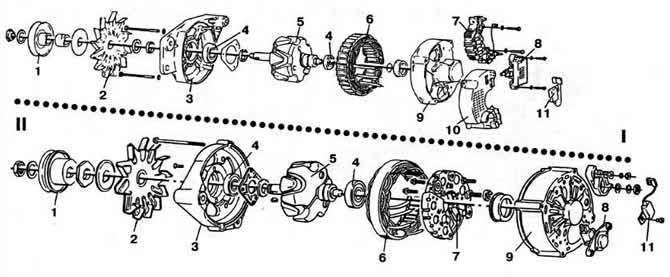
Fig. 8-3. Generator parts:
I — Valeo brands;
II — Bosch brand.
1 - pulley;
2 - fan;
3 - drive side cover;
4 — bearing;
5 — rotor;
6 — stator;
7 - rectifier block;
8 — brush holder;
9 - cover from the contact ring side;
10 - plastic casing;
11 - noise suppression capacitor.
Note. It is prohibited to check the electrical characteristics of the generator, in particular the rectifier unit, in circuits with a voltage of more than 14 V. Otherwise, some elements of the generator may fail. Rectifier diodes are sensitive to high temperatures, so soldering when replacing them should be done as quickly as possible using a low-power soldering iron.
Rectifier diodes are sensitive to temperature. Therefore, when replacing them, solder as quickly as possible, using a low-power soldering iron. After repairing the generator, it is advisable to test it on a special stand that allows you to change the rotor speed and generator load. Generators of all types are tested under self-excitation, when the excitation winding is powered from the generator itself (Fig. 8-4). A voltmeter 2 is connected to the B+ terminal of the generator 1, and parallel to it, through a switch 3 and an ammeter 4, a load rheostat 5 and a storage battery 6. The stand's electric motor is turned on and the (switch contacts 3 are open) the generator rotor speed. At frequencies close to the output start frequency specified in the technical specification, the generator should be excited. After this, the voltage will increase with increasing rotation speed. If self-excitation does not occur, switch 7 is closed for a short time. In this case, the D+ output of the generator through resistor 8 (resistance 3-10 Ohm) is connected to the positive terminal of the battery. If the generator is still not excited, it is faulty.
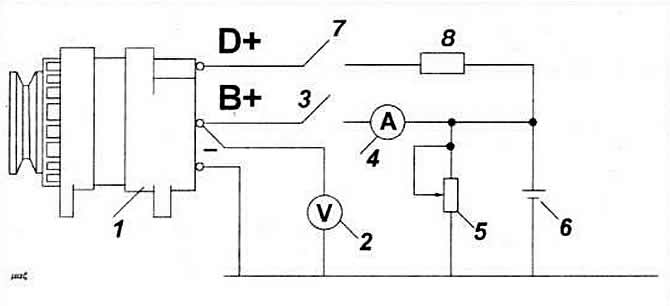
Fig. 8.4. Generator test diagram:
1 - generator;
2 - voltmeter;
3, 7 - switch;
4 - ammeter;
5 - variable resistor;
6 - battery;
8 — resistor.
After the generator is excited, the rotor speed is increased to a value at which the generator voltage is 12 V. In this case, the rotor speed should not be greater than the return start frequency specified in the technical specification. If the test result is satisfactory, a check is made for the return current at a rotor speed of 7000 rpm. To do this, close the contacts of switch 3 and smoothly increase the rotor speed and the generator load so that the generator voltage is 12 V. When the speed reaches 7000 rpm, the load current must correspond to the values specified in the technical specification.
Then check the value of the regulated voltage of the generator. To do this, reduce the generator load current to the values specified in the technical specification. The generator voltage should be within 14.2±0.1 V.
The information is presented on the website [VWmanual.ru]
Visitor comments