



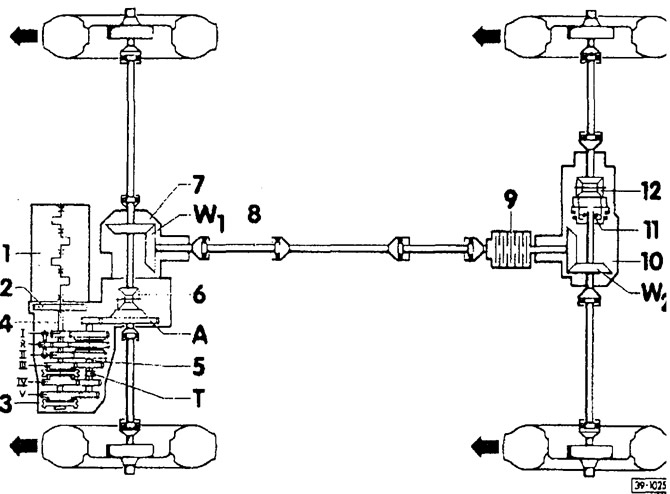
- 1 - engine
- 2 - clutch
- 3 - speed gearbox
- 4 - transmission drive shaft
- 5 - the driven shaft of the gearbox
- 6 - differential
- 7 - corner gear
- 8 - cardan shaft
- 9 - viscous coupling
- 10 - rear drive axle
- 11 - freewheel mechanism
- 12 - differential
- W1 - front corner gear
- W2 - rear corner gear
- T - tachometer drive
- A - main gear
PASSAT vehicles with synchronizer are equipped with all-wheel drive. A distinctive feature is the presence of a viscous coupling between the front and rear axles.
The viscous coupling consists of a housing filled with silicone oil, in which discs are located close to each other, between which there is no mechanical connection. One discs (through one) connected to the clutch housing (and thus with cardan shaft), and others - with the drive shaft of the rear axle. The forceful engagement is due to the viscosity of the silicone oil, which responds to the difference in plate speeds. The greater the speed difference between the front and rear axles, the more torque is transmitted from the front axle to the rear axle. The drive of the rear wheels is carried out gently and without shocks, it is hardly noticed by the driver.
On dry roads and normal driving, with all wheels spinning at approximately the same speed, nearly all of the torque is transferred to the front wheels. If, during strong acceleration or on a bad road, a tendency of the front wheels to slip is detected, that is, they begin to rotate faster than the rear wheels, the viscous coupling immediately transfers more force to the rear axle. If the front wheels slip, almost all of the torque is transferred to the rear wheels.
When braking in the rear axle differential, the freewheel mechanism automatically turns on and breaks the power flow to the rear axle. Thanks to this, the correct distribution of braking forces is not disturbed and the vehicle remains stable.
Visitor comments