



Contents: Air Conditioning Control Knobs ↓ Ventilation grilles and nozzles ↓ General instructions ↓ Economical use of air conditioning ↓
An air conditioner is a device capable of cooling the outside air entering the passenger compartment. A car air conditioner is combined with a heater into a single system - an artificial microclimate installation that provides maximum comfort at any time of year.
The air conditioner cooling circuit operates only when the engine is running, at an outside air temperature of +5°C and in fan mode from 1 to 4.
When the air conditioner is on, not only the temperature but also the humidity inside the car decreases. This increases the comfort of the passengers in the car and prevents the windows from fogging up.
Air Conditioning Control Knobs
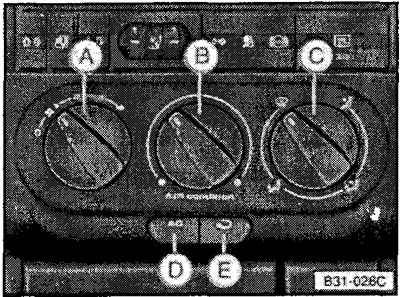
Handle A - Fan mode switch
4 fixed fan operation modes (speeds) can be set. In the handle 1 position, the fan and air conditioner are turned off. To stop outside air entering the interior of the car, press the E button (air recirculation mode).
Handle B - Temperature regulator
Turning it clockwise increases the temperature, turning it counterclockwise decreases it. When the air conditioner is on, turning the knob counterclockwise increases the intensity of its operation.
Handle C - Air distribution regulator
Depending on the position of this handle, the air entering the cabin is directed to certain ventilation grilles and nozzles (see table) and figure B31-027C.
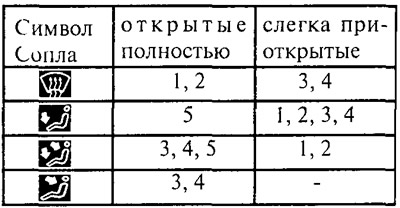
Button D - turns the air conditioner on and off
Pressing the button turns the air conditioner on and off. When the air conditioner is running, the "AC" symbol lights up on the button.
Button E - air recirculation mode
Pressing the button switches the air recirculation mode on and off. When the mode is switched on, the symbol on the button lights up.
It is recommended to turn on the air circulation mode only for a short time, since without the supply of fresh air from outside when the air conditioner is turned off, the windows quickly fog up.
Note: Buttons D and E can be pressed simultaneously.
Ventilation grilles and nozzles
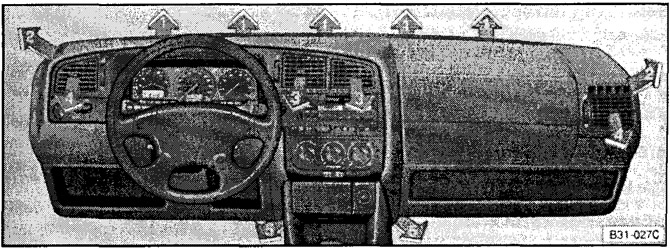
The temperature of the air supplied through the heater and air conditioner to the ventilation grilles is regulated using handle B, and the distribution of the air flow between the grilles (nozzles) is regulated using handle C. Grilles 3 and 4 can additionally be opened and closed: by turning the handle located on the side of the grille upwards, the grille opens, by turning it downwards, it closes.
To change the vertical direction of the air flow, grilles 3 and 4 can be rotated up and down.
To change the horizontal direction of the air flow, move the handle located in the middle of the corresponding grille.
Rear lower nozzles (at the feet of the rear passengers) nozzles 5 open simultaneously.
Removal frost from windshield and side windows:
- Set handle A to position 3
- Turn knobs B and C clockwise until they stop.
- Close the grill 3.
- Warm air can be additionally directed to the side windows through grilles 4.
Preventing the windshield and side windows from fogging up:
If there is high humidity (for example, during rain) if the glass fogs up, it is recommended to set the following mode:
- Set handle A to position 2 or 3
- If necessary, set handle B to the middle position (heating mode)
- Set regulator C to position

- Close the grill 3.
- Warm air can be additionally directed to the side windows through grilles 4.
Fast interior heating:
- Set handle A to position 3
- Turn handle B clockwise until it stops
- Set handle C to position

- Close the grill 3
- Grilles 4 open partially or completely
Moderate heating of the passenger compartment
After the windows have defogged and the desired air temperature in the cabin has been reached, the following mode is recommended:
- Set handle A to position 1 or 2
- Use knob B to set the desired heater temperature
- Use handle C to set the desired direction of warm air flow
 or
or 
- If the windshield fogs up, set the knob C to position

- Close the grill 3
- Adjust the desired power and direction of the warm air flow coming out of the grilles 4.
Ventilation and normal cooling mode
- Set the desired ventilation intensity with knob A (position 1-4)
- Use knob B to set the desired temperature (so that heating would also be possible)
- Set handle C to the desired position
- If handle C is in position
 , at least one grille 3 and 4 must be open, otherwise the air conditioner may freeze.
 - Press button D. The direction of the air flow can be adjusted using grilles 3 and 4.
Intensive cooling mode
- Close all windows and the sunroof
- Turn handle A to position 4
- Turn handle B counterclockwise until it stops
- Set handle C to position

- Turn on the air conditioner by pressing button D
- Turn on the recirculation mode by pressing the E button
- Open grates 3 and 4.
At least one grille must be open, otherwise the air conditioner may freeze.
In recirculation mode, air is sucked in from the cabin, cooled and returned back to the cabin. This mode cannot be set for a long time, since there is no ventilation of the cabin.
Note: When using the recirculation mode, do not smoke in the cabin, as the soot sucked in with the air settles on the air conditioner evaporator, which leads to its rapid wear.
General instructions
At high outside temperatures and high air humidity, condensed moisture may drip from the evaporator, forming a puddle underneath it - this is not a malfunction and does not indicate a leak in the air conditioning system.
Handles B and C provide smooth adjustment and can be set to any position; handle A has fixed positions 1-4.
To prevent the windows from fogging up at low speeds, always set the heater fan to low or medium speed.
Heating depends on the coolant temperature - full heater power can only be achieved when the engine is warm.
Exhaust ventilation is provided through openings in the rear of the passenger compartment, which must be freely accessible. For this reason, in a Limousine, the gap between the luggage rack and the rear window must not be blocked by luggage, and in a Variant, it is not recommended to heavily load the rear corners of the luggage compartment. In addition, on models with a folding shelf, the gaps between the shelf and the side consoles of the shelf must not be blocked by cargo.
Economical use of air conditioning
In cooling mode, the air conditioner compressor consumes engine energy and thus affects fuel consumption. To reduce the time it takes for the air conditioner to reach operating mode, the following must be taken into account:
If the car interior has become very hot in the sun, it is recommended to open the windows and doors for a while before turning on the air conditioner to let out the hot air.
Do not operate the air conditioner while driving if the windows or sunroof are open.
It is advisable to bring the interior temperature to the desired value without turning on the air conditioner cooling circuit.
Visitor comments