



Voltage measurement
You can verify the presence of voltage using a simple test lamp or voltage indicator. This first of all determines whether there is voltage at all. In order to measure the value of the existing voltage, you need to connect a voltmeter (voltage measuring device). A voltmeter is always included in a universal measuring device.
First of all, the voltmeter must be set to the measurement range in which the voltage to be measured is presumably located. Voltages in a car do not exceed, as a rule, approximately 14 volts. The exception is the ignition system: here the ignition voltage can be up to 30,000 volts. This high voltage is measured only with a special measuring device or oscilloscope.
If when using measuring devices designed specifically for cars, you only need to turn on the voltmeter on the control panel, then when using a universal device, you first need to make a number of decisions. First of all, the constant voltage area is set on the control panel (DCV instead of ACV corresponding to alternating voltage). Then the measurement range is selected. Since in the car, except for the ignition system, there is no voltage greater than 14 volts, the upper value of the measurement range to be set should be somewhat larger (approximately 15 to 20 volts). If it is known for certain that the measured voltage is significantly lower, for example, about 2 volts, the upper value of the set measurement range can be reduced to achieve higher measurement accuracy. If the measured voltage values exceed the measurement range of the device, the device may fail.
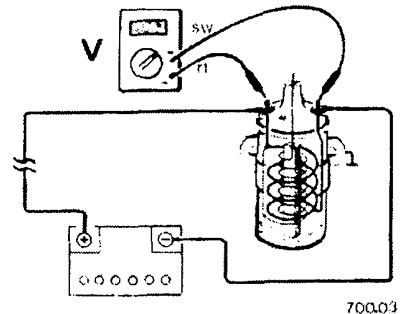
Connect the measuring device cables as shown in the figure, parallel to the power consumer. In this case, connect the red cable of the device to the conductor going to the positive (+) pole of the battery, and the black cable to the ground wire or to the vehicle ground, for example, the engine cylinder block. Measurement example: When the engine does not start correctly because the starter rotates too slowly, it is advisable to check the battery voltage with the starter running. To do this, connect the red cable (+) of the voltmeter to the positive pole of the battery and the black cable to the vehicle ground (-). Then ask an assistant to turn on the starter and read the voltage value. If the voltage is below approximately 7 volts, the battery must be checked and, if possible, charged before the next attempt to start the engine.
Measuring current
In cars, it is relatively rare to need to measure current. For example, see section "Spontaneous battery discharge". This requires an ammeter built into a universal measuring instrument.
Before measuring the current, the device is set to the measurement range in which the measured current strength is presumably located. If the current strength is not known in advance, the device is set to the maximum measurement range. If the device does not show any value, sequentially switch the device to smaller measurement ranges.
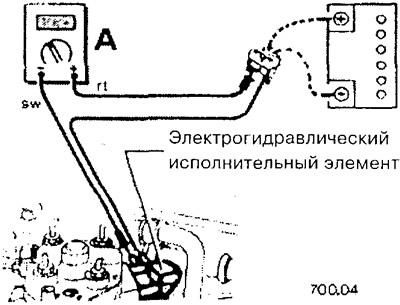
To measure the current, the electrical circuit must be disconnected, as shown in the figure, and the measuring device (ammeter) must be connected across the circuit. For this, for example, the plug is disconnected and the red cable (+) of the ammeter is connected to the current-carrying conductor. The black cable (-) is connected to the contact to which the conductor is normally connected. The ground contacts between the power consumer and the plug must be connected with a jumper.
Example: see below section "Spontaneous battery discharge".
Caution: Never use a regular ammeter to measure the current in the starter wire (approximately 150 A) or to the glow plugs of a diesel engine (up to 60 A). The high currents that arise in this case can damage the measuring device. In the workshop, an ammeter with a DC clamp is used for such measurements. In this case, the clamp is connected via an insulated cable, and the current value is measured by induction.
Measuring resistance
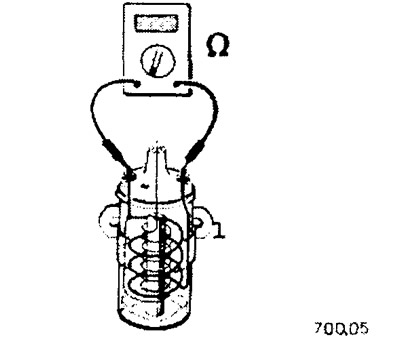
Before checking the resistance, it is necessary to make sure that no voltage is applied to the part to which the ohmmeter is connected. That is, you should always disconnect the plug, turn off the ignition, remove the conductor or unit, or disconnect the battery. Otherwise, the device may fail.
The ohmmeter is connected to two consumer connectors or to two ends of an electrical conductor. It does not matter which cable (+/-) of the measuring device is connected to which contact.
There are two types of resistance measurements in a car:
1. Monitoring of constant or variable resistance in an electrical circuit.
Example: Checking the resistance of the temperature sensor. To do this, disconnect the temperature sensor plug and connect an ohmmeter between the sensor contact and ground (engine block). Set the ohmmeter to the measurement range in which the value of the measured resistance is presumably located, and compare the measured resistance with the prescribed value given in the table.
2. Checking the conductivity of an electrical conductor, switch or heating element. This checks whether there is a break in the electrical conductor in the car, which means that the connected electrical device cannot function. To measure, an ohmmeter is connected to both ends of the corresponding conductor. If the conductor conducts electric current, the measuring device will show a resistance value of 0 Ohm. This means that the conductor is in order. If the conductor is broken, the device will show a resistance value of ∞ (infinity) Ohm.
Visitor comments